<?xml version="1.0" encoding="utf-8" ?>
<rdf:RDF xmlns:rdf="http://www.w3.org/1999/02/22-rdf-syntax-ns#" xmlns:dc="http://purl.org/dc/elements/1.1/" xmlns:syn="http://purl.org/rss/1.0/modules/syndication/" xmlns="http://purl.org/rss/1.0/">


<channel rdf:about="https://www.doc.ks.gov/search_rss">
  <title>public</title>
  <link>https://www.doc.ks.gov</link>

  <description>
    
            These are the search results for the query, showing results 105 to 119.
        
  </description>


  <image rdf:resource="https://www.doc.ks.gov/logo.png"/>

  <items>
    <rdf:Seq>
      
        <rdf:li rdf:resource="https://www.doc.ks.gov/victim-services/publications/newsletters/fall-2013-newsletter"/>
      
      
        <rdf:li rdf:resource="https://www.doc.ks.gov/facilities/faq/questions"/>
      
      
        <rdf:li rdf:resource="https://www.doc.ks.gov/facilities/faq/rdu"/>
      
      
        <rdf:li rdf:resource="https://www.doc.ks.gov/facilities/faq/locating"/>
      
      
        <rdf:li rdf:resource="https://www.doc.ks.gov/facilities/lcf/visit/faq"/>
      
      
        <rdf:li rdf:resource="https://www.doc.ks.gov/facilities/hcf/programs/reentry"/>
      
      
        <rdf:li rdf:resource="https://www.doc.ks.gov/facilities/ecf/programs-1"/>
      
      
        <rdf:li rdf:resource="https://www.doc.ks.gov/facilities/ecf/history"/>
      
      
        <rdf:li rdf:resource="https://www.doc.ks.gov/facilities/edcf/programs"/>
      
      
        <rdf:li rdf:resource="https://www.doc.ks.gov/facilities/tcf/visit-1/handbook"/>
      
      
        <rdf:li rdf:resource="https://www.doc.ks.gov/publications/juvenile/dmc"/>
      
      
        <rdf:li rdf:resource="https://www.doc.ks.gov/publications/Reports/Archived/2013"/>
      
      
        <rdf:li rdf:resource="https://www.doc.ks.gov/juvenile-services/supervision-standards/glossary"/>
      
      
        <rdf:li rdf:resource="https://www.doc.ks.gov/newsroom/capital/data"/>
      
      
        <rdf:li rdf:resource="https://www.doc.ks.gov/publications/CFS/sex-offender-housing-restrictions"/>
      
    </rdf:Seq>
  </items>

</channel>


  <item rdf:about="https://www.doc.ks.gov/victim-services/publications/newsletters/fall-2013-newsletter">
    <title>Fall 2013 Newsletter </title>
    <link>https://www.doc.ks.gov/victim-services/publications/newsletters/fall-2013-newsletter</link>
    <description>See the latest from the Office of Victims Services in the Fall edition of THE BEACON.</description>
    
    <dc:publisher>No publisher</dc:publisher>
    <dc:creator>Kimberly_Marotta</dc:creator>
    <dc:rights></dc:rights>
    <dc:date>2014-01-15T20:37:29Z</dc:date>
    <dc:type>File</dc:type>
  </item>


  <item rdf:about="https://www.doc.ks.gov/facilities/faq/questions">
    <title>General Questions</title>
    <link>https://www.doc.ks.gov/facilities/faq/questions</link>
    <description></description>
    <content:encoded xmlns:content="http://purl.org/rss/1.0/modules/content/"><![CDATA[<p></p>
<ul>
<li><strong><a class="anchor-link" href="#smoking">Is smoking allowed by staff and residents?</a></strong></li>
<li><strong><a class="anchor-link" href="#air conditioned">Are the resident living units air conditioned?</a></strong></li>
<li><strong><a class="anchor-link" href="#maxiumum security">Why is a non-maximum custody resident in a maximum-security facility?</a></strong></li>
<li><strong><a class="anchor-link" href="#electronic equipment 1">Why are residents allowed to possess electronic equipment (radios, televisions, mp3 players, etc.,)?</a></strong></li>
<li><strong><a class="anchor-link" href="#electronic equipment 2">Who provides funding for residents to obtain electronic equipment while in prison?</a></strong></li>
<li><strong><a class="anchor-link" href="#equipment funded">How is recreation/leisure time equipment funded for the resident population?</a></strong></li>
<li><strong><a class="anchor-link" href="#canteen equipment">What is available in the facility canteen for residents to purchase?</a></strong></li>
<li><strong><a class="anchor-link" href="#compensation">Are residents compensated when assigned to work programs?</a></strong></li>
<li><strong><a class="anchor-link" href="#work details">Are resident work details available to perform work for community organizations?</a></strong></li>
<li><strong><a class="anchor-link" href="#financially responsible">Are residents financially responsible for housing and services they receive while incarcerated?</a></strong></li>
<li><strong><a class="anchor-link" href="#transfer">What is an inter-facility transfer?</a></strong></li>
<li><strong><a class="anchor-link" href="#compact">What is the interstate compact?</a></strong></li>
<li><strong><a class="anchor-link" href="#lockdown">What is a lockdown?</a></strong></li>
<li><strong><a class="anchor-link" href="#good time">What is good time?</a></strong></li>
<li><strong><a class="anchor-link" href="#sentence computation">How is an resident's sentence computed and how does good time work?</a></strong></li>
<li><strong><a class="anchor-link" href="#sex offender mgmt">What does sex offender management status mean?</a></strong></li>
<li><strong><a class="anchor-link" href="#status change">Can a resident sex offender management status be changed?</a></strong></li>
<li><strong><a class="anchor-link" href="#religious">Are religious services/programs available to residents?</a></strong></li>
<li><strong><a class="anchor-link" href="#wedding">Can a resident and I have a wedding ceremony in a correctional facility?</a></strong></li>
<li><strong><a class="anchor-link" href="#bedside">Can a resident be released to attend a funeral or make a bedside visit?</a></strong></li>
<li>
<div class="ARBodyText"><strong><a class="anchor-link" href="#functional">What is a functional incapacitation release?</a></strong></div>
</li>
<li><strong><a class="anchor-link" href="#legal services">Are there legal services available to an resident?</a></strong></li>
<li><strong><a class="anchor-link" href="#release day">What happens the day of release?</a></strong></li>
</ul>
<p class="indent" style="text-align: center; ">____________________________________________________________________________</p>
<p><strong>Is smoking allowed by staff and residents?<a name="smoking"></a> <br /></strong>No. The KDOC became a tobacco-free environment in March 2003.</p>
<p><strong>Are the resident living units air conditioned?<a name="air conditioned"></a><br /></strong>No. However, residents housed in facilities with or without appropriate circulation or air-handling systems are permitted to have an electric fan in their cell/bunk-area except as required for safety and/or security considerations. Fans are purchased with Inmate Benefit Fund monies for indigent residents. Non-indigent residents may purchase fans through the facility's canteen.</p>
<p><strong>Why is a non-maximum custody resident in a maximum-security facility?</strong></p>
<p>The security designation of a correctional facility is based upon its physical attributes (i.e., architectural, environmental) and, as it relates to residents, the type of physical constraints deemed appropriate for a particular resident. The security designation represents the highest custody resident that the facility may hold. For example, a maximum-security facility is capable of housing minimum-, medium- and maximum-custody residents. A minimum-security facility is capable of housing only minimum-custody residents. </p>
<p><strong>Why are residents allowed to possess electronic equipment (radios, televisions, mp3 players, etc.,)?<a name="electronic equipment 1"></a><br /></strong>Eligible residents are allowed to possess electronic equipment in an effort to prevent problems due to resident idleness.</p>
<p><strong>Who provides funding for residents to obtain electronic equipment while in prison?<a name="electronic equipment 2"></a><br /></strong>Residents are responsible for providing their own electronic equipment through personal funds derived from assigned work programs or funds sent in from outside sources.</p>
<p><strong>How is recreation/leisure time equipment funded for the resident population?<a name="equipment funded"></a><br /></strong>Equipment is provided through the Inmate Benefit Fund. The majority of the fund is comprised of proceeds from the resident canteen contract and telephone services.</p>
<p><strong>What is available in the facility canteen for residents to purchase?<a name="canteen equipment"></a><br /></strong>A facility canteen is a store through which residents are provided an opportunity to purchase allowable items such as for hygiene, snacks or other property items. For a list of available items and the cost of the items, please <strong><a class="internal-link" href="../canteen">visit the canteen section</a>.</strong></p>
<p><strong>Are residents compensated when assigned to work programs?<a name="compensation"></a><br /></strong>Depending on skill level, residents may earn from $0.45 to $1/05 per day.</p>
<p><strong>Are resident work details available to perform work for community organizations?<a name="work details"></a><br /></strong>Please check with <a class="internal-link" href="../index">each individual correctional facility </a>directly for information regarding assistance with local government or public non-profit organization projects.</p>
<p><strong>Are residents financially responsible for housing and services they receive while incarcerated?<a name="financially responsible"></a><br /></strong>During incarceration, residents are assessed the following fees:</p>
<ul>
<li>
<div class="ul">$2.00 sick call fee per visit if medical and dental services are initiated by the resident. Funds collected assist the Department in offsetting costs associated with health care contracts.</div>
</li>
<li>
<div class="ul">$1.00 monthly administrative fee for handling of resident trust funds. Collected fees are placed in the Crime Victims Compensation Fund.</div>
</li>
<li>
<div class="ul">$5.35 fee for each urinalysis test having positive result is assessed upon conclusion of the disciplinary process if the resident is found guilty. Collected fees are utilized to defray costs incurred in administering urinalysis tests.</div>
</li>
<li>
<div class="ul">Residents employed by private industry receive minimum wage and above. These residents are responsible for paying the State of Kansas 25% of gross wages per week for room and board. In addition, their earnings are subject to the following deductions: taxes, mandatory savings, victim restitution, dependent support, and fines/court costs.</div>
</li>
<li>
<div class="ul">Funds that residents receive from sources exterior to the Kansas Department of Corrections are subject to a 10% mandatory savings withholding (after deduction of any outstanding obligations), with the proceeds to be deposited into a mandatory savings account, which will accrue interest. These funds are provided to the resident upon release to assist them in improving their chance for a successful transition into society.</div>
</li>
</ul>
<p><strong><br />What is an inter-facility transfer?<a name="transfer"></a></strong><br />Residents may be transferred to any KDOC facility consistent with the custody classification, gender and other medical and/or programmatic needs of the resident and/or the management and operational needs of the KDOC.</p>
<p class="ARBodyText">A resident initiated, inter-facility transfer request must be submitted to the resident's unit team counselor through a Form-9. Residents in need of security transfers are given priority followed by those who have medical and mental health issues and program needs. Visitation is important but does not take priority over these other transfer needs. As much as the KDOC would like to house all residents near family and support group members, the KDOC is not able to accommodate every visitation transfer request. Those residents with the best record and who have waited the longest are given priority in granting visitation transfers.</p>
<p class="ARBodyText"><strong>What is the interstate compact?<a name="compact"></a></strong><br />Kansas has adopted an interstate compact with approximately 30 states that allows for the placement of a small number of Kansas residents in those states as needed for security considerations and subject to the approval of the other state. Interstate compact transfers are not considered for visitation purposes. </p>
<p class="ARBodyText"><strong>What is a lockdown?<a name="lockdown"></a></strong><br />Although infrequent, a lockdown can occur in cases of emergencies, disturbances or disruptions of a general nature or that involve a substantial number of residents. While in lockdown status, residents remain in their cells. Visitation, phone calls, along with resident work programs and activities, are halted during a lockdown. </p>
<p><strong>What is good time?<a name="good time"></a><br /></strong>Residents who demonstrate good work and behavior are eligible to earn good time credits which decrease part of the term of their incarceration.</p>
<p class="ARBodyText">Residents sentenced under the indeterminate sentencing structure are eligible to earn good time credits at a rate of 50 percent (one day earned for one day served). Residents sentenced under the determinate sentencing structure are eligible to earn good time credits at a rate of either 15 percent or 20 percent, depending on the date the crime was committed. Offenders sentenced under the determinate sentencing structure are also eligible to earn good time credits during their period of post-release supervision at a rate of 50 percent.</p>
<p class="ARBodyText">Good time credits may be withheld or forfeited for failure to comply with rules and regulations, resulting in the resident remaining in prison for a longer period of time. Good time credits withheld or forfeited on post-release supervision will result in the offender remaining under supervision for a longer period of time. </p>
<p><strong>How is an resident's sentence computed and how does good time work?<a name="sentence computation"></a><br /></strong>Please see the <strong><a class="external-link" href="http:// www.accesskansas.org/ksc">Kansas Sentencing Guidelines Desk Reference Manual</a></strong> available through the Kansas Sentencing Commission.</p>
<p class="ARBodyText">Residents earn good time in accordance with their sentences while incarcerated. The crime carrying the longest sentence and post-release time is the sentence that will be used to compute the amount of time that will be served.</p>
<p class="ARBodyText">Upon completion of the prison portion of the imposed sentence, a resident may be released to serve a term of post-release supervision, plus the amount of good time earned and retained while imprisoned.</p>
<p class="ARBodyText">If the resident is released to post release and finishes the post release without being revoked, the offender will then start serving the good time the offender earned while incarcerated. If the offender is on post release and is revoked, the offender will be brought back in to a correctional facility.</p>
<p class="ARBodyText">If the resident is a parole violator and was sentenced under the indeterminate sentencing law, the resident would be held until seen by the Kansas Parole Board.</p>
<p class="ARBodyText">Sentence computation is completed by a special unit at the KDOC’s central office.</p>
<p class="ARBodyText">Kansas sentencing laws are very complex and every detail cannot be covered here. This is intended to provide a general understanding of the good time processes. </p>
<p><strong>What does sex offender management status mean?<a name="sex offender mgmt"></a><br /></strong>The KDOC may manage residents as sex offenders based on their convictions or behavior. This status may affect the classification, visitation and available programming while incarcerated. It may also affect a resident's supervision upon release. This status may include any resident with one or more of the following: current sex crime conviction, prior adult or juvenile sex crime conviction, conviction for sexually-motivated crime, institutional behavior that shows a pattern of sexually-motivated behavior and/or designation as sex offender by the override panel. </p>
<p><strong>Can a resident's sex offender management status be changed?<a name="status change"></a><br /></strong>Residents may request an override of their sex offender status by submitting a request that includes the specific guidelines they would like changed to the Unit Team or Parole Officer, depending on the resident's or offender’s location. Specific sex offender conditions examples are: contact with minors, attending sex offender treatment or being managed as a sex offender.</p>
<p>The Unit Team or Parole Officer will complete and submit an override packet to the KDOC’s central office for review by an override panel, which meets once a month. </p>
<p><strong>Are religious services/programs available to residents?<a name="religious "></a><br /></strong>Every resident has the right to freedom of religious affiliation and voluntary worship. The exercise of such rights may be subject to the requirements of ensuring the safe, secure and orderly operation of the correctional facility. Chaplains and volunteers provide a range of religious services, pastoral counseling, study groups and other special events. </p>
<p><strong>Can a resident and I have a wedding ceremony in a correctional facility?<a name="wedding"></a><br /></strong>Yes. Residents make their request through the pastoral care department at which time the chaplain will follow a set of guidelines and protocol for the events leading up to the ceremony that must be approved by the Warden. This will include careful planning and may include marital counseling. The chaplain will lead the couple through this process and advise them of the criteria while keeping administrative staff informed of the proceedings.</p>
<p class="ARBodyText">All expenses associated with the marriage ceremony are the responsibility of the resident or prospective spouse. </p>
<p><strong>Can a resident be released to attend a funeral or make a bedside visit?<a name="bedside"></a><br /></strong>No. The loss of a loved one is a traumatic and stressful time that is intensified by also being incarcerated. In an effort to make this time as comfortable as possible for the resident, the KDOC has several resources available to the resident population.</p>
<p class="ARBodyText">The pastoral care department and mental health counselors along with unit staff work together to help an resident in his/her time of need.</p>
<p class="ARBodyText"><strong>What is a functional incapacitation release?<a name="functional"></a><br /></strong>Kansas law provides some residents, who are very ill, with the option to apply for a functional incapacitation release. Functional incapacitation is defined as a medical or mental health condition, including one rendering the resident terminally ill to the extent that death is imminent, resulting in the afflicted resident being incapable of causing physical harm.</p>
<p class="ARBodyText">Applications are submitted to the KDOC and subsequently referred to the Kansas Parole Board. The application cannot be approved unless the Parole Board determines that the resident is functionally incapacitated and does not pose a risk to public safety. </p>
<p><strong>Are there legal services available to an resident?<a name="legal services"></a><br /></strong>Residents also have access to a prison law library and legal materials through LexisNexis research which provides legal research materials.</p>
<p class="ARBodyText">Residents also may use a Form-9 or write a letter requesting services to obtain the assistance of Legal Services for Prisoners, Inc.</p>
<p class="ARBodyText">Legal Services for Prisoners, is a non-profit group that provides legal services to indigent residents in Kansas correctional facilities.  The program's goal is to ensure that residents' rights to the courts are met to pursue non-frivolous claims.  Funding for Legal Services for Prisoners is administered by the State Board of Indigents' Defense Services although the entity is not a state agency.</p>
<p class="ARBodyText">The program currently operates offices in El Dorado Correctional Facility, Lansing Correctional Facility, and Topeka  Correctional Facility. However, a resident may apply for services at any correctional facility. <a class="external-link" href="http://www.legalservicesforprisoners.org/">Legal Services for Prisoners.</a> For more information, contact Legal Services for Prisoners at (785) 746-7437. </p>
<p><strong>What happens the day of release?<a name="release day"></a><br /></strong>Each facility works with the resident to ensure the resident receives all remaining funds in his/her resident account. Transportation is established prior to the day of release and the resident is given civilian clothes to wear out of the facility. The resident will be given instructions on reporting to his/her parole officer upon release. The person picking up the resident must show their driver’s license to facility staff prior to leaving. </p>
<p class="indent" style="text-align: center; ">____________________________________________________________________________</p>]]></content:encoded>
    <dc:publisher>No publisher</dc:publisher>
    <dc:creator>Nancy Burghart</dc:creator>
    <dc:rights></dc:rights>
    <dc:date>2014-01-08T22:10:00Z</dc:date>
    <dc:type>Page</dc:type>
  </item>


  <item rdf:about="https://www.doc.ks.gov/facilities/faq/rdu">
    <title>Admission RDU</title>
    <link>https://www.doc.ks.gov/facilities/faq/rdu</link>
    <description>What is RDU?</description>
    <content:encoded xmlns:content="http://purl.org/rss/1.0/modules/content/"><![CDATA[<h2></h2>
<h2>Overview<a name="Overview"></a></h2>
<p class="ARBodyText">Upon admission, all residents are photographed, fingerprinted and placed in the Reception &amp; Diagnostic Unit (RDU). All residents are assigned to the intake level upon admission.</p>
<p class="ARBodyText">Male residents are initially housed at El Dorado Correctional Facility’s (EDCF) RDU. All female residents are housed at Topeka Correctional Facility (TCF) where the intake process occurs for females.</p>
<p class="ARBodyText">Residents are searched, showered and provided with a health evaluation. The resident's property will be inventoried and either issued to the resident or returned with officers transporting the resident to KDOC custody. Residents complete the RDU process in approximately two weeks though this time may vary. A permanent facility placement  for male residents may take up to two months. The initial classification process includes several tests, an interview and an evaluation of court documents and other information including physical, family and criminal history.</p>
<p class="ARBodyText">The process will determine the resident’s:</p>
<ul>
<li>Custody level</li>
<li>Service needs</li>
<li>Program needs including education</li>
<li>Facility placement.</li>
</ul>
<p><br />Residents also will undergo orientation. The resident will be provided with information about KDOC rules and regulations, behavioral expectations and the disciplinary process. Residents also are advised as to how to access medical, mental health, religious and educational services and programs. A staff member also will work with the resident on establishing a visiting and telephone list to communicate with family and friends.</p>
<p class="ARBodyText" style="text-align: center; "><span><span><span></span></span></span>___________________________________________________________________________ </p>
<ul>
<ul>
<ul>
<ul>
<ul>
<ul>
<ul>
<ul>
<ul>
<ul>
<li style="text-align: left; "><strong><a class="anchor-link" href="#Admission Property">Admission Property</a></strong></li>
<li style="text-align: left; "><strong><a class="anchor-link" href="#Visiting and Mail">Visiting &amp; Mail</a></strong></li>
<li style="text-align: left; "><strong><a class="anchor-link" href="#Telephone and Emergencies">Telephone &amp; Emergencies</a></strong></li>
<li style="text-align: left; "><a class="anchor-link" href="#Other Questions"><strong>Other General RDU Questions</strong><br /></a></li>
</ul>
</ul>
</ul>
</ul>
</ul>
</ul>
</ul>
</ul>
</ul>
</ul>
<p class="ARBodyText" style="text-align: center; "><span><span><span></span></span></span>_________________________________________________________________________</p>
<h3><strong><br />Admission Property:</strong> <a class="external-link" href="../../kdoc-policies/AdultIMPP/chapter-12/12120.pdf">Attachment H, IMPP 12-120</a><a name="Admission Property"></a></h3>
<p class="ARBodyText">Upon admission to the KDOC, residents are assigned to Intake Level. <a class="external" href="../../kdoc-policies/AdultIMPP/chapter-12/12120.pdf">Attachment H, IMPP 12-120</a> lists what items may be retained by resident when they are taken in to the custody of the KDOC. All other items are considered contraband.</p>
<p class="ARBodyText">Items not allowed by the KDOC will be subject to the policies and procedures of the facility from where the resident was held prior to KDOC custody, per IMPP 12-120, Security and Control: Control of Inmate Personal Property.</p>
<ul>
<li>
<div class="ARBodyText"><strong>What items are issued to an resident in RDU?</strong><br />Each inmate is provided with clean, durable and presentable clothing of the proper size that is suitable to climatic conditions, and basic hygiene items and shower shoes. Each resident also receives four pre-paid envelopes in their intake package. </div>
</li>
<li>
<div class="ARBodyText"><strong>What happens to the money that an inmate brings with him/her to RDU?</strong><br />If an inmate is in possession of any money, the funds will be placed in the inmate’s trust fund account. More information about sending money to an inmate can be found in the <a class="internal-link" href="../inmate-banking">Inmate Banking Section</a>. </div>
</li>
</ul>
<p class="ARBodyText" style="text-align: center; "><span><span><span></span></span></span>___________________________________________________________________________</p>
<h3 class="ARBodyText"><br />Visiting and Mail<a name="Visiting and Mail"></a> </h3>
<ul>
<ul>
<li>
<div class="ARBodyText"><strong>Can family members visit a resident in RDU?<br /></strong>No. All residents in the RDU process are at the Intake Level and have not yet earned visiting privileges. Visits are limited to attorneys, clergy and law enforcement until the resident earns a promotion to Incentive Level 1. While in RDU, a resident fills out a visitation form with the names he/she would like to be granted permission for visits when the resident has moved to the next incentive level. The resident is responsible for ensuring potential visitors receive visiting applications that must be approved before visitors will be allowed in to a correctional facility. The list will be valid for 45 days after leaving RDU. More information about the application process is available in the <a class="internal-link" href="visits">FAQs visiting section</a>.</div>
</li>
</ul>
</ul>
<div></div>
<div class="ARBodyText">
<ul>
<ul>
<li><strong>Can a resident send/receive mail while in RDU?<br /></strong><span>Yes. </span><span>You may send letters to a resident in the RDU; however, packages are not allowed</span><span>. Residents receive four pre-paid envelopes in their intake package. </span><span>Residents may not receive stamps through the mail.</span><span> </span><span>Stamps, envelopes and paper can be purchased through the facility’s canteen, a </span><span>store through which residents are provided an opportunity to purchase allowable items.</span></li>
</ul>
</ul>
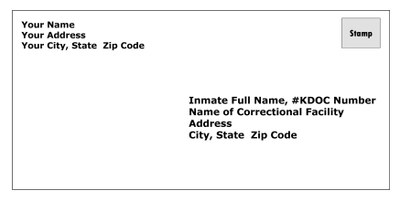
<span><br />To contact a male resident in the RDU, you may write to him at the following address until his approved phone list is activated:<br /></span><span> </span></div>
<p class="ARBodyText" style="padding-left: 60px; "><span>Resident’s Full Name,  KDOC# </span><span>XXXXX<br /></span><span>El Dorado Correctional Facility<br /></span><span>P.O. Box 311<br /></span><span>El Dorado, KS 67042</span><span> </span></p>
<p class="ARBodyText" style="padding-left: 30px; "><span></span><span>Female inmates may receive mail at:</span><span> </span></p>
<p class="ARBodyText" style="padding-left: 60px; "><span>Resident’s Full Name,  KDOC# </span><span>XXXXX<br /></span><span>Topeka Correctional Facility<br /></span><span>815 S.E. Rice Road<br /></span><span>Topeka, KS 66607</span></p>
<p class="ARBodyText" style="padding-left: 30px; "><strong>Please remember to include the resident’s full name and KDOC number in the address with all correspondence or the mail will not be delivered. The envelope also must contain the sender’s full name and address as well or the letter will not be delivered. Please note that all mail is subject to search.  </strong></p>
<p style="padding-left: 30px; ">Example:</p>
<p class="ARBodyText" style="padding-left: 30px; "><span><span><span><img class="image-inline" src="../../images/KDOC%20Envelope.jpg/@@images/image/preview" /></span></span></span></p>
<p style="padding-left: 30px; ">For more information about resident mail, please review <a href="http://www.dc.state.ks.us/kdoc-policies/kar/Article12.pdf/">Kansas Administrative Regulation (K.A.R.) 44-12-601, Inmate Writing and Other Inmate Communications or Publications</a>. Also, <a href="http://www.dc.state.ks.us/kdoc-policies/impp/chapter-12/12120.pdf/">Internal Management Policy and Procedure (IMPP) 12-120 Secuirty and Control: Control of Inmate Personal Property</a> provides additional information.</p>
<p class="ARBodyText" style="text-align: center; "><span><span><span></span></span></span>___________________________________________________________________________</p>
<h3 class="ARBodyText"><span><span><span><br />Telephone and Emergencies<a name="Telephone and Emergencies"></a></span></span></span></h3>
<ul>
<li>
<div class="ARBodyText"><strong>Can an inmate make phone calls while in RDU?<br /></strong>Yes. residents are permitted telephone privileges to make collect/pre-paid calls shortly after the reception process begins. Residents cannot receive calls. Upon admission, the resident fills out a phone list of those numbers that the resident would like to call. The resident will update the phone list every 120 days thereafter. Every number that a resident requests be added to the call list will be contacted by staff, verified and asked if the person wants to be on the resident's call list. The numbers are then activated through the facility’s phone system in approximately one week. Residents may establish a telephone list of up to 20 individual phone numbers.</div>
</li>
</ul>
<p>If you need additional information on theresident telephone process including how to establish an account, please visit the <a class="internal-link" href="../inmate-communications/inmate-telephone">Resident Communications section </a>and/or review <a href="../../kdoc-policies/impp/chapter-10/10111.pdf/">Internal Management Policy and Procedure (IMPP) 10-111 Programs and Services: Inmate Access to Facility and Coinless Telephones</a>.  </p>
<ul>
<ul>
<li><strong>How can I reach a resident in an emergency?</strong><br />In the event of a verifiable emergency such as a serious illness or death in the family, you may call the facility. Callers must provide a call back number and their relation to the inmate. Staff will also need the nature of the emergency, the name of the person who is sick or has passed away, the person’s relation to the resident and the name and contact information for the hospital or funeral home.</li>
Before the message will be given to the resident, facility staff will contact the hospital or funeral home to verify the information that you have provided concerning the emergency. Once the message is verified, the resident will be notified. Staff may discuss options with you for notifying the resident including if you would like to tell the resident or if you prefer a chaplain or counselor relay the information. </ul>
</ul>
<p></p>
<p class="ARBodyText" style="text-align: center; "><span><span><span></span></span></span>___________________________________________________________________________</p>
<ul></ul>
<ul></ul>
<ul></ul>
<ul></ul>
<ul></ul>
<ul></ul>
<ul></ul>
<ul></ul>
<h3><br />Other General RDU Questions<a name="Other Questions"></a></h3>
<ul>
<li> <strong>How does the KDOC determine where a resident will be housed?</strong></li>
</ul>
<p class="ARBodyText" style="padding-left: 30px; ">When bed space and programming slots become available in coordination with medical consultation, a resident’s facility placement is determined. If an offender is a recent parolee or post-release violator and not a new commitment to the KDOC, theresident could be placed wherever space is available in the KDOC system based on an resident’s classification status.</p>
<ul>
<li><strong>How can an resident address his/her questions while in RDU?<br /></strong>A form, called a Form-9,  is available to the resident as a formal procedure to address any questions or concerns. After the form is completed, theresident must turn it in to the security staff. After receiving the Form-9, the staff will have 10 days to respond to the resident’s request. </li>
<li><strong>What medical/dental/mental health services are available at RDU?<br /></strong>Within the first three days at RDU, the resident will be assessed for medical needs. Within seven days of being newly admitted and within 30 days for parole violators, each resident receives a dental exam. If major dental work is required, this will be done once the resident is transferred out of RDU to a permanent facility. Mental health services also are available. </li>
</ul>
<p class="ARBodyText" style="text-align: center; "><span><span><span></span></span></span>___________________________________________________________________________</p>]]></content:encoded>
    <dc:publisher>No publisher</dc:publisher>
    <dc:creator>Nancy Burghart</dc:creator>
    <dc:rights></dc:rights>
    <dc:date>2014-01-08T22:10:00Z</dc:date>
    <dc:type>Page</dc:type>
  </item>


  <item rdf:about="https://www.doc.ks.gov/facilities/faq/locating">
    <title>Locating a resident</title>
    <link>https://www.doc.ks.gov/facilities/faq/locating</link>
    <description>How do I know where a resident is housed?</description>
    <content:encoded xmlns:content="http://purl.org/rss/1.0/modules/content/"><![CDATA[<p class="indent" style="text-align: justify; "></p>
<p class="ARBodyText">You may check a resident’s location and status on the <a class="external-link" href="https://kdocrepository.doc.ks.gov/">Kansas Adult Supervised Population Electronic Repository (KASPER)</a> located on the KDOC’s website. Information is updated daily, excluding weekends.</p>
<p class="ARBodyText">KASPER is a database which contains information about offenders sentenced to the custody of the Secretary of Corrections since 1980. KASPER contains information regarding those who are: currently incarcerated; under post-incarceration supervision; and, who have been discharged from a sentence. KASPER does not have information available about inmates sent to Kansas under the provisions of the interstate compact agreement.</p>
<p class="ARBodyText">The information contained in KASPER is public information under provisions of Kansas statute and is made available to the public and law enforcement in the interest of public safety. No names are removed from the database unless a conviction is removed from the public record by one of three ways: one, if the conviction is overturned by means of an appeal; two, if the conviction is expunged; or three, if an offender is granted executive clemency.</p>
<p class="ARBodyText">Through KASPER you can find:</p>
<ul>
<li>Name and KDOC Registration Number;</li>
<li>Physical description (date of birth, height, weight, hair and eye color, body markings, including photograph);</li>
<li>Conviction description (crime(s) of conviction, county, case number);</li>
<li>Anticipated release date;</li>
<li>Inmate housing location (current location and facility movements, including movement dates, location of parole office maintaining supervision);</li>
<li>Custody or supervision level (Whether an offender has been released to post-incarceration supervision (parole, conditional release, post-release supervision, compact probation or parole); and,</li>
<li>Institutional disciplinary record (violations for which offender was found guilty).</li>
</ul>
<p class="ARBodyText">Please note that release dates may change and are contingent upon good time and program credit earnings and forfeitures.</p>
<p class="ARBodyText">Specific questions regarding an inmate’s release date should be directed to the KDOC’s sentence computation unit at (785) 296-3317 or by <a class="mail-link" href="mailto:Michelle.Sullivan@ks.gov">e-mail</a>.</p>
<p style="text-align: center; ">_________________________________________________________________</p>]]></content:encoded>
    <dc:publisher>No publisher</dc:publisher>
    <dc:creator>Nancy Burghart</dc:creator>
    <dc:rights></dc:rights>
    <dc:date>2014-01-08T22:10:00Z</dc:date>
    <dc:type>Page</dc:type>
  </item>


  <item rdf:about="https://www.doc.ks.gov/facilities/lcf/visit/faq">
    <title>FAQ</title>
    <link>https://www.doc.ks.gov/facilities/lcf/visit/faq</link>
    <description>Frequently Asked Questions about Visiting an Inmate</description>
    <content:encoded xmlns:content="http://purl.org/rss/1.0/modules/content/"><![CDATA[<blockquote><ol>
<li><b>I have a previous conviction, can I still visit?<br /></b>Each application is considered individually. If you have a previous conviction it does not necessarily disqualify you from visiting. Emphasis is placed on your honest and complete response to the visiting questionnaire.</li>
<li><b>I am currently on probation/parole, can I still visit?</b><br />Yes. You will need a letter from your probation/parole officer granting permission. Otherwise this fact alone will not disqualify you from visiting.</li>
<li><b>Can I be on more than one inmate's visiting list?</b><br />No. The only exception would be situations where all concerned are immediate family.</li>
<li><b>I am an ex-employee of the KDOC, can I visit?<br /></b>You will not be considered until two (2) years after your employment, and then final approval will rest with the warden.</li>
<li><b>How many of us can visit with the inmate at one time?</b><br />Due to space constraints, each inmate is limited to a maximum of four (4) visitors at a time.</li>
<li><b>Are cameras allowed in the visiting area?</b><br />No. In fact cameras are not allowed on the grounds of this facility at any time.</li>
<li><b>I am under 18 years of age, can I visit?</b><br />Only if you are immediate family as previously defined, and only if you are accompanied by a parent or legal guardian.</li>
<li><b>I have a relative in from out of town, can they come visit with me even though they are not on the visiting list?</b><br />An inmate can request a special visit for friends or relatives who are not on his list and have traveled a great distance. Several things are considered before granting the special visit request, to include: distance traveled, frequency of visits, and benefit to inmate adjustment, etc. You cannot call to set up a special visit. The inmate must initiate the request through his unit counselor.</li>
<li><b>Is there someone who will watch my children while I visit?</b><br />No, parents are responsible for their children’s behavior. Your visit may be terminated if your child is being disruptive in any manner. Children may not be left unattended in automobiles.</li>
<li><b>What kind of identification do I need?</b><br />If you are 18 or older, you will need a photo ID, A marriage license or birth certificate is acceptable for those under 18 years of age.</li>
</ol>
<p align="justify" style="text-align: left; "> </p>
<p style="text-align: center; "><span class="internal"><a class="internal" href="overview-1">Overview</a> </span>| <a class="internal" href="visit">Visitor Information<span class="internal"> </span></a>|<span class="internal"> <a class="internal" href="programs">Programs</a> </span>| <a class="internal" href="history-1">History</a><span class="internal"> </span>| <a class="internal" href="warden"><span class="internal">Warden</span><br /></a>____________________________________________________________________________</p>
</blockquote>]]></content:encoded>
    <dc:publisher>No publisher</dc:publisher>
    <dc:creator>cherylca</dc:creator>
    <dc:rights></dc:rights>
    <dc:date>2014-01-08T16:52:54Z</dc:date>
    <dc:type>Page</dc:type>
  </item>


  <item rdf:about="https://www.doc.ks.gov/facilities/hcf/programs/reentry">
    <title>Reentry</title>
    <link>https://www.doc.ks.gov/facilities/hcf/programs/reentry</link>
    <description></description>
    <content:encoded xmlns:content="http://purl.org/rss/1.0/modules/content/"><![CDATA[<p style="text-align: center; "><strong><br />HCF provides reentry planning and training in the following areas:</strong></p>
<ul>
<ul>
<ul>
<ul>
<ul>
<ul>
<ul>
<ul>
<ul>
<ul>
<li>Money Smart</li>
<li>Parole Interactions</li>
<li>Pre-Employment</li>
<li>Relapse Prevention</li>
<li>Resource Rooms</li>
<li>Tenant Responsibilities</li>
<li>Thinking for a Change</li>
<li>Veterans Benefits</li>
</ul>
</ul>
</ul>
</ul>
</ul>
</ul>
</ul>
</ul>
</ul>
</ul>
<p style="text-align: center; "><span class="internal"><br /><a class="internal" href="../visit-1/overview">Overview</a> </span>| <a class="internal" href="../visit-1/visit-1">Visitor Information</a><span class="internal"> </span>|<span class="internal"> <a class="internal" href="../visit-1/programs">Programs</a> </span>| <a class="internal" href="../visit-1/history">History</a><span class="internal"> </span>| <a class="internal" href="../visit-1/warden"><span class="internal">Warden</span></a><br />____________________________________________________________________________</p>]]></content:encoded>
    <dc:publisher>No publisher</dc:publisher>
    <dc:creator>cherylca</dc:creator>
    <dc:rights></dc:rights>
    <dc:date>2013-12-30T17:45:00Z</dc:date>
    <dc:type>Page</dc:type>
  </item>


  <item rdf:about="https://www.doc.ks.gov/facilities/ecf/programs-1">
    <title>Programs</title>
    <link>https://www.doc.ks.gov/facilities/ecf/programs-1</link>
    <description>The following are programs and services available at Ellsworth Correctional Facility: 
</description>
    <content:encoded xmlns:content="http://purl.org/rss/1.0/modules/content/"><![CDATA[<p><strong>CONTRACTED PROGRAMS </strong></p>
<blockquote>
<p style="text-align: left; "><strong>Education <br /></strong>The<strong> </strong>KDOC contracts with Southeast Kansas Education Service Center (Greenbush) to provide educational and vocational services. </p>
</blockquote>
<ul>
<li><strong>Barton Community College</strong> <br />Provides on-site educational opportunities through a U.S. Department of Labor Community-Based Job Training (CBJT) Grant Program.</li>
<ul>
<li><b>Manufacturing Skills Certification (MSC):</b>  The MSC course provides the student with the skills necessary to obtain entry level work on the shop floor of almost any manufacturing or construction company. The eight-hour credit course consists of five classes:  OSHA 10 Safety Course, basic shop math, blueprint reading/geometric dimensions, precision measurement and employability skills.</li>
<li style="text-align: left; "><b>Welding Certification:</b>  The welding instruction provides the student with the skills necessary to obtain an entry-level welding job. The course covers welding for various types of metals, including oil field pipe and aluminum. The 16-hour credit course consists of six classes: OSHA 10 Safety Course, shielded metal arc welding, gas metal arc welding, gas tungsten arc welding, blueprint ready for welders and cutting processes.</li>
<li style="text-align: left; "><b>Plumbing Certification:</b>  The plumbing instruction provides the student with the skills necessary to obtain an entry level plumbing job in either the residential or commercial areas. Training is provided utilizing numerous types of tools that will be encountered in the plumbing industry. The course allows the student hands-on experience in using PVC, copper, steel, and Pex pipe and fittings. The nine-hour credit course consists of the following classes: OSHA Safety Training, Plumbing I, Plumbing II and Shop Practicum. </li>
<li style="text-align: left; "><b>Internet and Computing Core Certification:</b> This two-course program provides the student with the knowledge and skills necessary to take the Certiport IC-3 certification examination. The three credit hour course includes instruction in introduction to computers and computer concepts and cpplications.  </li>
<li style="text-align: left; "><b>GED Instruction/Testing:</b> This course provides GED instruction and preparation throughout a 40-hour workweek. </li>
<li style="text-align: left; "><b>Work Ready Instruction/Testing: </b>This course provides the student with the knowledge and skills necessary to take the Work Ready certification examination. The program includes classes in reading, locating information and mathematics.</li>
</ul>
</ul>
<p></p>
<p style="text-align: left; "><strong>Medical<br /></strong></p>
<p style="text-align: left; ">ECF's medical services encompass many areas of resident medical needs. In addition to the 24-hour nursing care that is available, a physician is on site 20 hours per week and a dentist is on site 30 hours each week. Services include medical screenings and physical exams; dental exams and prophylaxis with treatment that include oral surgery and limited prosthetics; optometry needs for prescribing and fitting of eye wear; ancillary services for laboratory values and x-rays; referral entities for specialty needs of brace/limb prosthetics; orthopedic consultations and surgeries; neurosurgical and neurological consultations; ophthalmological consultations for general surgical conditions; general medical diagnosis and treatments; internal medicine diagnosis and treatments; and other specialty referrals subject to approval of the state medical director. The chronic care clinic currently provides services in the following areas:  pulmonary, hypertension, diabetic, cardiac, epileptic, positive HIV, TB prophylaxis, past positive TB prophylaxis and hyperthyroidism.</p>
<p style="text-align: left; "><strong>Mental Health<br /></strong>The mental health department’s overall goal is to provide services that encourage and assist the resident in making positive changes and meeting his individual needs. The mental health therapy program provides a variety of services which include mental health group counseling, intensive groups, individual counseling, psychiatric intervention, crisis intervention, psychological evaluations, activity therapy, discharge planning, tele-psychiatry to assist in the management of inmates on psychotropic drugs and on-call services. In addition, mental health professionals provide staff instruction on the assessment and management of the resident population. </p>
<p style="text-align: left; "><strong>Inmate Responsibility and Accountability Model (RAM) Training<br /></strong>The desired result of this training is that the participants will utilize the tools in their daily life. They can also apply the tools when they are released and strengthen their ability to remain on post-release supervision. The focus is on the behavior cycle, errors in thinking, thinking reports and problem resolution techniques. The course has been re-configured as a therapeutic group and targets those who successfully completed a previous group. The group meets once a week for 24 weeks.</p>
<p style="text-align: left; "><strong>NON-CONTRACTED PROGRAMS </strong></p>
<p style="text-align: left; "><strong>Religion<br /></strong>The goal and objective of chaplaincy services is to assist inmates in achieving individual spiritual growth. Services are held weekly for Catholic, protestant, Muslim, Moorish Science Temple of America, Jehovah Witness, United Tribes, Wicca, Buddhist, Assembly of Yahweh, Latter Day Saints, Judaism, Rastafarian and Asatru studies for inmates wishing to attend. A Native American Sweat Lodge ceremony is held on the third Sunday of each month and a pow wow is held quarterly. A variety of counseling services are available, including marriage, crisis, family, individual sessions and Alcoholics Anonymous/Narcotics Anonymous.</p>
<p>Numerous <a class="internal-link" href="volunteers">volunteers conduct religious services, bible studies and assist with other inmate activities</a>.</p>
<p style="text-align: left; ">To further support this mission, a free-standing <a class="internal-link" href="spiritual-life-center-1/slc">Spiritual Life Center (SLC)</a> has been constructed at ECF. The total cumulative cost of this capital improvement funding project was approximately $361,000. This project was accomplished primarily through the efforts of volunteers and facility staff using inmate labor. Project funding came exclusively from donations received from churches, individuals, corporations and grants from private foundations.   </p>
<p><strong>Reentry</strong></p>
<ul>
<li><strong>Central Kansas Reentry Program (CKRP)</strong></li>
</ul>
<p style="text-align: left; padding-left: 30px; ">CKRP primary objective is to ensure inmates have the opportunity to improve their probability of a successful return to society. The program utilizes partnerships with corrections agencies, law enforcement, victim services, mental health services, medical health providers, political and community representatives, employers and employment agencies, landlords, housing authorities and faith-based organizations. </p>
<p style="text-align: left; padding-left: 30px; ">CKRP’s target population consists of inmates who are assessed with high risks and needs in specific areas of their lives, are releasing to the Central Kansas area within a 90-minute radius of the Ellsworth Correctional Facility and who are within 12-14 months from their scheduled release. Once assessed for needs in their high risk-to-reoffend areas, these individuals are referred to groups, classes and workshops designed around their case management plan to target their specific needs. The primary areas of focus include but are not limited to:</p>
<ul>
<ul>
<ul>
<li>
<div style="text-align: justify; ">Thinking for a Change – focuses on the process of acceptance of social controls, the constructs of our environment, understanding thought patterns and ramifications of actions.</div>
</li>
<li>
<div style="text-align: justify; ">Job Readiness Training - designed to increase the likelihood of employment stability through education, career assessments, resume building, interview proficiency and networking.</div>
</li>
<li>
<div style="text-align: justify; ">Family Transitions –  emphasizes creating positive rewards and value systems in relationships including how to avoid and handle conflicts.</div>
</li>
<li>
<div style="text-align: justify; ">Transitional Planning – focuses on housing and reentry in the community and seeking out pro-social rewards and support systems.</div>
</li>
<li>
<div style="text-align: justify; ">Money Matters – provides instruction on financial matters such budgeting, managing bank accounts and incorporating savings and retirement plans into a financial plan.</div>
</li>
<li>
<div style="text-align: justify; ">Interventions – focuses on daily functioning and emotional interventions that address primary life stressors.</div>
</li>
</ul>
</ul>
</ul>
<p style="text-align: left; ">Pro-social supports are also a highlight of CKRP. Families attend quarterly family workshops in the community to speak with reentry and parole staff regarding release planning and community transitions.Providing community supports to individuals assures the best chance for their success. Reentry staff will continue working with the individual and their parole supervisor post-release offering services and mediation as needed until societal stability is achieved and the individual advances through the commencement process.   </p>
<p style="text-align: left; "><strong>Bicycle Refurbishing Program<br /></strong>Established in 1999, the program employs 12 inmates who repair and refurbish bicycles that are then donated to less fortunate individuals in Kansas communities and throughout the United States. The bicycle parts and materials are obtained through donations by individuals, law enforcement agencies and civic organizations.</p>
<p style="text-align: left; "><strong>Recreation<br /></strong>Inmates participate in recreational or leisure time activities depending upon their physical ability, fitness and acceptable behavior. The program targets physical and mental fitness, promotes productive leisure time, and includes intramural, social and cultural programming in addition to special events. The gym and yard are open seven days a week for inmate use. </p>
<p style="text-align: left; "><strong>Community Access Network (CAN), Inc.<br /></strong>Implemented in 2003, this project is a not-for-profit collaborative initiative comprised of representatives from various Kansas government organizations and community partners. The purpose of CAN is to develop an online resource to promote social issues, identify available services, and provide community statistics surrounding social issues and services.</p>
<p style="text-align: left; "><strong>Wheels for the World <br /></strong>Established in 1993, this outreach program for Joni and Friends Ministries refurbishes used wheelchairs that are distributed throughout the world. ECF’s program also manugactures universal footrests that are shipped to other distribution centers. Additionally, the program produced a new all-terrain attachment which allows individuals in various areas of the world to maneuver a wheelchair in rough terrain. The program's ECF supervisors are often called upon to lend their support in training and technical advice to setup similar programs in other states and countries. The program contracts with Personal Energy Transportation Kansas from Moundridge, Kan., to build parts for hand-cranked carts that are needed by those who lost the use of their legs due to polio, landmine injuries or amputation.  </p>
<p style="text-align: left; "><strong>Library<br /></strong>The library provides recreational, educational, legal and other information resources contributing to the development of the inmates in their physical, intellectual, moral and spiritual well-being. The library has approximately 12,000 books, receives about 30 newspapers and magazines and provides reference collection of encyclopedias, dictionaries, directories and other ready reference books. The collection is supplemented by an efficient, state-wide inter-library loan service. Inmates are provided access to all the legal documents, cases, statutes, administrative rules and case notes through the computerized LexisNexis system. The library also provides photocopying services and typewriters for inmates doing legal work. </p>
<p style="text-align: left; "><strong>Canine Assistance Rehabilitation Education and Services (CARES), Inc.<br /></strong>Since 1999, the CARES group has worked with ECF inmates who teach puppies basic obedience and socialization skills during a three- to six-month period.Once these skills are mastered, the dogs are placed with individuals who have a variety of challenges (physical, mental or emotional). </p>
<p style="text-align: left; "><strong>Work Programs<br /></strong>ECF’s policy is to provide inmates with a variety of meaningful work/program assignments patterned after a typical workday in the community. Assignments are designed to encourage inmates to develop desirable work habits and skills while engaging in work projects for ECF and the State of Kansas. </p>
<p style="text-align: left; ">An inmate employment assessment and job assignment program has been established at ECF which is utilized to ensure inmates are assigned jobs commensurate with their technical skills and to encourage inmates to possess positive behavioral characteristics. In addition, inmates are assigned to work crews to obtain on-the-job training which allows them to develop their work skills and assist them with reintegration into society.</p>
<p style="text-align: center; "><span class="internal"><a class="internal" href="overview">Overview</a> </span>| <a class="internal" href="visit">Visitor Information</a><span class="internal"> </span>|<span class="internal"> <a class="internal" href="programs-1">Programs</a> </span>| <a class="internal" href="copy_of_history">History</a><span class="internal"> </span>| <a class="internal" href="warden"><span class="internal">Warden</span><br /></a></p>
<p style="text-align: center; ">____________________________________________________________________________</p>]]></content:encoded>
    <dc:publisher>No publisher</dc:publisher>
    <dc:creator>cherylca</dc:creator>
    <dc:rights></dc:rights>
    <dc:date>2013-12-24T20:05:00Z</dc:date>
    <dc:type>Page</dc:type>
  </item>


  <item rdf:about="https://www.doc.ks.gov/facilities/ecf/history">
    <title>History</title>
    <link>https://www.doc.ks.gov/facilities/ecf/history</link>
    <description>ECF History</description>
    <content:encoded xmlns:content="http://purl.org/rss/1.0/modules/content/"><![CDATA[<p> </p>
<blockquote>
<div class="columns"><strong><br /></strong></div>
<table class="invisible" style="width: 311px;">
<tbody>
<tr><th colspan="3" style="text-align: center; ">Wardens</th></tr>
<tr>
<td style="text-align: center; ">
<p style="text-align: left; "><span>Don Langford<br />Martin J. Sauers<br /></span><span>Dan Schnurr<br /></span><span>Johnnie Goddard<br /></span><span>Sam Cline<br /></span><span>Raymond N. Roberts<br /></span><span>L.E. Bruce<br /></span><span>Robert Harrison<br /></span><span>Michael A. Nelson</span></p>
</td>
<td style="text-align: left; "></td>
<td style="text-align: left; ">
<p>2019-present<br />2016-2019<br />2011-2016<br />2007-2011<br />2003-2007<br />1999-2003<br />1992-1999<br />1990-1992<br />1987-1990</p>
</td>
</tr>
</tbody>
</table>
<p></p>
<div class="columns"><strong><br /></strong></div>
<table class="plain" style="width: 515px;">
<thead>
<tr>
<td colspan="2" style="text-align: center; "><strong> ECF Timeline</strong></td>
</tr>
</thead>
<tbody></tbody>
<tbody>
<tr>
<td>1986</td>
<td>The Kansas Legislature approved construction of a correctional facility to house 96 minimum-custody youthful inmates convicted of non-violent crimes.</td>
</tr>
<tr>
<td>1987</td>
<td>Ellsworth is selected as the location to receive the new facility that will house 252 medium-custody inmates. The facility will be called the Ellsworth Correctional Work Facility (ECWF).</td>
</tr>
<tr>
<td></td>
<td>Michael A. Nelson is named ECWF’s first Warden. (Additional administrative staff was added in 1988.)</td>
</tr>
<tr>
<td>1988</td>
<td>The word “Work” is removed from the title of the facility.</td>
</tr>
<tr>
<td></td>
<td>The first inmates were transferred to ECF to help with construction of the facility.</td>
</tr>
<tr>
<td></td>
<td>The Kansas Legislature approved an expansion of the original project to provide housing for 516 multi-custody inmates.</td>
</tr>
<tr>
<td>1990</td>
<td>Governor Mike Hayden and KDOC Secretary Steve Davies dedicated the facility at a ribbon-cutting ceremony on June 5.</td>
</tr>
<tr>
<td>1994</td>
<td>For two years, the facility housed parole condition violators, conditional release violators and post-release supervision violators KDOC wanted to house separately from the general prison population.</td>
</tr>
<tr>
<td>1995</td>
<td>The Department of Corrections began assessing offender fees for the following:  administrative fees for management of inmate trust fund accounts ($1.00 per inmate, per month); sick call ($2.00 per inmate-initiated visit); and urinalysis testing ($5.35 per confirmed positive test).</td>
</tr>
<tr>
<td>2000</td>
<td>Kansas Legislature approved construction of a 100-cell maximum security unit at ECF. Due to increasing numbers of medium custody inmates in the system, the unit is currently being utilized to house medium custody inmates and facility's segregation population.</td>
</tr>
<tr>
<td>2004</td>
<td>ECF’s Spiritual Life Center was constructed entirely with private donations to provide religious programs to inmates.</td>
</tr>
<tr>
<td colspan="1">2006</td>
<td colspan="1">Then-Senator Sam Brownback, contemplating a presidential run in 2008, spent the night at ECF and met with inmates on May 31.</td>
</tr>
<tr>
<td colspan="1">2012</td>
<td colspan="1">In the fall, a minimum-security unit (ECF East Unit) opened in the southeast corner of Ellsworth, housing 95 inmates, increasing the total operating capacity at the ECF Central and East Units to 915.</td>
</tr>
</tbody>
</table>
<p style="text-align: center; "> </p>
<p style="text-align: center; "><span class="internal"><a class="internal" href="overview">Overview</a> </span>| <a class="internal" href="visit">Visitor Information</a><span class="internal"> </span>|<span class="internal"> <a class="internal" href="programs-1">Programs</a> </span>| <a class="internal" href="copy_of_history">History</a><span class="internal"> </span>| <a class="internal" href="warden"><span class="internal">Warden</span><br /></a></p>
<p style="text-align: center; ">____________________________________________________________________________</p>
</blockquote>]]></content:encoded>
    <dc:publisher>No publisher</dc:publisher>
    <dc:creator>cherylca</dc:creator>
    <dc:rights></dc:rights>
    <dc:date>2013-12-24T20:05:00Z</dc:date>
    <dc:type>Page</dc:type>
  </item>


  <item rdf:about="https://www.doc.ks.gov/facilities/edcf/programs">
    <title>Programs</title>
    <link>https://www.doc.ks.gov/facilities/edcf/programs</link>
    <description>The following are programs and services available at El Dorado Correctional Facility: 
</description>
    <content:encoded xmlns:content="http://purl.org/rss/1.0/modules/content/"><![CDATA[<p>The programs division provides oversight for risk reduction, reentry and case management initiatives at EDCF. The division ensures effective programming is offered to provide rehabilitative treatment to assist inmates for return to society. These programs include academic and vocational education, cognitive skills, self-help groups and mental health services. Programs to enhance work ethics, relapse prevention and goal setting are also available. </p>
<p style="text-align: justify; ">Within the program division, unit teams manage the inmate population assigned to each housing unit. A unit team manager is responsible for the day-to-day operation of the housing unit. Uniformed staff and corrections counselors are also part of each unit team. The unit team's purpose is to decentralize programs and operations to provide more individual attention to the inmate population and to respond to the needs of individual inmates. </p>
<p style="text-align: justify; ">An individualized treatment program is developed, implemented and maintained for each inmate by unit team staff. The unit teams provide services to inmates in the form of work assignments, progress reviews, attitudinal and adjustment counseling, release counseling and other matters. For unit teams, release planning for all inmates is vital to an inmate’s successful transition into society. An inmate employment assessment and job assignment program is utilized to ensure inmates are assigned jobs commensurate with their technical skills. Inmates are also assigned to work crews to obtain on-the-job training which allows them to develop work skills and assist them with reintegration into society. The records office is responsible for providing clerical support for the unit teams and for updating records of inmates received, processed and transferred into and from EDCF.</p>
<p style="text-align: justify; ">Contract services, including medical, mental health and education programs are also overseen by the deputy warden of programs.</p>
<p style="text-align: justify; "><strong>NON-CONTRACTED PROGRAMS </strong></p>
<p style="text-align: justify; "><strong>Facility/Parole Interaction</strong><b><br /></b>Facility/parole interaction meetings convene on a monthly basis for parole and facility staff to make presentations to inmates who will be releasing in 30 to 60 days. Discussions occur surrounding the 12 standard conditions of parole to dispel common myths and beliefs about post release supervision. In Phase 2, conference calls occur between inmates, facility staff (IPO, Unit Manager, Counselor, Release Planner, etc.) inmate family members or home plan sponsor and other appropriate participants.</p>
<p style="text-align: justify; "><strong>SKIP </strong><b><br /></b>The Kansas Strengthening Kids of Incarcerated Parents (KS-SKIP) program is a model program designed to connect incarcerated parents to their children prior to release from prison. The initial phase of the KS-SKIP program is a 13-week parenting class that focuses on increasing the father's understanding of their role as a parent, in spite of incarceration. The goal is to strengthen the father-child relationship prior to release and to prepare fathers to reconnect with their child/children. The second phase is Play and Learn groups. The groups are mobile preschool environments where parents and children gather to play and learn together under the supervision of trained facilitators. Each week for 8-12 weeks, fathers turn an adult space into a playgroup environment for their children. When children arrive at the facility, fathers become the primary caregiver for that hour and a half session. The program's third phase includes support to the caregivers. Concurrent to the Play and Learn group, a support group is offered for the caregivers of the children.</p>
<p style="text-align: justify; "><strong>FLIP </strong><b><br /></b>Directed at segregation inmates, FLIP (Fundamental Lessons in Psychology) consists of various psychological topics including: anger management, anxiety, assertiveness, cognitive self-change, depression, general mental health, grief, loss and forgiveness, men’s issues/adjustment and self-esteem. </p>
<p style="text-align: justify; "><strong>Chaplaincy</strong><b><br /></b>EDCF has two full time chaplains who facilitate, coordinate, and oversee religious programs for the Central Unit. There are over 24 different groups facilitated by the Chaplain's office including Alcoholics and Narcotics Anonymous, Asatru, Assembly of Yahweh, Buddhist, Church of Christ Study, House of Yahweh, Innerchange, Islamic Study, Jehovah's Witnessess, Jewish Study, Latter Day Saints, Mennonite Study, Moorish Science Temple, Native Americans, Pentecostal Worship, Non-Catholic Christian Study, Sunday Services, Rastafarian, Roman Catholic Study/Mass, Seventh Day Adventists, Spanish Speaking Bible Study and Wicca.  The Chaplain's office provides greeting cards and reading materials to inmates as they are provided by donations.  This office also provides premarital counseling, grief counseling, memorial services and emergency notification for families of inmates.  Additionally, counseling is provided for inmates with families, and counseling and assistance is provided to staff as needed and requested.  The chaplains coordinate volunteer services for approximately 250 volunteers, provide training to both volunteers and facility staff, work with local community leaders and clergy and lead worship services for inmates.</p>
<p style="text-align: justify; "><strong>Spritual Life Center<br /></strong>Opened in June 2010, the Spiritual Life Center is an 11,500 sq. foot structure designed to support the spiritual needs of inmates. Constructed primarily through the efforts of inmate labor, volunteers, and facility staff, project funding, furnishings, and equipment have come exclusively from donations received from individuals, corporations and foundation grants. The Spiritual Life Center provides space to an increased number of inmates to attend religious services along with housing support groups such as AA and Life Skills training.  The building contains a large chapel area, a multi-purpose room, five classrooms, a library, two chaplain's offices and a conference room.  </p>
<p style="text-align: justify; "><strong>Transitional Segregation Program (Segregation to Society (STS)) <br /></strong>Aimed at long-term segregation inmates who have 12 to 16 months until release, the program provides a number of tools necessary for the transition to the community. Inmates in this setting have been more restricted in their movement and access to others and have not been able to attend release and re-entry classes. In-cell assignments are conducted through handouts, workbooks, manuals, etc. Instruction is provided directly to inmates by trained staff.<strong> </strong></p>
<p style="text-align: justify; "><strong>Behavior Modification Program (BMP)</strong><b><br /></b>The BMP is a program designed to deal with transitioning segregation inmates in a stratified behavior modification program based on increased steps of privileges for demonstrated appropriate behavior and program compliance. The nine-month, cognitive-based program integrates inmates in a 3-step process that includes portions of Thinking for a Change, Motivation for Change, PAD (Positive Attitude Development), and Anger Management programs.</p>
<ul>
<li>
<div style="text-align: justify; "><span>Step 1: C</span>onsists of the Positive Attitude Development program (9 weeks) and the Positive Communication Development (3 weeks).</div>
</li>
<li>
<div style="text-align: justify; "><span>Step 2: Consists of the </span>Positive Communication Development (12 weeks) and the Self Actualization program (12 weeks).</div>
</li>
<li>
<div style="text-align: justify; "><span>Step 3:</span> Consists of inmates participating in at least two general population groups per week. The programs are Road to Recovery, Life Skills, FLIP: Fundamental Lessons in Psychology, Meditation, Crochet and Communication.</div>
</li>
</ul>
<p style="text-align: justify; ">Added to the program is an additional three months of monitoring under intensive supervision. </p>
<p style="text-align: justify; "><strong>Offender Workforce Development (OWDS)</strong><b><br /></b>OWDS works with inmates to address internal and external barriers and assesses individual interests and skills in preparation for job readiness. OWDS assists with developing such job search skills as developing a resume, completing an application, conducting a job search, honing interview skills and discussing how to address the inmate's felony conviction.</p>
<p style="text-align: center; "><span class="internal"><a class="internal" href="overview">Overview</a> </span>| <a class="internal" href="visit">Visitor Information</a><span class="internal"> </span>|<span class="internal"> <a class="internal-link" href="programs">Programs</a> </span>| <a class="internal" href="history">History</a><span class="internal"> </span>|  <a class="internal" href="warden"><span class="internal">Warden</span><span class="internal"></span></a><a class="internal" href="visit/holiday"><br /></a>____________________________________________________________________________</p>]]></content:encoded>
    <dc:publisher>No publisher</dc:publisher>
    <dc:creator>cherylca</dc:creator>
    <dc:rights></dc:rights>
    <dc:date>2013-12-03T16:25:00Z</dc:date>
    <dc:type>Page</dc:type>
  </item>


  <item rdf:about="https://www.doc.ks.gov/facilities/tcf/visit-1/handbook">
    <title>Visitor Handbook</title>
    <link>https://www.doc.ks.gov/facilities/tcf/visit-1/handbook</link>
    <description>Information for visitors</description>
    
    <dc:publisher>No publisher</dc:publisher>
    <dc:creator>cherylca</dc:creator>
    <dc:rights></dc:rights>
    <dc:date>2013-12-02T16:40:00Z</dc:date>
    <dc:type>File</dc:type>
  </item>


  <item rdf:about="https://www.doc.ks.gov/publications/juvenile/dmc">
    <title>Kansas State DMC Assessment (July 2013)</title>
    <link>https://www.doc.ks.gov/publications/juvenile/dmc</link>
    <description>Kansas State DMC Assessment (July 2013)</description>
    
    <dc:publisher>No publisher</dc:publisher>
    <dc:creator>cherylca</dc:creator>
    <dc:rights></dc:rights>
    <dc:date>2013-11-20T17:30:00Z</dc:date>
    <dc:type>File</dc:type>
  </item>


  <item rdf:about="https://www.doc.ks.gov/publications/Reports/Archived/2013">
    <title>FY 2013 KDOC Annual Report</title>
    <link>https://www.doc.ks.gov/publications/Reports/Archived/2013</link>
    <description>An overview of the Department’s activities including Juvenile Services throughout the Fiscal Year 2013.</description>
    
    <dc:publisher>No publisher</dc:publisher>
    <dc:creator>cherylca</dc:creator>
    <dc:rights></dc:rights>
    <dc:date>2013-11-06T17:00:00Z</dc:date>
    <dc:type>File</dc:type>
  </item>


  <item rdf:about="https://www.doc.ks.gov/juvenile-services/supervision-standards/glossary">
    <title>Glossary</title>
    <link>https://www.doc.ks.gov/juvenile-services/supervision-standards/glossary</link>
    <description></description>
    <content:encoded xmlns:content="http://purl.org/rss/1.0/modules/content/"><![CDATA[<p style="text-align: center; "><a name="Back to Top"></a> </p>
<p style="text-align: center; "><a class="internal" href="supervision-standards">Supervision Standards: Forms</a> | <a class="internal" href="supervision-standards-1">Return to Standards Listing </a><br />   ____________________________________________________________________________</p>
<p style="text-align: center; "> </p>
<p style="text-align: center; "><a class="anchor-link" href="#A"><b>A</b> </a>| <b><a class="anchor-link" href="#B">B</a></b> | <b><a class="anchor-link" href="#C">C</a></b> | <b><a class="anchor-link" href="#D">D</a></b> | <b><a class="anchor-link" href="#E">E</a></b> | <b><a class="anchor-link" href="#F">F</a></b> | <b><a class="anchor-link" href="#G">G</a></b> | <b><a class="anchor-link" href="#H">H</a></b> | <a class="anchor-link" href="#I"><b>I</b> </a>| <b><a class="anchor-link" href="#J">J</a></b> | <b><a class="anchor-link" href="#K">K</a></b> | <b><a class="anchor-link" href="#L">L</a></b> | <b><a class="anchor-link" href="#M">M</a></b> | <a class="anchor-link" href="#N"><b>N</b> </a>| <b><a class="anchor-link" href="#O">O</a></b> | <b><a class="anchor-link" href="#P">P</a></b> | <b><a class="anchor-link" href="#QR">Q</a></b> | <b><a class="anchor-link" href="#QR">R</a></b> | <b><a class="anchor-link" href="#S">S</a></b> | <a class="anchor-link" href="#T"><b>T</b> </a>| <b><a class="anchor-link" href="#U">U</a></b> | <b><a class="anchor-link" href="#V">V</a></b> | <b><a class="anchor-link" href="#W">W</a></b> | <b><a class="anchor-link" href="#XYZ">X</a></b> | <b><a class="anchor-link" href="#XYZ">Y</a></b> | <b><a class="anchor-link" href="#XYZ">Z</a></b></p>
<p style="text-align: left; "><strong><a name="A"></a><br />Abconder/AWOL</strong><br />A youth who has been adjudicated as a juvenile offender and has run away from supervision including probation, conditional release (parole) or a juvenile charged as an offender (no sentence imposed yet).</p>
<p style="text-align: left; "><strong>Adjudication</strong><br />Finding by the court that the respondent committed the offense.</p>
<p style="text-align: left; "><strong>Administrative County</strong><br />The county in a judicial district which receives grant funds from the Division of Juvenile Services for the operation of juvenile justice programs.</p>
<p style="text-align: left; "><strong>Administrative County's Conditions of Grant<br /></strong>Requirements for the Board of County Commissioners to receive funding from the Division of Juvenile Services.</p>
<p style="text-align: left; "><strong>Administrative Level</strong><br />A level of supervision reserved for juvenile offenders who are not available for direct supervision (i.e. detention treatment, sanction house, etc.,).</p>
<p style="text-align: left; "><strong>Adoption </strong><br />Legal action to have the court approve adoptive parents as legal parent(s) after the parental rights of the biological parents have been terminated.</p>
<p style="text-align: left; "><strong>Adoption and Foster Care Analysis Reporting System (AFCARS) </strong><br />The U.S. Department of Health and Human Services-Administration for Children and Families requires each state to submit a AFCARS report, regarding specific data elements for Kansas' foster care population, twice a year (May and November).</p>
<p style="text-align: left; "><strong>Affidavit</strong><br />A written sworn statement of fact.</p>
<p style="text-align: left; "><strong>Aftercare</strong><br />1. A period of supervision and/or treatement of a juvenile offender who has been returned to the community from a confinement or treatment facility.<br />2. The status or program membership of a juvenile offender who has been committed to a treatment or confinement facility then conditionally released from the facility and placed in a supervisory and/or treatment facility.</p>
<p style="text-align: left; "><strong>Arrest</strong><br />Taking a person into custody by authority of law, for the purpose of charging the person with a criminal offense, delinquent act and/or status offense.</p>
<p style="text-align: left; "><strong>Assault</strong><br />Verbally creating fear of bodily harm and/or the causing of bodily harm against another person.</p>
<p style="text-align: left; "><strong>Audit</strong><br />An official examination and verification of a account/record.</p>
<ul class="buttonList" style="text-align: center; ">
<ul class="buttonList" style="text-align: center; "></ul>
</ul>
<ul class="listTypeDisc">
<li><strong><a class="anchor-link" href="#Back to Top">Back to Top</a></strong></li>
 </ul>
<p style="text-align: center; "><a class="anchor" href="#A"><b>A</b> </a>| <b><a class="anchor" href="#B">B</a></b> | <b><a class="anchor" href="#C">C</a></b> | <b><a class="anchor" href="#D">D</a></b> | <b><a class="anchor" href="#E">E</a></b> | <b><a class="anchor" href="#F">F</a></b> | <b><a class="anchor" href="#G">G</a></b> | <b><a class="anchor" href="#H">H</a></b> | <a class="anchor" href="#I"><b>I</b> </a>| <b><a class="anchor" href="#J">J</a></b> | <b><a class="anchor" href="#K">K</a></b> | <b><a class="anchor" href="#L">L</a></b> | <b><a class="anchor" href="#M">M</a></b> | <a class="anchor" href="#N"><b>N</b> </a>| <b><a class="anchor" href="#O">O</a></b> | <b><a class="anchor" href="#P">P</a></b> | <b><a class="anchor" href="#QR">Q</a></b> | <b><a class="anchor" href="#QR">R</a></b> | <b><a class="anchor" href="#S">S</a></b> | <a class="anchor" href="#T"><b>T</b> </a>| <b><a class="anchor" href="#U">U</a></b> | <b><a class="anchor" href="#V">V</a></b> | <b><a class="anchor" href="#W">W</a></b> | <b><a class="anchor" href="#XYZ">X</a></b> | <b><a class="anchor" href="#XYZ">Y</a></b> | <b><a class="anchor" href="#XYZ">Z</a></b></p>
<p style="text-align: left; "><strong><a name="B"></a><br />Battery</strong><br />An offensive/harmful touching or use of force on a person without the person's consent.</p>
<p style="text-align: left; "><strong>Board of County Commissioners</strong><br />A group of elected officials charged with the administration of county government.</p>
<ul class="listTypeDisc">
<li><strong><a class="anchor anchor-link" href="#Back to Top">Back to Top</a></strong></li>
 </ul>
<p style="text-align: center; "><a class="anchor" href="#A"><b>A</b> </a>| <b><a class="anchor" href="#B">B</a></b> | <b><a class="anchor" href="#C">C</a></b> | <b><a class="anchor" href="#D">D</a></b> | <b><a class="anchor" href="#E">E</a></b> | <b><a class="anchor" href="#F">F</a></b> | <b><a class="anchor" href="#G">G</a></b> | <b><a class="anchor" href="#H">H</a></b> | <a class="anchor" href="#I"><b>I</b> </a>| <b><a class="anchor" href="#J">J</a></b> | <b><a class="anchor" href="#K">K</a></b> | <b><a class="anchor" href="#L">L</a></b> | <b><a class="anchor" href="#M">M</a></b> | <a class="anchor" href="#N"><b>N</b> </a>| <b><a class="anchor" href="#O">O</a></b> | <b><a class="anchor" href="#P">P</a></b> | <b><a class="anchor" href="#QR">Q</a></b> | <b><a class="anchor" href="#QR">R</a></b> | <b><a class="anchor" href="#S">S</a></b> | <a class="anchor" href="#T"><b>T</b> </a>| <b><a class="anchor" href="#U">U</a></b> | <b><a class="anchor" href="#V">V</a></b> | <b><a class="anchor" href="#W">W</a></b> | <b><a class="anchor" href="#XYZ">X</a></b> | <b><a class="anchor" href="#XYZ">Y</a></b> | <b><a class="anchor" href="#XYZ">Z</a></b></p>
<p style="text-align: left; "><strong><a name="C"></a><br />Case Management<br /></strong>Describes a variety of work done with juvenile offenders in the court ordered custody of – or at risk for coming into the court ordered custody of the Division of Juvenile Services. This work is done by the community supervision officers who are responsible for to fill this role by conducting thorough assessments; developing a case plan cooperation with the juvenile offender, the juvenile offenders family and other significant parties in the community; contracting for services that address the concerns outlined in the case plan; and by providing supervision and monitoring of the juvenile offender's behavior and progress in the program.</p>
<p style="text-align: left; "><strong>Central Office</strong><br />This refers to the Kansas Department of Corrections - Division of Juvenile Services.</p>
<p style="text-align: left; "><strong>Child Abuse/Neglect</strong><br />The physical, sexual or emotional mistreatment or neglect of a child or children.</p>
<p style="text-align: left; "><strong>Child in Need of Care (CINC)</strong><br />A child who currently is, has been or is at risk of being neglected, abused or inadequately supervised.</p>
<p style="text-align: left; "><strong>Child Support Services (CSS) </strong><br />A division within the Kansas Department of Children and Families (DCF) that pursues parents and seeks to establish orders for payment and collection of court ordered child support. CSS manages the child support  enforcement portion of court ordered custody cases through a written agreement with the Division of Juvenile Services.</p>
<p style="text-align: left; "><strong>Child Welfare System</strong><br />The coordinated system of governmental and private entities charged with the prevention, investigation, prosecution and provision of services to victims of abuse and neglect. The Kansas Department of Children and Families (DCF) is the state agency designated to coordinate this system; however, courts, law enforcement, prosecutors and service providers play key roles in this system.</p>
<p style="text-align: left; "><strong>Chrono(s)<br /></strong>Narratives or log notes typed into CASIMS that document the who, what, when, where and how of juvenile offender case activity. The Chronos provide a running history of the youth's case from beginning to end</p>
<p style="text-align: left; "><strong>Code of Federal Regulations (CFR)</strong><br />Refers to federal regulations based on federal law. CFRs commonly cited in juvenile offender foster care cases are based on the Social Security Act which governs programs such as: Title IV-A Temporary Assistance to Families, Title IV-D Child Support Enforcement, Title IV-E foster care and Title XIX Medicaid. CFR sections are numbered in the following manner: 45 CFR 1356.21.</p>
<p style="text-align: left; "><strong>Collateral Contacts</strong><br />Refers to telephone or personal contacts with anyone other than the juvenile offender. Collateral contacts should convey information to the supervising officer regarding juvenile offenders that is pertinent to supervision requirements and/or community adjustment.</p>
<p style="text-align: left; "><strong>Commitment</strong><br />A judge's order sending someone who has judicial proceedings to  a particular kind of confinement or residential facility, for a specific reason authorized by law.</p>
<p style="text-align: left; "><strong>Community Agency Supervision Information Management System (CASIMS)<br /></strong>A database designed to gather specific data regarding the supervision of juvenile offenders, which is used to generate reports and/or documents, populate forms and create the bi-annual AFCARS file. The official chronological record of all juvenile offender related activities and contacts is maintained in CASIMS.</p>
<p style="text-align: left; "><strong>Community-based Services Team (CBST)<br /></strong>An individualized team established to access and integrate community resources to meet mental health needs in the least restrictive environment. The CBST is comprised of the resident (as appropriate), a responsible family member/guardian, a knowledgeable representative from the Community Mental Health Center (CMHC), other clinicians, the custodial case manager, and any other individuals considered to be helpful in determining how to best help the youth.</p>
<p style="text-align: left; "><strong>Community Integration Program<br /></strong>Non-secure residential settings designed for youth who are ready to enter a phase of care, which will eventually transition them to independent living. It is a service that allows youth the opportunity to practice independent living skills with decreasing degrees of supervision. The program prepares youth to become socially and financially independent.</p>
<p style="text-align: left; "><strong>Community Resources<br /></strong>Refers to social and welfare agencies, service clubs, citizen interest groups, self-help groups and citizen volunteers who have the potential to assist juvenile offenders. These various resources, which may be public or private, national or local, have the potential for help ranging from material and financial assistance, to guidance, counseling and supportive services.</p>
<p style="text-align: left; "><strong>Community Service</strong><br />An alternative available to youth requiring them to devote time to the community as part of the Intake and Assessment Program’s conditions of release.</p>
<p style="text-align: left; "><strong>Community Supervision Agency</strong><br />A local juvenile justice program operated by the Administrative County which provides services for juvenile offenders and their families when the juvenile offender is subject to court-ordered supervision such as juvenile intensive supervised probation, court-ordered custody, interstate compact for juveniles, juvenile correctional facility and conditional release.</p>
<p style="text-align: left; "><strong>Community Supervision Agency Director</strong><br />The agency head designed by the Board of County Commissioners who is accountable for the community supervision agency.</p>
<p style="text-align: left; "><strong>Community Supervision Agency Facility On-site Youth Contact Guidelines</strong><br />Guidelines set to serve as the general framework for visitations that occur within a Juvenile Correctional Facility by an employee of the community superivsion officer.</p>
<p><strong>Community Supervision Agency Supervisor</strong><br />Staff position in a community supervision agency in which the job duties include the hiring, supervision and performance evaluation of community supervision officer(s) who are providing direct supervision of juvenile offenders. Depending upon agency organizational structure, these positions may be the Community Supervision Agency Director or separate positions. </p>
<p><strong>Community Supervision Officer</strong><br />Any employee of a community supervision agency whose job duties include supervision of any juvenile offender(s).</p>
<p><strong>Complaint</strong><br />Document filed with the court to commence an action under the juvenile offender code. </p>
<p><strong>Conditional Release (CR)</strong><br />A period of aftercare for juvenile offenders released from a Juvenile Correctional Facility. Duration of conditional release is set by the court per the provisions of K.S.A. 38-2369.</p>
<p><strong>Conflict Resolution</strong><br />A range of processes, such as negotiation, litigation or mediation aimed at alleviating or eliminating sources of conflict. </p>
<p><strong>Contraband</strong><br />Any goods or merchandise whose importation, exportation or possession is forbidden.</p>
<p><strong>Contractual services</strong><br />Services obtained by the intake and assessment program from another entity in exchange for consideration, or the intake and assessment program performing a service and receiving consideration from another entity.</p>
<p><strong>Court</strong><br />An agency or unit of the judicial branch of government authorized or established by statute or constitution, and consisting of one or more judicial officers, which has the authority to decide upon cases, controversies in law and disputed matters of fact brought before it.</p>
<p><strong>Court Order(s)</strong><br />A mandated, command or direction issued by a judge through the judge's judicial authority.</p>
<p><strong>Court-ordered Custody</strong><br />Placed into court-ordered custody of the Division of Juvenile Services, pursuant to K.S.A. 38-2384 or K.S.A. 38-2362 for out-of-home placement.</p>
<p><strong>Courtesy Supervision</strong><br />A supervision practice that facilitates a cooperative sharing of staff resources between judicial districts for the purpose of providing for the supervision of a juvenile offender when not physically located within the judicial district that has supervision responsibility under an order of the court.</p>
<p><strong>Courtroom Protocol</strong><br />The formal or informal procedure and/or actions regulating  one's behavior in the courtroom.</p>
<p><strong>Critical Incident</strong><br />Various types of incidents that can involve or may lead to: suicide, homicide, death (accidental or from natural causes), riot/hostage situations, abuse, sexual abuse or sexual harrassment, AWOL, serious injuries/illnesses, assault/battery, serious infectious disease, attempted suicide, natural disaster, or anything that may have the potential for significant media coverage. Strict reporting guidelines through standards are outlined for each of the above incidents. </p>
<p><strong>Crossover Youth</strong><br />A young person <strong> </strong>age 10 or older with any level of concurrent involvement with the child welfare and juvenile justice system</p>
<ul>
<li><span>Involvement in the juvenile justice system includes: court ordered community supervision, and Immediate Intervention Programs (IIP).             </span></li>
<li><span> </span><span>Involvement in the child welfare system includes: out of home placement, as assigned investigation of alleged abuse or neglect with a youth person name as alleged perpetrator, and/or participate in voluntary/preventive services that are open for services.</span></li>
</ul>
<p><span> </span><strong>                                                                                                                                                                                                                </strong></p>
<p><strong></strong><strong>Cultural Diversity<br /></strong><span>The coexistence of different ethnic, gender, racial and socioeconomic groups based on the understanding that each individual is unique and different within one social unit.</span></p>
<ul class="listTypeDisc">
<li><strong><a class="anchor anchor-link" href="#Back to Top">Back to Top</a></strong></li>
 </ul>
<p style="text-align: center; "><a name="Top"></a><br /><a class="anchor-link" href="#A"><b>A</b> </a>| <b><a class="anchor-link" href="#B">B</a></b> | <b><a class="anchor-link" href="#C">C</a></b> | <b><a class="anchor-link" href="#D">D</a></b> | <b><a class="anchor-link" href="#E">E</a></b> | <b><a class="anchor-link" href="#F">F</a></b> | <b><a class="anchor-link" href="#G">G</a></b> | <b><a class="anchor-link" href="#H">H</a></b> | <a class="anchor-link" href="#I"><b>I</b> </a>| <b><a class="anchor-link" href="#J">J</a></b> | <b><a class="anchor-link" href="#K">K</a></b> | <b><a class="anchor-link" href="#L">L</a></b> | <b><a class="anchor-link" href="#M">M</a></b> | <a class="anchor-link" href="#N"><b>N</b> </a>| <b><a class="anchor-link" href="#O">O</a></b> | <b><a class="anchor-link" href="#P">P</a></b> | <b><a class="anchor-link" href="#QR">Q</a></b> | <b><a class="anchor-link" href="#QR">R</a></b> | <b><a class="anchor-link" href="#S">S</a></b> | <a class="anchor-link" href="#T"><b>T</b> </a>| <b><a class="anchor-link" href="#U">U</a></b> | <b><a class="anchor-link" href="#V">V</a></b> | <b><a class="anchor-link" href="#W">W</a></b> | <b><a class="anchor-link" href="#XYZ">X</a></b> | <b><a class="anchor-link" href="#XYZ">Y</a></b> | <b><a class="anchor-link" href="#XYZ">Z</a></b></p>
<p><b><a name="D"></a><br />Deoxyribonucleic Acid (DNA)</b><br />Located in the nucleus of cells, which provides an individual’s personal genetic blueprint.</p>
<p><strong>Designee</strong><br />Staff member authorized by the Community Supervision Agency Director to review or approve actions by a community supervision officer in performance of duties.  A designee cannot be the community supervision officer taking the action.</p>
<p><strong>Detention</strong><br />Confinement of a youth in a licensed detention center pursuant to a court order or arrest by law enforcement pending a court hearing.</p>
<p><strong>Direct Commitment</strong><br />Commit the juvenile offender to a juvenile correctional facility, per Sentencing Alternatives, K.S.A. 38-2361(a)(12).</p>
<p><strong>Discharge</strong><br />In criminal justice usage, to release from confinement or supervision, or to release from a legal status imposing an obligation upon the person.</p>
<p><strong>Discrimination</strong><br />The treatment or consideration of, or making a distinction in favor or against a category to which a person or thing belongs rather than based on individual merit.</p>
<p><strong>Disposition</strong><br />The sentence given to, or treatment prescribed for, a juvenile offender by the court.</p>
<p><strong>Dispositional Custody</strong><br />Court-ordered custody of a juvenile offender awarded to the Secretary of Juvenile Services after the dispositional hearing.</p>
<p><strong>Dispositional Hearing</strong><br />The hearing held by the court after a youth has been adjudicated (CINC or JO) to determine the outcome for the youth’s case.</p>
<p><strong>Division of Juvenile Services Justice Child Support (CSE) Handbook</strong><br />A handbook detailing how to manage CSE within the Division of Juvenile Services court-ordered custody cases.</p>
<p><strong>Division of Juvenile Services Deputy Compact Administrator for ICJ</strong><br />The position at the Division of Juvenile Services responsible for administering the Interstate Compact for juvenile offenders for the State of Kansas.</p>
<p><strong>Division of Juvenile Services Financial Rules and Guidelines</strong><br />A manual published by the Division of Juvenile Services Fiscal Services, to provide detailed financial rules for Community Supervision Agencies.</p>
<p><strong>Division of Juvenile Services Payment System Handbook</strong><br />A Division of Juvenile Services  Manual providing detailed written instructions for managing the payment of juvenile offender services.</p>
<ul class="listTypeDisc">
<li><strong><a class="anchor anchor-link" href="#Back to Top">Back to Top</a></strong></li>
 </ul>
<p style="text-align: center; "><a name="Top"></a><br /><a class="anchor-link" href="#A"><b>A</b> </a>| <b><a class="anchor-link" href="#B">B</a></b> | <b><a class="anchor-link" href="#C">C</a></b> | <b><a class="anchor-link" href="#D">D</a></b> | <b><a class="anchor-link" href="#E">E</a></b> | <b><a class="anchor-link" href="#F">F</a></b> | <b><a class="anchor-link" href="#G">G</a></b> | <b><a class="anchor-link" href="#H">H</a></b> | <a class="anchor-link" href="#I"><b>I</b> </a>| <b><a class="anchor-link" href="#J">J</a></b> | <b><a class="anchor-link" href="#K">K</a></b> | <b><a class="anchor-link" href="#L">L</a></b> | <b><a class="anchor-link" href="#M">M</a></b> | <a class="anchor-link" href="#N"><b>N</b> </a>| <b><a class="anchor-link" href="#O">O</a></b> | <b><a class="anchor-link" href="#P">P</a></b> | <b><a class="anchor-link" href="#QR">Q</a></b> | <b><a class="anchor-link" href="#QR">R</a></b> | <b><a class="anchor-link" href="#S">S</a></b> | <a class="anchor-link" href="#T"><b>T</b> </a>| <b><a class="anchor-link" href="#U">U</a></b> | <b><a class="anchor-link" href="#V">V</a></b> | <b><a class="anchor-link" href="#W">W</a></b> | <b><a class="anchor-link" href="#XYZ">X</a></b> | <b><a class="anchor-link" href="#XYZ">Y</a></b> | <b><a class="anchor-link" href="#XYZ">Z</a></b></p>
<p><strong><a name="E"></a><br />Early Termination</strong><br />Release from supervision prior to the termination date set by the Court.</p>
<p><strong>Educational Advocate</strong><br />An education advocate represents juvenile offenders who do not have parental involvement in their educational process due to no available parent. Education advocates are appointed for juvenile offenders by the Kansas Department of Education (KSDE) or their designated contractor for those offenders receiving Special Education Services or who are in need of an evaluation to determine eligibility for Special Education Services and their parents are unavailable. </p>
<p><strong>Educational Enrollment Information Form (EEIF)</strong><br />A database designed by a joint Education/Division of Juvenile Services/DCF work group which provides schools basic information upon enrollment for students in state court-ordered custody.</p>
<p><strong>Electronic Monitoring</strong><br />Devices used to determine an juvenile offender's compliance to court/supervision requirements by restricting his or her movement to acceptable/approved locations.</p>
<p><strong>Emancipated</strong><br />Set free from restraint. Circumstances such as  legal, social, or political restrictions. Given the freedom of adult privileges.</p>
<p><strong>Emergency Shelter</strong><br />Provides twenty-four hour care that meets the requirements of K.A.R. 28-4-268-280. It has been licensed by KDHE as a Group Boarding Home or Residential Center to cover the programming the facility will provide for the populations of children/youth whom the facility will serve. The purpose of placement in an Emergency Shelter is to ensure the youth has a short-term safe place to stay until a long-term placement for the youth can be found.</p>
<p><strong>Evidence-based Approaches/Practices</strong><br />Specific methods that are proven through research to be more effective at delivering a particular outcome than any other method.</p>
<p><strong>Expungement</strong><br />The removal and sealing of records concerning a juvenile offender as authorized by court order. K.S.A 38-2312</p>
<p><strong>Extended Juvenile Jurisdiction (EJJ)</strong><br />A term applied when a juvenile is sentenced to both a juvenile and adult sentence. The adult sentence is stayed and the juvenile sentence is imposed. If the juvenile violates the juvenile sentence, the juvenile must serve the adult sentence.</p>
<p><strong>Extradition</strong><br />An official process whereby one state surrenders a suspected or adjudicated youth to another state.</p>
<ul class="listTypeDisc">
<li><strong><a class="anchor anchor-link" href="#Back to Top">Back to Top</a></strong></li>
 </ul>
<p style="text-align: center; "><a name="Top"></a><br /><a class="anchor-link" href="#A"><b>A</b> </a>| <b><a class="anchor-link" href="#B">B</a></b> | <b><a class="anchor-link" href="#C">C</a></b> | <b><a class="anchor-link" href="#D">D</a></b> | <b><a class="anchor-link" href="#E">E</a></b> | <b><a class="anchor-link" href="#F">F</a></b> | <b><a class="anchor-link" href="#G">G</a></b> | <b><a class="anchor-link" href="#H">H</a></b> | <a class="anchor-link" href="#I"><b>I</b> </a>| <b><a class="anchor-link" href="#J">J</a></b> | <b><a class="anchor-link" href="#K">K</a></b> | <b><a class="anchor-link" href="#L">L</a></b> | <b><a class="anchor-link" href="#M">M</a></b> | <a class="anchor-link" href="#N"><b>N</b> </a>| <b><a class="anchor-link" href="#O">O</a></b> | <b><a class="anchor-link" href="#P">P</a></b> | <b><a class="anchor-link" href="#QR">Q</a></b> | <b><a class="anchor-link" href="#QR">R</a></b> | <b><a class="anchor-link" href="#S">S</a></b> | <a class="anchor-link" href="#T"><b>T</b> </a>| <b><a class="anchor-link" href="#U">U</a></b> | <b><a class="anchor-link" href="#V">V</a></b> | <b><a class="anchor-link" href="#W">W</a></b> | <b><a class="anchor-link" href="#XYZ">X</a></b> | <b><a class="anchor-link" href="#XYZ">Y</a></b> | <b><a class="anchor-link" href="#XYZ">Z</a></b></p>
<p><strong><a name="F"></a><br />Face-to-face Visits</strong><br />In person contact between the juvenile offender and the supervision officer which are conducted in the juvenile offender’s residence, community supervision agency office or locations in the community. Visits are to be well-planned and focused upon issues pertinent to the supervision plan and provision of services identified in the plan, ensure the safety of the juvenile offender and the public, and assess progress toward and appropriateness of the current permanency goal.</p>
<p><strong>Faith Based</strong><br />Affiliated with, supported by, or based on a religion or religious group</p>
<p><strong>Family Member</strong><br />A person's spouse (including common-law), parent, grandparent, brother, sister, half siblings, children, grandchildren, cousin, niece, nephew, aunt or uncle and any parent or child of a preceding or subsequent generation as noted by the prefix of "great". Where applicable, each of these categories includes foster, step, adoptive or in-law relationships.</p>
<p><strong>Federal Family Educational Rights &amp; Privacy Act (FERPA)</strong><br />Governs the sharing of educational records.</p>
<p><strong>Force</strong><br />Physical contact or contact through use of an object.</p>
<p><strong>Foster Care</strong><br />Refers to a home in which 24-hour care is provided to children who are in need of out-of-home placement to meet their safety and well-being needs. The home must comply with KDHE licensure requirements, and be sponsored by a licensed, child placing agency. There are several types of foster care. Examples are: family, emergency, maternity, specialized, relative and kinship.</p>
<p><strong>Foster Parent</strong><br />The licensee who is responsible for the care of foster children. (KAR 28-4-311)</p>
<ul class="listTypeDisc">
<li><strong><a class="anchor-link" href="#Back to Top">Back to Top</a></strong></li>
 </ul>
<p style="text-align: center; "><a name="Top"></a><br /><a class="anchor-link" href="#A"><b>A</b> </a>| <b><a class="anchor-link" href="#B">B</a></b> | <b><a class="anchor-link" href="#C">C</a></b> | <b><a class="anchor-link" href="#D">D</a></b> | <b><a class="anchor-link" href="#E">E</a></b> | <b><a class="anchor-link" href="#F">F</a></b> | <b><a class="anchor-link" href="#G">G</a></b> | <b><a class="anchor-link" href="#H">H</a></b> | <a class="anchor-link" href="#I"><b>I</b> </a>| <b><a class="anchor-link" href="#J">J</a></b> | <b><a class="anchor-link" href="#K">K</a></b> | <b><a class="anchor-link" href="#L">L</a></b> | <b><a class="anchor-link" href="#M">M</a></b> | <a class="anchor-link" href="#N"><b>N</b> </a>| <b><a class="anchor-link" href="#O">O</a></b> | <b><a class="anchor-link" href="#P">P</a></b> | <b><a class="anchor-link" href="#QR">Q</a></b> | <b><a class="anchor-link" href="#QR">R</a></b> | <b><a class="anchor-link" href="#S">S</a></b> | <a class="anchor-link" href="#T"><b>T</b> </a>| <b><a class="anchor-link" href="#U">U</a></b> | <b><a class="anchor-link" href="#V">V</a></b> | <b><a class="anchor-link" href="#W">W</a></b> | <b><a class="anchor-link" href="#XYZ">X</a></b> | <b><a class="anchor-link" href="#XYZ">Y</a></b> | <b><a class="anchor-link" href="#XYZ">Z</a></b></p>
<p><strong><a name="G"></a><br />Global Positioning System (GPS)</strong><br />A space-based satellite navigation system that provides location and time information in all weather conditions.</p>
<p><strong>Graduated Sanctions</strong><br />A continuum of interventions designed to have multiple levels of interventions of varying intensity for youth involved in the juvenile justice system.</p>
<p><strong>Graduated Sanctions Block Grant</strong><br />Funding allocated to administrative counties by the Division of Juvenile Services in order to operate Juvenile Intake and Assessment, Juvenile Intensive Supervised Probation and Community Case Management.</p>
<p><strong>Grievance</strong><br />A circumstance or action considered to be unjust and grounds for complaint or resentment.</p>
<p><strong>Guardian</strong><br />A person(s) appointed by the court to be the guardian of a child who has the duty and authority to make important decisions in the life of the youth concerning the youth’s general welfare, such as signing medical consents, release of information, school enrollment forms, etc.</p>
<p><strong>Guardianship</strong><br />A status in which the court gives a person specified rights to the court ordered custody and control of a juvenile offender subject to ongoing review by the court of jurisdiction.</p>
<ul class="listTypeDisc">
<li><strong><a class="anchor-link" href="#Back to Top">Back to Top</a></strong></li>
 </ul>
<p style="text-align: center; "><a name="Top"></a><br /><a class="anchor-link" href="#A"><b>A</b> </a>| <b><a class="anchor-link" href="#B">B</a></b> | <b><a class="anchor-link" href="#C">C</a></b> | <b><a class="anchor-link" href="#D">D</a></b> | <b><a class="anchor-link" href="#E">E</a></b> | <b><a class="anchor-link" href="#F">F</a></b> | <b><a class="anchor-link" href="#G">G</a></b> | <b><a class="anchor-link" href="#H">H</a></b> | <a class="anchor-link" href="#I"><b>I</b> </a>| <b><a class="anchor-link" href="#J">J</a></b> | <b><a class="anchor-link" href="#K">K</a></b> | <b><a class="anchor-link" href="#L">L</a></b> | <b><a class="anchor-link" href="#M">M</a></b> | <a class="anchor-link" href="#N"><b>N</b> </a>| <b><a class="anchor-link" href="#O">O</a></b> | <b><a class="anchor-link" href="#P">P</a></b> | <b><a class="anchor-link" href="#QR">Q</a></b> | <b><a class="anchor-link" href="#QR">R</a></b> | <b><a class="anchor-link" href="#S">S</a></b> | <a class="anchor-link" href="#T"><b>T</b> </a>| <b><a class="anchor-link" href="#U">U</a></b> | <b><a class="anchor-link" href="#V">V</a></b> | <b><a class="anchor-link" href="#W">W</a></b> | <b><a class="anchor-link" href="#XYZ">X</a></b> | <b><a class="anchor-link" href="#XYZ">Y</a></b> | <b><a class="anchor-link" href="#XYZ">Z</a></b></p>
<p><strong><a name="H"></a><br />Health Insurance Portability and Accountability Act (HIPAA)</strong><br />A federal act that regulates different aspects of health insurance availability and access to health insurance information overseen by the Centers for Medicare &amp; Medicaid Services (CMS).</p>
<p><strong>Household Member(s)</strong><br />A person(s) having legal residence within the youth’s place of residence.</p>
<ul class="listTypeDisc">
<li><strong><a class="anchor-link" href="#Back to Top">Back to Top</a></strong></li>
 </ul>
<p style="text-align: center; "><a name="Top"></a><br /><a class="anchor-link" href="#A"><b>A</b> </a>| <b><a class="anchor-link" href="#B">B</a></b> | <b><a class="anchor-link" href="#C">C</a></b> | <b><a class="anchor-link" href="#D">D</a></b> | <b><a class="anchor-link" href="#E">E</a></b> | <b><a class="anchor-link" href="#F">F</a></b> | <b><a class="anchor-link" href="#G">G</a></b> | <b><a class="anchor-link" href="#H">H</a></b> | <a class="anchor-link" href="#I"><b>I</b> </a>| <b><a class="anchor-link" href="#J">J</a></b> | <b><a class="anchor-link" href="#K">K</a></b> | <b><a class="anchor-link" href="#L">L</a></b> | <b><a class="anchor-link" href="#M">M</a></b> | <a class="anchor-link" href="#N"><b>N</b> </a>| <b><a class="anchor-link" href="#O">O</a></b> | <b><a class="anchor-link" href="#P">P</a></b> | <b><a class="anchor-link" href="#QR">Q</a></b> | <b><a class="anchor-link" href="#QR">R</a></b> | <b><a class="anchor-link" href="#S">S</a></b> | <a class="anchor-link" href="#T"><b>T</b> </a>| <b><a class="anchor-link" href="#U">U</a></b> | <b><a class="anchor-link" href="#V">V</a></b> | <b><a class="anchor-link" href="#W">W</a></b> | <b><a class="anchor-link" href="#XYZ">X</a></b> | <b><a class="anchor-link" href="#XYZ">Y</a></b> | <b><a class="anchor-link" href="#XYZ">Z</a></b></p>
<p><strong><a name="I"></a><br />Immigration and Customs Enforcement (ICE)</strong><br />A federal law enforcement agency responsible for identifying and investigating vulnerabilities to the nations border and infrastructure.</p>
<p><strong>Independent Living</strong><br />As it applies to the juvenile offender population, the state of a juvenile offender who llives on his/her own without the direct supervision or financial support of a parent or guardian. These juvenile offenders have transitioned from foster care or group living environments and may be utilizing community support services as a young adult in the community.  </p>
<p><strong>Independent Living Plan</strong><br />A plan which identifies independent living needs and services for juvenile offenders. Juvenile offenders age 16 and older are required to have an independent living plan.</p>
<p><strong>Independent Living Services</strong><br />Services that assist a juvenile offenders transition to adulthood and self sufficiency, including but not limited to education, housing, job skills, general household and life management skills.</p>
<p><strong>Informant</strong><br />Collaboration with law enforcement that may place the juvenile offender at risk for harm, i.e., participating in a law enforcement-sanctioned activity that would otherwise be considered illegal.</p>
<p><strong>Intensive Supervision Probation</strong><br />A form of probation supervision involving frequent face-to-face contacts between the probationary client and probation officers. In Kansas, these programs are operated by Community Supervision Agencies</p>
<p><strong>Interstate Compact on Juveniles (ICJ)</strong><br />Legislative enactment that regulates the interstate transfer of supervision of juvenile offenders and the return of absconders/runaways from state to state. Compliance with this compact ensures public protection and provides juvenile offenders with accountability and needed services. The Compact is a legally binding agreement between all states included within the Compact. </p>
<ul class="listTypeDisc">
<li><strong><a class="anchor-link" href="#Back to Top">Back to Top</a></strong></li>
 </ul>
<p style="text-align: center; "><a name="Top"></a><br /><a class="anchor-link" href="#A"><b>A</b> </a>| <b><a class="anchor-link" href="#B">B</a></b> | <b><a class="anchor-link" href="#C">C</a></b> | <b><a class="anchor-link" href="#D">D</a></b> | <b><a class="anchor-link" href="#E">E</a></b> | <b><a class="anchor-link" href="#F">F</a></b> | <b><a class="anchor-link" href="#G">G</a></b> | <b><a class="anchor-link" href="#H">H</a></b> | <a class="anchor-link" href="#I"><b>I</b> </a>| <b><a class="anchor-link" href="#J">J</a></b> | <b><a class="anchor-link" href="#K">K</a></b> | <b><a class="anchor-link" href="#L">L</a></b> | <b><a class="anchor-link" href="#M">M</a></b> | <a class="anchor-link" href="#N"><b>N</b> </a>| <b><a class="anchor-link" href="#O">O</a></b> | <b><a class="anchor-link" href="#P">P</a></b> | <b><a class="anchor-link" href="#QR">Q</a></b> | <b><a class="anchor-link" href="#QR">R</a></b> | <b><a class="anchor-link" href="#S">S</a></b> | <a class="anchor-link" href="#T"><b>T</b> </a>| <b><a class="anchor-link" href="#U">U</a></b> | <b><a class="anchor-link" href="#V">V</a></b> | <b><a class="anchor-link" href="#W">W</a></b> | <b><a class="anchor-link" href="#XYZ">X</a></b> | <b><a class="anchor-link" href="#XYZ">Y</a></b> | <b><a class="anchor-link" href="#XYZ">Z</a></b></p>
<p><strong><a name="J"></a><br />Job Shadowing</strong><br />A short-term placement with trained staff that permits a new employee to spend time observing the trained staff in their daily tasks.</p>
<p><strong>Journal Entry</strong><br />A formal written document prepared in the court to accomplish the explanation of an order or judgment given by the judge.</p>
<p><strong>Judicial District</strong><br />A single county or a group of counties organized for the administration of the judicial system in Kansas.</p>
<p><strong>Jurisdiction</strong><br />The county or counties served by a Community Supervision Agency.</p>
<p><strong>Juvenile Corrections Advisory Board (JCAB)</strong><br />The body appointed by the Administrative County’s Board of County Commissioners (BOCC) to advise the BOCC in the development, implementation and operation of juvenile programs within the judicial district.</p>
<p><strong>Juvenile Correctional Facility (JCF)</strong><br />Juvenile Correctional Facilities are the most restrictive placements for juvenile offenders and are intended to protect public safety as well as provide programs that develop accountability and skill development for juvenile offenders.</p>
<p><strong>Juvenile Intake and Assessment Services (JIAS)</strong><br />Specific services provided by an intake and assessment program, operated by each administrative county, that serve children in need of care and juvenile offenders taken into custody by law enforcement. The program serves to assist law enforcement by assessing immediate needs and making release or placement recommendations. </p>
<p><strong>Juvenile Justice and Delinquency Prevention Act of 2002 (JJDP)</strong><br />Establishes four core protections with which participating states and territories must comply to receive grants under the JJDP Act: deinstitutionalization of status offenders; removal of juveniles from adult jails and lockups; separation of juveniles and adults in institutions; and the reduction of disproportionate minority contact where it exists. </p>
<p><b>Juvenile Justice and Delinquency Prevention Manual</b><br />This manual provides clarification, regulations and guidance for all requirements as set forth by the Juvenile Justice and Delinquency Prevention Act of 2002.</p>
<p><b>Juvenile Offender<br /></b>A person 10 or more years of age but less than 18 who commits an act while a juvenile, which, if done by an adult, would constitute the commission of a felony or misdemeanor (K.S.A. 38-2302).</p>
<ul class="listTypeDisc">
<li><strong><a class="anchor-link" href="#Back to Top">Back to Top</a></strong></li>
 </ul>
<p style="text-align: center; "><a name="Top"></a><br /><a class="anchor-link" href="#A"><b>A</b> </a>| <b><a class="anchor-link" href="#B">B</a></b> | <b><a class="anchor-link" href="#C">C</a></b> | <b><a class="anchor-link" href="#D">D</a></b> | <b><a class="anchor-link" href="#E">E</a></b> | <b><a class="anchor-link" href="#F">F</a></b> | <b><a class="anchor-link" href="#G">G</a></b> | <b><a class="anchor-link" href="#H">H</a></b> | <a class="anchor-link" href="#I"><b>I</b> </a>| <b><a class="anchor-link" href="#J">J</a></b> | <b><a class="anchor-link" href="#K">K</a></b> | <b><a class="anchor-link" href="#L">L</a></b> | <b><a class="anchor-link" href="#M">M</a></b> | <a class="anchor-link" href="#N"><b>N</b> </a>| <b><a class="anchor-link" href="#O">O</a></b> | <b><a class="anchor-link" href="#P">P</a></b> | <b><a class="anchor-link" href="#QR">Q</a></b> | <b><a class="anchor-link" href="#QR">R</a></b> | <b><a class="anchor-link" href="#S">S</a></b> | <a class="anchor-link" href="#T"><b>T</b> </a>| <b><a class="anchor-link" href="#U">U</a></b> | <b><a class="anchor-link" href="#V">V</a></b> | <b><a class="anchor-link" href="#W">W</a></b> | <b><a class="anchor-link" href="#XYZ">X</a></b> | <b><a class="anchor-link" href="#XYZ">Y</a></b> | <b><a class="anchor-link" href="#XYZ">Z</a></b></p>
<p><b><a name="K"></a><br />Kan Be Healthy (KBH)<br /></b>The Kansas name for the federally funded Early and Periodic Screening, Diagnosis, and Treatment (EPSDT) program. The Kan Be Healthy program is a Medicaid reimbursed health program for eligible juvenile offenders. Kan Be Healthy recipients are eligible for dental, visual, psychiatric, and other services covered under Kan Be Healthy.</p>
<p><b>Kansas Administrative Regulation (K.A.R.)<br /></b>Permanent procedural and substantive rules enacted by state agencies that are issued to implement or interpret legislation.</p>
<p><b>Kansas Adult Abuse Registry</b><br />A background check conducted through the Kansas Department of Children and Families to determine if the person is a known child abuser as identified by the Child Abuse and Neglect Information System (CANIS).</p>
<p><strong>Kansas Bureau of Investigation (KBI)</strong><br />The state agency directed to conduct investigations at the request of the Attorney General and local law enforcement and to maintain state criminal justice records.</p>
<p><strong>Kansas Child Abuse Hotline</strong><br />The toll-free phone number designated by the Secretary of Kansas Department of Children and Families for reporting the alleged abuse and/or neglect of a youth. </p>
<p><strong>Kansas Child Abuse Registry</strong><br />A background check conducted through the Kansas Department of Children and Families to determine if the person is a known child abuser as identified by the Child Abuse and Neglect Information System (CANIS).</p>
<p><strong>Kansas Criminal Justice Information System (KCJIS)</strong><br />A database which contains information about offenders sentenced to the custody of the Secretary of Corrections.</p>
<p><strong>Kansas Department for Children and Families</strong><br />The state agency designated to coordinate the child welfare system in Kansas.</p>
<p><strong>Kansas Department of Education</strong><br />The state agency that administers all state/federal programs dealing with education for grades K-12. This includes standards, accreditation, assessments, licensure, laws and regulations and improvements.</p>
<p><strong>Kansas Department of Corrections - Division of Juvenile Services</strong><br />The state agency charged under Kansas law to lead a broad-based state and local, public and private partnership to provide the state’s comprehensive juvenile justice system. This includes prevention and intervention programs, community-based graduated sanctions and juvenile correctional facilities.</p>
<p><strong>Kansas Offender Registration Act</strong><br />K.S.A. 22-4901 through 22-4910 covers Kansas offender registration requirements for specific sex crimes, drug crimes and violent crimes. It is intended to provide the public with information regarding convicted offenders who could pose a threat to the safety of our families.</p>
<p><strong>Kansas State Historical Society</strong><br />The state agency that determines which records must be retained and for what length of time for all governmental entities in Kansas. </p>
<p><strong>Kansas Statutes Annotated (K.S.A.)</strong><br />A compilation, with annual updates, of all laws passed by the Kansas Legislature. </p>
<p><strong>Kinship (placement)</strong><br />The placement of a child in the home of the child's relative or in the home of another adult with whom the child or the child's parent already has a close emotional attachment. Relative is defined as a person related by blood, marriage or adoption but when referring to a relative of a child's parent, does not include the child's other parent. Kinship care involves relatives and non-relative members  (extended, blended and other significant support persons) caring for the child when the birth parent(s) cannot. </p>
<ul class="listTypeDisc">
<li><strong><a class="anchor-link" href="#Back to Top">Back to Top</a></strong></li>
 </ul>
<p style="text-align: center; "><a name="Top"></a><br /><a class="anchor-link" href="#A"><b>A</b> </a>| <b><a class="anchor-link" href="#B">B</a></b> | <b><a class="anchor-link" href="#C">C</a></b> | <b><a class="anchor-link" href="#D">D</a></b> | <b><a class="anchor-link" href="#E">E</a></b> | <b><a class="anchor-link" href="#F">F</a></b> | <b><a class="anchor-link" href="#G">G</a></b> | <b><a class="anchor-link" href="#H">H</a></b> | <a class="anchor-link" href="#I"><b>I</b> </a>| <b><a class="anchor-link" href="#J">J</a></b> | <b><a class="anchor-link" href="#K">K</a></b> | <b><a class="anchor-link" href="#L">L</a></b> | <b><a class="anchor-link" href="#M">M</a></b> | <a class="anchor-link" href="#N"><b>N</b> </a>| <b><a class="anchor-link" href="#O">O</a></b> | <b><a class="anchor-link" href="#P">P</a></b> | <b><a class="anchor-link" href="#QR">Q</a></b> | <b><a class="anchor-link" href="#QR">R</a></b> | <b><a class="anchor-link" href="#S">S</a></b> | <a class="anchor-link" href="#T"><b>T</b> </a>| <b><a class="anchor-link" href="#U">U</a></b> | <b><a class="anchor-link" href="#V">V</a></b> | <b><a class="anchor-link" href="#W">W</a></b> | <b><a class="anchor-link" href="#XYZ">X</a></b> | <b><a class="anchor-link" href="#XYZ">Y</a></b> | <b><a class="anchor-link" href="#XYZ">Z</a></b></p>
<p><strong><a name="L"></a><br />Law Enforcement Agency</strong><br />A federal, state or local criminal justice agency, or identifiable subunit, whose principal functions are the prevention, detection and investigation of crime, and the apprehension of alleged offenders. </p>
<p><strong>Law Enforcement Officer</strong><br />Any person who by virtue of that person’s office or public employment is vested by law with a duty to maintain public order or to make arrests for crimes, whether that duty extends to all crimes or is limited to specific crimes. </p>
<p><strong>Litigation</strong><br />A civil action brought in a court of law in which a plaintiff, a part who claims to have incurred loss as a result of a defendants actions, demands legal or equitable remedy.</p>
<ul class="listTypeDisc">
<li><strong><a class="anchor-link" href="#Back to Top">Back to Top</a></strong></li>
 </ul>
<p style="text-align: center; "><a name="Top"></a><br /><a class="anchor-link" href="#A"><b>A</b> </a>| <b><a class="anchor-link" href="#B">B</a></b> | <b><a class="anchor-link" href="#C">C</a></b> | <b><a class="anchor-link" href="#D">D</a></b> | <b><a class="anchor-link" href="#E">E</a></b> | <b><a class="anchor-link" href="#F">F</a></b> | <b><a class="anchor-link" href="#G">G</a></b> | <b><a class="anchor-link" href="#H">H</a></b> | <a class="anchor-link" href="#I"><b>I</b> </a>| <b><a class="anchor-link" href="#J">J</a></b> | <b><a class="anchor-link" href="#K">K</a></b> | <b><a class="anchor-link" href="#L">L</a></b> | <b><a class="anchor-link" href="#M">M</a></b> | <a class="anchor-link" href="#N"><b>N</b> </a>| <b><a class="anchor-link" href="#O">O</a></b> | <b><a class="anchor-link" href="#P">P</a></b> | <b><a class="anchor-link" href="#QR">Q</a></b> | <b><a class="anchor-link" href="#QR">R</a></b> | <b><a class="anchor-link" href="#S">S</a></b> | <a class="anchor-link" href="#T"><b>T</b> </a>| <b><a class="anchor-link" href="#U">U</a></b> | <b><a class="anchor-link" href="#V">V</a></b> | <b><a class="anchor-link" href="#W">W</a></b> | <b><a class="anchor-link" href="#XYZ">X</a></b> | <b><a class="anchor-link" href="#XYZ">Y</a></b> | <b><a class="anchor-link" href="#XYZ">Z</a></b></p>
<p><strong><a name="M"></a><br />Major Violations</strong><br />Acts, behaviors or conduct of offenders that violate court-ordered conditions, pose a threat to public safety, or demonstrate an unwillingness or inability to comply with program conditions with the instructions of the supervising officer.</p>
<p><strong>Mandatory Reporter</strong><br />A person mandated to report child abuse or neglect as required by K.S.A. 38-2223.</p>
<p><strong>Medicaid</strong><br />A health program for certain people and families with low incomes and resources. It is a means-tested program that is jointly funded by the state and federal governments, and is managed by the states.</p>
<p><strong>Medical Consent</strong><br />Consent to medical care by a parent or guardian, or in the case of a juvenile offender in court-ordered custody designee.</p>
<p><strong>Memorandum of Understanding (MOU)</strong><br />A cooperative agreement between the intake and assessment program and another entity  used to define the relationship, shared resources, services or workflow, and the like where no consideration is received or exchanged to guarantee the performance of services. </p>
<p><strong>Minor Violations</strong><br />Acts, behaviors, or conduct of juvenile offenders that do not pose a serious or immediate threat to the public safety and which may be effectively addressed by program sanctions, treatment or other responses in lieu of revocation of court ordered supervision. </p>
<p><strong>Multiple Sentence Offender/Supervision</strong><br />Refers to a juvenile offender subject to two or more different sentencing alternatives imposed by the court under K.S.A. 38-2362. Kansas law permits courts to impose multiple sentences in a single juvenile offender case or multiple juvenile offender cases.</p>
<ul class="listTypeDisc">
<li><strong><a class="anchor-link" href="#Back to Top">Back to Top</a></strong></li>
 </ul>
<p style="text-align: center; "><a name="Top"></a><br /><a class="anchor-link" href="#A"><b>A</b> </a>| <b><a class="anchor-link" href="#B">B</a></b> | <b><a class="anchor-link" href="#C">C</a></b> | <b><a class="anchor-link" href="#D">D</a></b> | <b><a class="anchor-link" href="#E">E</a></b> | <b><a class="anchor-link" href="#F">F</a></b> | <b><a class="anchor-link" href="#G">G</a></b> | <b><a class="anchor-link" href="#H">H</a></b> | <a class="anchor-link" href="#I"><b>I</b> </a>| <b><a class="anchor-link" href="#J">J</a></b> | <b><a class="anchor-link" href="#K">K</a></b> | <b><a class="anchor-link" href="#L">L</a></b> | <b><a class="anchor-link" href="#M">M</a></b> | <a class="anchor-link" href="#N"><b>N</b> </a>| <b><a class="anchor-link" href="#O">O</a></b> | <b><a class="anchor-link" href="#P">P</a></b> | <b><a class="anchor-link" href="#QR">Q</a></b> | <b><a class="anchor-link" href="#QR">R</a></b> | <b><a class="anchor-link" href="#S">S</a></b> | <a class="anchor-link" href="#T"><b>T</b> </a>| <b><a class="anchor-link" href="#U">U</a></b> | <b><a class="anchor-link" href="#V">V</a></b> | <b><a class="anchor-link" href="#W">W</a></b> | <b><a class="anchor-link" href="#XYZ">X</a></b> | <b><a class="anchor-link" href="#XYZ">Y</a></b> | <b><a class="anchor-link" href="#XYZ">Z</a></b></p>
<p><strong><a name="N"></a><br />National Crime Information Center (NCIC)</strong><br />A computerized index of criminal justice information such as: criminal record history information; fugitives; stolen properties; and missing persons. It is available to federal, state, and local law enforcement officials and other criminal justice agencies and is operational 24 hours a day, 365 days a year.</p>
<p><strong>Nepotism (policy)</strong><br />Showing favoritism towards an individual on the basis of a family relationship.</p>
<p><strong>Neutral Third Party</strong><br />Is a participant not directly responsible for the implementation of services and supervision of the juvenile offender’s case.</p>
<p><strong>Non-medical Consents</strong><br />Consent given by a parent, guardian or in the case of a juvenile offender in court ordered custody by a designee, for a juvenile offender to participate in activities, enter training programs, travel and other non-medical requests.</p>
<ul class="listTypeDisc">
<li><strong><a class="anchor-link" href="#Back to Top">Back to Top</a></strong></li>
</ul>
</ul>
<p><a class="anchor-link" href="#Back to Top"> </a></p>
<p style="text-align: center; "><a name="Top"></a><br /><a class="anchor-link" href="#A"><b>A</b> </a>| <b><a class="anchor-link" href="#B">B</a></b> | <b><a class="anchor-link" href="#C">C</a></b> | <b><a class="anchor-link" href="#D">D</a></b> | <b><a class="anchor-link" href="#E">E</a></b> | <b><a class="anchor-link" href="#F">F</a></b> | <b><a class="anchor-link" href="#G">G</a></b> | <b><a class="anchor-link" href="#H">H</a></b> | <a class="anchor-link" href="#I"><b>I</b> </a>| <b><a class="anchor-link" href="#J">J</a></b> | <b><a class="anchor-link" href="#K">K</a></b> | <b><a class="anchor-link" href="#L">L</a></b> | <b><a class="anchor-link" href="#M">M</a></b> | <a class="anchor-link" href="#N"><b>N</b> </a>| <b><a class="anchor-link" href="#O">O</a></b> | <b><a class="anchor-link" href="#P">P</a></b> | <b><a class="anchor-link" href="#QR">Q</a></b> | <b><a class="anchor-link" href="#QR">R</a></b> | <b><a class="anchor-link" href="#S">S</a></b> | <a class="anchor-link" href="#T"><b>T</b> </a>| <b><a class="anchor-link" href="#U">U</a></b> | <b><a class="anchor-link" href="#V">V</a></b> | <b><a class="anchor-link" href="#W">W</a></b> | <b><a class="anchor-link" href="#XYZ">X</a></b> | <b><a class="anchor-link" href="#XYZ">Y</a></b> | <b><a class="anchor-link" href="#XYZ">Z</a></b></p>
<p><strong><a name="O"></a><br />Offense</strong><br />A violation of the criminal law.</p>
<p><strong>Original Supervision Jurisdiction</strong><br />The judicial district in which an individual juvenile offender is first sentenced to a program funded by the juvenile justice authority. Operationally this definition includes a first sentence to JISP, CM, or JCF including a subsequent period of CR. Original supervision jurisdiction does not apply to court services probation, other sentencing alternatives under K.S.A. 38-2361 not funded by the Kansas Department of Corrections - Division of Juvenile Services or to ICJ cases.</p>
<p><strong>Originating County</strong><br />The county that has the original jurisdiction in the case under an order of the court and which seeks to enter into a courtesy supervision agreement with a peer supervision program in the community in which the juvenile offender currently physically resides.</p>
<p><strong>Other Permanent Planned Living Arrangement (OPPLA)</strong><br />A foster care permanency goal. OPPLA equates to independent living.</p>
<p><strong>Out-of-home Placement</strong><br />The living arrangement made for a juvenile offender by the supervising officer, after court-ordered Division of Juvenile Services custody and removal from home have occurred.</p>
<ul class="listTypeDisc">
<li><strong><a class="anchor-link" href="#Back to Top">Back to Top</a></strong></li>
 </ul>
<p style="text-align: center; "><a name="Top"></a><br /><a class="anchor-link" href="#A"><b>A</b> </a>| <b><a class="anchor-link" href="#B">B</a></b> | <b><a class="anchor-link" href="#C">C</a></b> | <b><a class="anchor-link" href="#D">D</a></b> | <b><a class="anchor-link" href="#E">E</a></b> | <b><a class="anchor-link" href="#F">F</a></b> | <b><a class="anchor-link" href="#G">G</a></b> | <b><a class="anchor-link" href="#H">H</a></b> | <a class="anchor-link" href="#I"><b>I</b> </a>| <b><a class="anchor-link" href="#J">J</a></b> | <b><a class="anchor-link" href="#K">K</a></b> | <b><a class="anchor-link" href="#L">L</a></b> | <b><a class="anchor-link" href="#M">M</a></b> | <a class="anchor-link" href="#N"><b>N</b> </a>| <b><a class="anchor-link" href="#O">O</a></b> | <b><a class="anchor-link" href="#P">P</a></b> | <b><a class="anchor-link" href="#QR">Q</a></b> | <b><a class="anchor-link" href="#QR">R</a></b> | <b><a class="anchor-link" href="#S">S</a></b> | <a class="anchor-link" href="#T"><b>T</b> </a>| <b><a class="anchor-link" href="#U">U</a></b> | <b><a class="anchor-link" href="#V">V</a></b> | <b><a class="anchor-link" href="#W">W</a></b> | <b><a class="anchor-link" href="#XYZ">X</a></b> | <b><a class="anchor-link" href="#XYZ">Y</a></b> | <b><a class="anchor-link" href="#XYZ">Z</a></b></p>
<p><strong><a name="P"></a><br />Parental Deprivation</strong><br />The juvenile offender is deprived of the support of one or both parents due to death, separation, divorce, continual absence, incarceration, mental/physical health, institutionalization, unemployment, underemployment or parental rights terminated.</p>
<p><strong>Parental Rights Terminated</strong><br />Court action to end a parent’s right to be involved or even have knowledge about a youth. </p>
<p><strong>Pepper Spray</strong><br />Any variation of oleoresin capsicum (OC) designated for use within a use of force continuum.</p>
<p><b>Permanency Goals</b><br />Goal or planned outcome of the court ordered custody episode. Currently five permanency goals are authorized under the federal code of regulations 1. Reintegration, 2. Adoption, 3. Permanent Guardianship, 4. Kinship Placement, 5. Other Planned Permanent Living Arrangement (OPPLA).</p>
<p><b>Permanency Hearing</b><br />Means a notice and opportunity to be heard is provided to interested parties, foster parents, pre-adoptive parents or relatives providing care. The court, after consideration of the evidence, shall determine whether progress toward the case plan goal is adequate or reintegration is a viable alternative, or if the case should be referred to the county or district attorney for filing of a petition to terminate parental rights or to appoint a permanent guardian.</p>
<p><b>Perpetrator</b><br />A person who has been or is alleged to have committed a crime including the abuse and/or neglect of a child. </p>
<p><b>Placement Agreement</b><br />A written agreement between the Community Supervision Agency and a provider for a maximum of 90 days per agreement, using form JS-0086.</p>
<p><b>Presentence/Predispositon Report (PSI/PDI)</b><br />An investigation report provided to the court prior to a sentencing hearing, per K.S.A. 38-2360.</p>
<p><b>Prevention and Protection Services (PPS)<br /></b>A division within Kansas Department of Children and Families,  PPS responsibilities include Foster Care, Adoption, Family Preservation, Family Services, Independent Living and Foster Care Medicaid services. CFS determines IV-E and Medicaid eligibility for juvenile offenders in the Division of Juvenile Services custody.</p>
<p><b>Prevention Block Grant</b><br />Funding allocated to Administrative Counties by the Division of Juvenile Services to operate an array of local Prevention Programs.</p>
<p><b>Probation</b><br />Conditional freedom granted by a judicial officer to an adjudicated or adjudged adult or juvenile offender, as long as the person meets certain conditions of behavior during the term of probation.</p>
<p><b>Program Planning</b><br />A meeting held between necessary parties to develop the supervision guidelines and program recommendations while on supervision or in a correctional facility. These plans should be individualized for each youth and address the 3-4 most problematic (moderate to high need) domains.</p>
<p><b>Pyschiatric Residential Treatment Facility (PRTF)</b><br />Provide non-acute inpatient facility care for recipients who have a mental illness and/or substance abuse/dependency and need 24-hour supervision and specialized interventions.</p>
<ul class="listTypeDisc">
<li><strong><a class="anchor-link" href="#Back to Top">Back to Top</a></strong></li>
 </ul>
<p style="text-align: center; "><a name="Top"></a><br /><a class="anchor-link" href="#A"><b>A</b> </a>| <b><a class="anchor-link" href="#B">B</a></b> | <b><a class="anchor-link" href="#C">C</a></b> | <b><a class="anchor-link" href="#D">D</a></b> | <b><a class="anchor-link" href="#E">E</a></b> | <b><a class="anchor-link" href="#F">F</a></b> | <b><a class="anchor-link" href="#G">G</a></b> | <b><a class="anchor-link" href="#H">H</a></b> | <a class="anchor-link" href="#I"><b>I</b> </a>| <b><a class="anchor-link" href="#J">J</a></b> | <b><a class="anchor-link" href="#K">K</a></b> | <b><a class="anchor-link" href="#L">L</a></b> | <b><a class="anchor-link" href="#M">M</a></b> | <a class="anchor-link" href="#N"><b>N</b> </a>| <b><a class="anchor-link" href="#O">O</a></b> | <b><a class="anchor-link" href="#P">P</a></b> | <b><a class="anchor-link" href="#QR">Q</a></b> | <b><a class="anchor-link" href="#QR">R</a></b> | <b><a class="anchor-link" href="#S">S</a></b> | <a class="anchor-link" href="#T"><b>T</b> </a>| <b><a class="anchor-link" href="#U">U</a></b> | <b><a class="anchor-link" href="#V">V</a></b> | <b><a class="anchor-link" href="#W">W</a></b> | <b><a class="anchor-link" href="#XYZ">X</a></b> | <b><a class="anchor-link" href="#XYZ">Y</a></b> | <b><a class="anchor-link" href="#XYZ">Z</a></b></p>
<p><b><a name="QR"></a><br />Reassessment</b><br />A review of the current full assessment based upon new or additional information that could positively or negatively impact the score on one or more domains, but not all domains.</p>
<p><b>Receiving County</b><br />The county which provides supervision to a juvenile offender per an agreement reached with an originating county.</p>
<p><b>Reintegration</b><br />Reintegration (reunification) indicates the permanency goal is returning the juvenile offender to their parent(s) or removal home.</p>
<p><b>Relative Placement<br /></b>Out-of-home placement into the home of a person related to a juvenile offender in court-ordered custody by blood, marriage or adoption.</p>
<p><b>Removal Home</b><br />The home from which a juvenile offender is removed by court order and placed into the Division of Juvenile Services  or DCF custody for out-of-home placement.</p>
<p><b>Residential County</b><br />County in which a juvenile offender under supervision by a community supervision agency resides. </p>
<p><b>Residential Facility/Placement</b><br />A facility appropriately licensed to provide housing for juvenile offenders in foster care.</p>
<p><b>Residential Provider</b><br />An entity appropriately licensed to provide a residential service for juvenile offenders (e.g., child placing agency, residential facility).</p>
<p><b>Restraints</b><br />Devices used to prevent an uncontrollable youth from injuring him or herself and others. Types of restraints include, but are not limited to, mechanical, physical and chemical.</p>
<p><b>Revocation</b><br />Court review of alleged violation(s) of at least one of the conditions of supervision with the option of changing or modifying the court imposed conditions of supervision.  </p>
<ul class="listTypeDisc">
<li><strong><a class="anchor-link" href="#Back to Top">Back to Top</a></strong></li>
 </ul>
<p style="text-align: center; "><a name="Top"></a><br /><a class="anchor-link" href="#A"><b>A</b> </a>| <b><a class="anchor-link" href="#B">B</a></b> | <b><a class="anchor-link" href="#C">C</a></b> | <b><a class="anchor-link" href="#D">D</a></b> | <b><a class="anchor-link" href="#E">E</a></b> | <b><a class="anchor-link" href="#F">F</a></b> | <b><a class="anchor-link" href="#G">G</a></b> | <b><a class="anchor-link" href="#H">H</a></b> | <a class="anchor-link" href="#I"><b>I</b> </a>| <b><a class="anchor-link" href="#J">J</a></b> | <b><a class="anchor-link" href="#K">K</a></b> | <b><a class="anchor-link" href="#L">L</a></b> | <b><a class="anchor-link" href="#M">M</a></b> | <a class="anchor-link" href="#N"><b>N</b> </a>| <b><a class="anchor-link" href="#O">O</a></b> | <b><a class="anchor-link" href="#P">P</a></b> | <b><a class="anchor-link" href="#QR">Q</a></b> | <b><a class="anchor-link" href="#QR">R</a></b> | <b><a class="anchor-link" href="#S">S</a></b> | <a class="anchor-link" href="#T"><b>T</b> </a>| <b><a class="anchor-link" href="#U">U</a></b> | <b><a class="anchor-link" href="#V">V</a></b> | <b><a class="anchor-link" href="#W">W</a></b> | <b><a class="anchor-link" href="#XYZ">X</a></b> | <b><a class="anchor-link" href="#XYZ">Y</a></b> | <b><a class="anchor-link" href="#XYZ">Z</a></b></p>
<p><b><a name="S"></a><br />Sanction</b><br />The penalty for noncompliance typically applied as a program response to acts of non compliance or conformity in lieu of revocation by a court.</p>
<p><b>School Resource Officer (SRO)</b><br />A law enforcement officer who is assigned to either an elementary, middle or high school. The SRO's main goal is to prevent juvenile delinquency by promoting positive relations between youth and law enforcement.</p>
<p><b>Secretary</b><br />The Secretary of Juvenile Services per KSA 38-2302(a).</p>
<p><b>Self-help Group</b><br />Groups convened to help people overcome problems such as: alcohol abuse, drug abuse, physical abuse, sexual abuse, parenting issues and crime. Well known self-help groups are Alcoholics Anonymous and Narcotics Anonymous. Others include, but are not limited to, parenting classes, battered women groups and crime victim groups.  </p>
<p><b>Sentencing</b><br />The sentence given to, or treatment prescribed for, an adult by the court.</p>
<p><b>Sex Offender</b><br />A youth has been adjudicated of a sex crime according to Kansas statute.</p>
<p><b>Span of Control</b><br />Any area in which a supervisory employee may have some performance reviews, in whole or in part, or otherwise having any impact on the terms or conditions of employment.</p>
<p><b>Social Security Administration (SSA)</b><br />SSA benefits are for persons who have made Social Security contributions through their employment and are disabled, deceased or retired. SSA benefits may also be awarded to dependent juvenile offenders whose parents receive these funds.</p>
<p><b>Social Security Income (SSI)</b><br />SSI is a federal income support program for low-income persons who are also aged, blind or disabled. Eligibility is based on disability and a family or individual's income and resources, not on contributions from employment.</p>
<p><b>Statute</b><br />A compilation, with annual updates, of all laws passed by the Kansas Legislature. </p>
<p><b>Stayed (Sentence)<br /></b>A legal term for a judge's delaying of a defendant's serving of a sentence after they have been found guilty, in order to allow the defendant to perform a period of probation.</p>
<p><b>Subpoena(ed)<br /></b>An order by the court that has authority to compel testimony by a witness or a production of evidence under a penalty for failure.</p>
<p><b>Supervision Plan<br /></b>Developed for/with the youth based off of their risks and needs. The plan should address problems, treatment goals, obectives, responsibility, duration, responsivity factors and strengths. </p>
<p><b>Supervision Requirements<br /></b>Requirement(s) imposed by the court and/or supervision or diversion program upon a juvenile offender. Failure to abide by supervision requirements may result in further sanctions or revocation proceedings.</p>
<p><b>Support Staff<br /></b>Individuals who are also known as administrative assistants, interns, volunteers, transporters, surveillance and clerical staff. Their job duties include, filing, copying, answering the phone, transporting, etc.</p>
<p><b>Suspended (Sentence)<br /></b>A legal term for a judge's delaying of a defendant's serving of a sentence after they have been found guilty, in order to allow the defendant to perform a period of probation.</p>
<ul class="listTypeDisc">
<li><strong><a class="anchor-link" href="#Back to Top">Back to Top</a></strong></li>
 </ul>
<p style="text-align: center; "><a name="Top"></a><br /><a class="anchor-link" href="#A"><b>A</b> </a>| <b><a class="anchor-link" href="#B">B</a></b> | <b><a class="anchor-link" href="#C">C</a></b> | <b><a class="anchor-link" href="#D">D</a></b> | <b><a class="anchor-link" href="#E">E</a></b> | <b><a class="anchor-link" href="#F">F</a></b> | <b><a class="anchor-link" href="#G">G</a></b> | <b><a class="anchor-link" href="#H">H</a></b> | <a class="anchor-link" href="#I"><b>I</b> </a>| <b><a class="anchor-link" href="#J">J</a></b> | <b><a class="anchor-link" href="#K">K</a></b> | <b><a class="anchor-link" href="#L">L</a></b> | <b><a class="anchor-link" href="#M">M</a></b> | <a class="anchor-link" href="#N"><b>N</b> </a>| <b><a class="anchor-link" href="#O">O</a></b> | <b><a class="anchor-link" href="#P">P</a></b> | <b><a class="anchor-link" href="#QR">Q</a></b> | <b><a class="anchor-link" href="#QR">R</a></b> | <b><a class="anchor-link" href="#S">S</a></b> | <a class="anchor-link" href="#T"><b>T</b> </a>| <b><a class="anchor-link" href="#U">U</a></b> | <b><a class="anchor-link" href="#V">V</a></b> | <b><a class="anchor-link" href="#W">W</a></b> | <b><a class="anchor-link" href="#XYZ">X</a></b> | <b><a class="anchor-link" href="#XYZ">Y</a></b> | <b><a class="anchor-link" href="#XYZ">Z</a></b></p>
<p><b><a name="T"></a><br />Temporary Custody<br /></b>At a detention hearing, subject to provisions of KSA 38-2384 and KSA 38-2365, the court may place a juvenile offender into the temporary court ordered custody of a residential facility, some other willing person or the court ordered custody of KDOC - Division of Juvenile Services .   </p>
<p><b>Title IV-E<br /></b>Provision of the Social Security Act which places requirements on states for juvenile offenders in foster care and provides funding to those states.</p>
<p><b>Transitional Living Program<br /></b>Designed for youth who are ready to enter a phase of care that will eventually transition them to independent living. Transitional living affords youth an opportunity to practice basic independent living skills in a variety of settings with decreasing degrees of supervision.</p>
<p><b>Trial Home Visit<br /></b>When the juvenile offender is returned back to the home of court-ordered removal and juvenile offender remains in court-ordered custody.</p>
<ul class="listTypeDisc">
<li><strong><a class="anchor-link" href="#Back to Top">Back to Top</a></strong></li>
 </ul>
<p style="text-align: center; "><a name="Top"></a><br /><a class="anchor-link" href="#A"><b>A</b> </a>| <b><a class="anchor-link" href="#B">B</a></b> | <b><a class="anchor-link" href="#C">C</a></b> | <b><a class="anchor-link" href="#D">D</a></b> | <b><a class="anchor-link" href="#E">E</a></b> | <b><a class="anchor-link" href="#F">F</a></b> | <b><a class="anchor-link" href="#G">G</a></b> | <b><a class="anchor-link" href="#H">H</a></b> | <a class="anchor-link" href="#I"><b>I</b> </a>| <b><a class="anchor-link" href="#J">J</a></b> | <b><a class="anchor-link" href="#K">K</a></b> | <b><a class="anchor-link" href="#L">L</a></b> | <b><a class="anchor-link" href="#M">M</a></b> | <a class="anchor-link" href="#N"><b>N</b> </a>| <b><a class="anchor-link" href="#O">O</a></b> | <b><a class="anchor-link" href="#P">P</a></b> | <b><a class="anchor-link" href="#QR">Q</a></b> | <b><a class="anchor-link" href="#QR">R</a></b> | <b><a class="anchor-link" href="#S">S</a></b> | <a class="anchor-link" href="#T"><b>T</b> </a>| <b><a class="anchor-link" href="#U">U</a></b> | <b><a class="anchor-link" href="#V">V</a></b> | <b><a class="anchor-link" href="#W">W</a></b> | <b><a class="anchor-link" href="#XYZ">X</a></b> | <b><a class="anchor-link" href="#XYZ">Y</a></b> | <b><a class="anchor-link" href="#XYZ">Z</a></b></p>
<p><b><a name="U"></a><br />Universal Precautions<br /></b>Refers to the practice of avoiding contact with a person's bodily fluids, by means of the wearing safety barriers such as medical gloves, goggles and face shields.</p>
<ul class="listTypeDisc">
<li><strong><a class="anchor-link" href="#Back to Top">Back to Top</a></strong></li>
 </ul>
<p style="text-align: center; "><a name="Top"></a><br /><a class="anchor-link" href="#A"><b>A</b> </a>| <b><a class="anchor-link" href="#B">B</a></b> | <b><a class="anchor-link" href="#C">C</a></b> | <b><a class="anchor-link" href="#D">D</a></b> | <b><a class="anchor-link" href="#E">E</a></b> | <b><a class="anchor-link" href="#F">F</a></b> | <b><a class="anchor-link" href="#G">G</a></b> | <b><a class="anchor-link" href="#H">H</a></b> | <a class="anchor-link" href="#I"><b>I</b> </a>| <b><a class="anchor-link" href="#J">J</a></b> | <b><a class="anchor-link" href="#K">K</a></b> | <b><a class="anchor-link" href="#L">L</a></b> | <b><a class="anchor-link" href="#M">M</a></b> | <a class="anchor-link" href="#N"><b>N</b> </a>| <b><a class="anchor-link" href="#O">O</a></b> | <b><a class="anchor-link" href="#P">P</a></b> | <b><a class="anchor-link" href="#QR">Q</a></b> | <b><a class="anchor-link" href="#QR">R</a></b> | <b><a class="anchor-link" href="#S">S</a></b> | <a class="anchor-link" href="#T"><b>T</b> </a>| <b><a class="anchor-link" href="#U">U</a></b> | <b><a class="anchor-link" href="#V">V</a></b> | <b><a class="anchor-link" href="#W">W</a></b> | <b><a class="anchor-link" href="#XYZ">X</a></b> | <b><a class="anchor-link" href="#XYZ">Y</a></b> | <b><a class="anchor-link" href="#XYZ">Z</a></b></p>
<p><b><a name="V"></a><br />Victim<br /></b>A person who has suffered death, physical injury or mental anguish and/or loss of property as the result of an actual or attempted criminal offense committed by another person.</p>
<p><b>Violation(s)<br /></b>Acts, behaviors or conduct of offenders that violate court-ordered conditions, pose a threat to public safety, or demonstrate an unwillingness or inability to comply with program conditions with the instructions of the supervising officer.</p>
<p><b>Volunteers and Interns<br /></b>Individuals whoprovide services or do other work without payment for educational or other purposes that are beneficial to the intake and assessment program.</p>
<ul class="listTypeDisc">
<li><strong><a class="anchor-link" href="#Back to Top">Back to Top</a></strong></li>
 </ul>
<p style="text-align: center; "><a name="Top"></a><br /><a class="anchor-link" href="#A"><b>A</b> </a>| <b><a class="anchor-link" href="#B">B</a></b> | <b><a class="anchor-link" href="#C">C</a></b> | <b><a class="anchor-link" href="#D">D</a></b> | <b><a class="anchor-link" href="#E">E</a></b> | <b><a class="anchor-link" href="#F">F</a></b> | <b><a class="anchor-link" href="#G">G</a></b> | <b><a class="anchor-link" href="#H">H</a></b> | <a class="anchor-link" href="#I"><b>I</b> </a>| <b><a class="anchor-link" href="#J">J</a></b> | <b><a class="anchor-link" href="#K">K</a></b> | <b><a class="anchor-link" href="#L">L</a></b> | <b><a class="anchor-link" href="#M">M</a></b> | <a class="anchor-link" href="#N"><b>N</b> </a>| <b><a class="anchor-link" href="#O">O</a></b> | <b><a class="anchor-link" href="#P">P</a></b> | <b><a class="anchor-link" href="#QR">Q</a></b> | <b><a class="anchor-link" href="#QR">R</a></b> | <b><a class="anchor-link" href="#S">S</a></b> | <a class="anchor-link" href="#T"><b>T</b> </a>| <b><a class="anchor-link" href="#U">U</a></b> | <b><a class="anchor-link" href="#V">V</a></b> | <b><a class="anchor-link" href="#W">W</a></b> | <b><a class="anchor-link" href="#XYZ">X</a></b> | <b><a class="anchor-link" href="#XYZ">Y</a></b> | <b><a class="anchor-link" href="#XYZ">Z</a></b></p>
<p><b><a name="W"></a><br />Warrant (Arrest)<br /></b></p>
<p>A court order typically issused by a judge or magistrate on behalf of the state, which authorizes the arrest and detention of an individual.</p>
<p><b>Witness<br /></b>A person who has knowledge of the circumstances of the case; in the court usage it is the one who testifies as to what he or she has seen, heard, or otherwise observed.</p>
<p><b>Work Place Diversity<br /></b>The variety of differences between people in an agency, which includes race, gender, ethnicity, age, personality, tenure, agency function, education and background.</p>
<ul class="listTypeDisc">
<li><strong><a class="anchor-link" href="#Back to Top">Back to Top</a></strong></li>
 </ul>
<p style="text-align: center; "><a name="Top"></a><br /><a class="anchor-link" href="#A"><b>A</b> </a>| <b><a class="anchor-link" href="#B">B</a></b> | <b><a class="anchor-link" href="#C">C</a></b> | <b><a class="anchor-link" href="#D">D</a></b> | <b><a class="anchor-link" href="#E">E</a></b> | <b><a class="anchor-link" href="#F">F</a></b> | <b><a class="anchor-link" href="#G">G</a></b> | <b><a class="anchor-link" href="#H">H</a></b> | <a class="anchor-link" href="#I"><b>I</b> </a>| <b><a class="anchor-link" href="#J">J</a></b> | <b><a class="anchor-link" href="#K">K</a></b> | <b><a class="anchor-link" href="#L">L</a></b> | <b><a class="anchor-link" href="#M">M</a></b> | <a class="anchor-link" href="#N"><b>N</b> </a>| <b><a class="anchor-link" href="#O">O</a></b> | <b><a class="anchor-link" href="#P">P</a></b> | <b><a class="anchor-link" href="#QR">Q</a></b> | <b><a class="anchor-link" href="#QR">R</a></b> | <b><a class="anchor-link" href="#S">S</a></b> | <a class="anchor-link" href="#T"><b>T</b> </a>| <b><a class="anchor-link" href="#U">U</a></b> | <b><a class="anchor-link" href="#V">V</a></b> | <b><a class="anchor-link" href="#W">W</a></b> | <b><a class="anchor-link" href="#XYZ">X</a></b> | <b><a class="anchor-link" href="#XYZ">Y</a></b> | <b><a class="anchor-link" href="#XYZ">Z</a></b></p>
<p><b><a name="XYZ"></a><br />Youthful Level of Service/Case Management Inventory (YLS/CMI)<br /></b>A checklist that provides a broad and detailed survey of risk, need, responsivity and protective factors of the youth. The instrument is then structured to encourage a linking of these factors with decisions regarding the level and types of services appropriate for the youth. The YLS/CMI assessment instrument examines 42 items that are divided into eight subscales: offense history, family circumstances/parenting, education, peer relations, substance abuse, leisure/recreation, personality/behavior, and attitudes/orientations. The overall YLS/CMI score provides the assessor with the risk level of the youth. The YLS/CMI assessment instrument is authorized by the Secretary for use by community supervision programs and is designed to be used by community supervision officers after successful completion of training. Developed by Drs. Robert D. Hoge and Don A. Andrews, the proprietary YLS/CMI is distributed by Multi-Health Systems, Inc.</p>
<ul>
<li><strong><a class="anchor-link" href="#Back to Top">Back to Top</a></strong></li>
</ul>
<p><strong></strong> </p>
<p style="text-align: center; "><a class="internal" href="supervision-standards">Supervision Standards: Forms</a> | <a class="internal" href="supervision-standards-1">Return to Standards Listing <br /></a>    ____________________________________________________________________________</p>]]></content:encoded>
    <dc:publisher>No publisher</dc:publisher>
    <dc:creator>Nancy Burghart</dc:creator>
    <dc:rights></dc:rights>
    <dc:date>2013-08-15T20:25:00Z</dc:date>
    <dc:type>Page</dc:type>
  </item>


  <item rdf:about="https://www.doc.ks.gov/newsroom/capital/data">
    <title>Capital Punishment Information</title>
    <link>https://www.doc.ks.gov/newsroom/capital/data</link>
    <description>The State of Kansas has not conducted an execution since 1965.</description>
    <content:encoded xmlns:content="http://purl.org/rss/1.0/modules/content/"><![CDATA[<p> </p>
<ul>
<li>The U.S. Supreme Court struck down the death penalty laws in 40 states, including Kansas, in 1972. After several previous attempts, the 1994 Legislature enacted a death penalty law, which Governor Joan Finney allowed to become law without her signature. The statute took effect on July 1, 1994.</li>
<li>Kansas statute established the death penalty by lethal injection as a sentencing option for offenders 18 years of age and older who are convicted of capital murder (K.S.A. 21-3439).</li>
<li>A number of inmates have been convicted of capital murder but sentenced to life in prison (with a minimum term of 25 years to parole eligibility) instead of death.</li>
<li>Kansas does not have a separate “death row.” Inmates sentenced to death are typically housed in El Dorado Correctional Facility (EDCF), along with other inmates who are in administrative segregation.</li>
<li>Inmate Scott Cheever was sentenced to death for the murder of Greenwood County Sheriff Matt Samuels. Inmate Cheever is held in the Administrative Segregation Unit at Lansing Correctional Facility (LCF) due to the number of friends and family of Sheriff Samuels who are employed at EDCF.</li>
<li>In the event that a female inmate is sentenced to death, she will be held at the Topeka Correctional Facility (TCF), the only facility for female inmates in Kansas.</li>
<li>Inmates managed at EDCF or TCF will be transferred to the Lansing Correctional Facility within a week of the scheduled date of the execution.</li>
<li>The average annual cost of incarceration at the El Dorado Correctional Facility for Fiscal Year 2016 was $25,596.</li>
 </ul>
<table class="grid listing" style="width: 680px;">
<tbody>
<tr><th colspan="6" scope="col">
<p style="text-align: center; ">KANSAS CAPITAL PUNISHMENT INMATES (as of November 2016)</p>
</th></tr>
<tr><th scope="col" style="text-align: center; ">Name</th><th scope="col" style="text-align: center; "> KDOC#</th><th scope="col" style="text-align: center; ">Race</th><th scope="col" style="text-align: center; ">Date of Birth</th><th style="text-align: center; ">Date Capital<br /> Sentence Imposed</th><th style="text-align: center; ">County of Conviction</th></tr>
<tr>
<td colspan="1">Kyle Trevor Flack</td>
<td colspan="1" style="text-align: right; ">84374</td>
<td colspan="1">White</td>
<td colspan="1" style="text-align: right; ">Jun 18, 1985</td>
<td colspan="1" style="text-align: right; ">May 18, 2016</td>
<td colspan="1" style="text-align: center; ">Franklin</td>
</tr>
<tr>
<td scope="row">James Kraig Kahler</td>
<td style="text-align: right; ">101355</td>
<td style="text-align: right; "> White</td>
<td style="text-align: right; ">Jan. 15, 1963</td>
<td style="text-align: right; ">Oct. 11, 2011</td>
<td style="text-align: center; ">Osage</td>
</tr>
<tr>
<td scope="row">Justin Eugene Thurber</td>
<td style="text-align: right; ">93868</td>
<td style="text-align: right; ">White</td>
<td style="text-align: right; ">March 14, 1983</td>
<td style="text-align: right; ">March 20, 2009</td>
<td style="text-align: center; ">Cowley</td>
</tr>
<tr>
<td scope="row">Gary Wayne Kleypas</td>
<td style="text-align: right; ">66129</td>
<td style="text-align: right; ">White</td>
<td style="text-align: right; ">Oct. 8, 1955</td>
<td style="text-align: right; ">Dec. 3, 2008</td>
<td style="text-align: center; ">Crawford</td>
</tr>
<tr>
<td>Scott Dever Cheever</td>
<td style="text-align: right; ">72423</td>
<td style="text-align: right; ">White</td>
<td style="text-align: right; ">Aug. 19, 1981</td>
<td style="text-align: right; ">January 23, 2008</td>
<td style="text-align: center; ">Greenwood</td>
</tr>
<tr>
<td scope="row">Sidney John Gleason</td>
<td style="text-align: right; ">64187</td>
<td style="text-align: right; ">Black</td>
<td style="text-align: right; ">April 22, 1979</td>
<td style="text-align: right; ">Aug. 28, 2006</td>
<td style="text-align: center; ">Barton</td>
</tr>
<tr>
<td scope="row">John Edward Robinson, Sr.</td>
<td style="text-align: right; ">45690</td>
<td style="text-align: right; ">White</td>
<td style="text-align: right; ">Dec. 27, 1943</td>
<td style="text-align: right; ">Jan. 21, 2003</td>
<td style="text-align: center; ">Johnson</td>
</tr>
<tr>
<td scope="row">Johnathan Daniel Carr</td>
<td style="text-align: right; ">76065</td>
<td style="text-align: right; ">Black</td>
<td style="text-align: right; ">March 30, 1980</td>
<td style="text-align: right; ">Nov. 15, 2002</td>
<td style="text-align: center; ">Sedgwick</td>
</tr>
<tr>
<td scope="row">Reginald Dexter Carr, Jr.</td>
<td style="text-align: right; ">63942</td>
<td style="text-align: right; ">Black</td>
<td style="text-align: right; ">Nov. 14, 1977</td>
<td style="text-align: right; ">Nov. 15, 2002</td>
<td style="text-align: center; ">Sedgwick</td>
</tr>
<tr>
<td colspan="6" rowspan="1" style="text-align: center; ">------------------------------------------------------------------------</td>
</tr>
</tbody>
</table>]]></content:encoded>
    <dc:publisher>No publisher</dc:publisher>
    <dc:creator>Nancy Burghart</dc:creator>
    <dc:rights></dc:rights>
    <dc:date>2013-06-27T18:35:00Z</dc:date>
    <dc:type>Page</dc:type>
  </item>


  <item rdf:about="https://www.doc.ks.gov/publications/CFS/sex-offender-housing-restrictions">
    <title>Sex Offender Housing Restrictions</title>
    <link>https://www.doc.ks.gov/publications/CFS/sex-offender-housing-restrictions</link>
    <description>Twenty Findings of Research on Residential Restrictions for Sex Offenders and the Iowa Experience with Similar Policies</description>
    <content:encoded xmlns:content="http://purl.org/rss/1.0/modules/content/"><![CDATA[<ol>
<li>Housing restrictions appear to be based largely on three myths that are repeatedly propagated by the media: 1) all sex offenders reoffend; 2) treatment does not work; and 3) the concept of “stranger danger.” Research does not support these myths, but there is research to suggest that such policies may ultimately be counterproductive. Sex offender residence restrictions. A Report to the Florida Legislature, October 2005, Jill S. Levinson, Ph.D.</li>
<li>Research shows that there is no correlation between residency restrictions and reducing sex offenses against children or improving the safety of children. Iowa County Attorneys Association</li>
<li>The resulting damage to the reliability of the sex offender registry does not serve the interests of public safety. Iowa County Attorneys Association</li>
<li>There is no demonstrated protective effect of the residency requirement that justifies the huge draining of scarce law enforcement resources in the effort to enforce the restriction. Iowa County Attorneys Association</li>
<li>Many prosecutors have observed that the numerous negative consequences of the lifetime residency restriction has caused a reduction in the number of confessions made by offenders in cases where defendants usually confess after disclosure of the offense by the child. In addition, there are more refusals by defendants charged with sex offenses to enter plea agreements. Plea agreements are necessary in many cases involving child victims in order to protect the children from trauma of the trial process. Iowa County Attorneys Association</li>
<li>Recommendation 1: Shared Living Arrangements appear to be a frequently successful mode of containment and treatment for higher risk sex offenders and should be considered a viable living situation for higher risk sex offenders in the community…. Recommendation 2: Placing restrictions on the location of correctionally supervised sex offender residences may not deter the sex offender from re-offending and should not be considered as a method to control sexual offending recidivism. Report on Safety Issues Raised by Living Arrangements for and Location of Sex Offenders in the Community; Colorado Department of Public Safety, Division of Criminal justice, Sex Offender Management Board</li>
<li>....the number of sex offenders who are unaccounted for has doubled since the law went into effect. Iowa Coalition Against Sexual Assault</li>
<li>There is no accommodation in the current statute for persons on parole or probation supervision. These offenders are already monitored and their living arrangements approved. Iowa County Attorneys Association</li>
<li> [This policy] is contrary to well-established principles of treatment and rehabilitation of sex offenders….These goals are severely impaired by the residency restriction, compromising the safety of children by obstructing the use of the best known corrections practice. Iowa County Attorneys Association</li>
<li>The sex offender residency restriction was a very well intentioned effort to keep the children of our communities safe from sex offenders. It has, however, had unintended consequences that effectively decrease community safety. Iowa Coalition Against Sexual Assault</li>
<li>….some offenders are attempting to comply by providing descriptions of where they are actually living….”under the 7<sup>th</sup> street bridge,” “truck near river,” “rest area mile marker 149,” “Flying J, in truck,” “in tent, S side of I-80,” “RV in old K-Mart parking lot,” “I-35 rest area,”….Two listed Quick Trips…. For the first time, sex offender treatment providers tell us, sex offenders are absconding in larger numbers. Iowa Coalition Against Sexual Assault</li>
<li>When a brutal sexually violent crime occurs, such as the one that occurred in Iowa last year, our societal tendency is to focus all our resources and energy on stopping offenders. The long-term solutions to eradicating sexual violence from our society, however, do not lie in measures taken to stop re-offense, but rather in preventing sexual violence from happening in the first place. Iowa Coalition Against Sexual Assault</li>
<li>… the Board of the Iowa Coalition Against Sexual Assault joined the Iowa County Attorneys Association in stating that these unintended consequences warrant replacing the residency restriction with more effective measures. Iowa Coalition Against Sexual Assault</li>
<li>Housing restrictions have passed in most localities with little resistance. Child safety is rightly the primary concern when sex offender restrictions are imposed. It seems to make sense that decreasing access to potential victims would be a feasible strategy to preventing sex crimes. There is no evidence, however, that such laws are effective in reducing recidivistic sexual violence. On the other hand, such laws aggravate the scarcity of housing options for sex offenders, forcing them out of metropolitan areas and farther away from the social support, employment opportunities and social services that are known to aid offenders in successful community re-entry. Sex offender residence restrictions. A Report to the Florida Legislature, October 2005, Jill S. Levinson, Ph.D.</li>
<li>Despite overwhelming public and political support, there is no evidence that proximity to schools increases recidivism, or, conversely, that housing restrictions reduce reoffending or increase community safety. Sex offender residence restrictions. A Report to the Florida Legislature, October 2005, Jill S. Levinson, Ph.D.</li>
<li>Based on the examination of level three re-offenders, there were no examples that residential proximity to a park or school was a contributing factor in any of the sexual re-offenses noted… Enhanced safety due to proximity restrictions may be a comfort factor for the general public, but it does not have any basis in fact…it appears that a sex offender attracted to such locations for purposes of committing a crime is more likely to travel to another neighborhood on order to in secret rather than in a neighborhood where his or her picture is well known. Level Three Sex Offenders Residential Placement Issues, 2003 Report to the Legislature, Minnesota Department of Corrections</li>
<li>Having such restrictions in the cities of Minneapolis and St. Paul would likely force level three offenders to move to more rural areas that would not contain nearby schools and parks but would pose other problems, such as high concentration of offenders with no ties to the community; isolation; lack of work, education and treatment options; and an increase in the distance traveled by agents who supervise offenders. Again, no evidence points to any effect on offense rates of school proximity residential restrictions. Level Three Sex Offenders Residential Placement Issues, 2003 Report to the Legislature, Minnesota Department of Corrections</li>
<li>Since blanket proximity restrictions on residential locations of level three offenders do not enhance community safety, the current offender-by-offender restrictions should be retained. Proximity restrictions, based on circumstances on an individual offender, serve as a valuable supervision tool…Most of these supervision proximity restrictions address the issue of the offender associating or interacting with children or minors, rather than where the offender resides. Level Three Sex Offenders Residential Placement Issues, 2003 Report to the Legislature, Minnesota Department of Corrections</li>
<li>A significant number of offenders have married or have been reunited with their victims; and, in those cases, the residency restriction is imposed on the victims as well as the offenders. Iowa County Attorneys Association…</li>
<li>A tight web of supervision, treatment and surveillance may be more important in maintaining community safety than where a sex offender resides. Report on Safety Issues Raised by Living Arrangements for and Location of Sex Offenders in the Community; Colorado Department of Public Safety, Division of Criminal justice, Sex Offender Management Board.</li>
</ol>]]></content:encoded>
    <dc:publisher>No publisher</dc:publisher>
    <dc:creator>cherylca</dc:creator>
    <dc:rights></dc:rights>
    <dc:date>2013-06-21T14:50:00Z</dc:date>
    <dc:type>Page</dc:type>
  </item>


</rdf:RDF>