<?xml version="1.0" encoding="utf-8" ?>
<rdf:RDF xmlns:rdf="http://www.w3.org/1999/02/22-rdf-syntax-ns#" xmlns:dc="http://purl.org/dc/elements/1.1/" xmlns:syn="http://purl.org/rss/1.0/modules/syndication/" xmlns="http://purl.org/rss/1.0/">


<channel rdf:about="https://www.doc.ks.gov/search_rss">
  <title>public</title>
  <link>https://www.doc.ks.gov</link>

  <description>
    
            These are the search results for the query, showing results 263 to 277.
        
  </description>


  <image rdf:resource="https://www.doc.ks.gov/logo.png"/>

  <items>
    <rdf:Seq>
      
        <rdf:li rdf:resource="https://www.doc.ks.gov/facilities/lcmhf/warden"/>
      
      
        <rdf:li rdf:resource="https://www.doc.ks.gov/facilities/lcmhf/history"/>
      
      
        <rdf:li rdf:resource="https://www.doc.ks.gov/facilities/lcmhf/lcmhf"/>
      
      
        <rdf:li rdf:resource="https://www.doc.ks.gov/facilities/faq/visits"/>
      
      
        <rdf:li rdf:resource="https://www.doc.ks.gov/facilities/faq/contraband"/>
      
      
        <rdf:li rdf:resource="https://www.doc.ks.gov/facilities/faq/questions"/>
      
      
        <rdf:li rdf:resource="https://www.doc.ks.gov/facilities/faq/banking"/>
      
      
        <rdf:li rdf:resource="https://www.doc.ks.gov/facilities/faq/communication/phone"/>
      
      
        <rdf:li rdf:resource="https://www.doc.ks.gov/facilities/faq/communication/mail"/>
      
      
        <rdf:li rdf:resource="https://www.doc.ks.gov/facilities/faq/rdu"/>
      
      
        <rdf:li rdf:resource="https://www.doc.ks.gov/facilities/faq/faq"/>
      
      
        <rdf:li rdf:resource="https://www.doc.ks.gov/facilities/canteen/canteen"/>
      
      
        <rdf:li rdf:resource="https://www.doc.ks.gov/facilities/lcf/programs/programs"/>
      
      
        <rdf:li rdf:resource="https://www.doc.ks.gov/facilities/ncf/visit/holiday"/>
      
      
        <rdf:li rdf:resource="https://www.doc.ks.gov/facilities/lcmhf/visit/holiday-visitation"/>
      
    </rdf:Seq>
  </items>

</channel>


  <item rdf:about="https://www.doc.ks.gov/facilities/lcmhf/warden">
    <title>Warden</title>
    <link>https://www.doc.ks.gov/facilities/lcmhf/warden</link>
    <description>Biography: Tim Easley</description>
    <content:encoded xmlns:content="http://purl.org/rss/1.0/modules/content/"><![CDATA[<p style="text-align: center; "><br /><br /><strong>Warden Tim Easley</strong></p>
<p>Tim Easley was appointed warden of Larned Correctional Mental Health Facility (LCMHF) by KDOC Secretary Jeff Zmuda in March 2020.  The name of the facility changed on April 27, 2023 to Larned State Correctional Facility.</p>
<p style="text-align: left; ">Previously, Easley had been LCMHF's deputy warden. Since joining KDOC as a corrections officer in 1996, Easley also has held the positions of sergeant and EAI agent. </p>
<p style="text-align: center; "><span class="internal"><a class="internal-link" href="overview-1">Overview</a> </span>| <a class="internal" href="visit">Visitor Information</a><span class="internal"> </span>|<span class="internal"> <a class="internal" href="programs">Programs</a> </span>| <a class="internal" href="history">History</a><span class="internal"></span><span class="internal"><br /></span>____________________________________________________________________________</p>]]></content:encoded>
    <dc:publisher>No publisher</dc:publisher>
    <dc:creator>Nancy Burghart</dc:creator>
    <dc:rights></dc:rights>
    <dc:date>2014-01-09T22:20:00Z</dc:date>
    <dc:type>Page</dc:type>
  </item>


  <item rdf:about="https://www.doc.ks.gov/facilities/lcmhf/history">
    <title>History</title>
    <link>https://www.doc.ks.gov/facilities/lcmhf/history</link>
    <description>LSCF History</description>
    <content:encoded xmlns:content="http://purl.org/rss/1.0/modules/content/"><![CDATA[<p style="text-align: justify; "> </p>
<p style="text-align: justify; ">The Larned State Correctional Facility (LSCF) was built in response to a 1989 federal court order which directed the KDOC to meet the long-term needs of mentally ill residents. Construction of the 150-bed facility began on the grounds of the Larned State Hospital (LSH) in 1991 and the facility was dedicated in December of that same year.  The facility received its first inmates on January 22, 1992. </p>
<p style="text-align: justify; ">The name of the facility was officially changed on April 27, 2023 from Larned Correctional Mental Health Facility to the Larned State Correctional Facility.</p>
<p> </p>
<p style="text-align: center; "><span class="internal"><a class="internal-link" href="overview-1">Overview</a> </span>| <a class="internal" href="visit">Visitor Information</a><span class="internal"> </span>|<span class="internal"> <a class="internal" href="programs">Programs</a> </span>| <a class="internal" href="history">History</a><span class="internal"><br class="internal" /></span>____________________________________________________________________________</p>]]></content:encoded>
    <dc:publisher>No publisher</dc:publisher>
    <dc:creator>cherylca</dc:creator>
    <dc:rights></dc:rights>
    <dc:date>2014-01-09T22:20:00Z</dc:date>
    <dc:type>Page</dc:type>
  </item>


  <item rdf:about="https://www.doc.ks.gov/facilities/lcmhf/lcmhf">
    <title>Larned State Correctional  Facility</title>
    <link>https://www.doc.ks.gov/facilities/lcmhf/lcmhf</link>
    <description></description>
    <content:encoded xmlns:content="http://purl.org/rss/1.0/modules/content/"><![CDATA[<p style="text-align: center; "><br /><img class="image-inline" src="images/building" /></p>
<p style="text-align: center; "><span class="mail mail-link"><span class="mail-link"><span class="mail"><a class="mail-link" href="mailto:Penny.Riedel@ks.gov">E-mail</a></span></span><a class="mail-link" href="mailto:kdocpub@doc.ks.gov?subject=LCMHF INQUIRY:"><br /></a></span>Phone: (620) 285-6249<br />Fax: (620) 285-8070<br />1318 KS Highway 264<br />Larned, KS 67550-0280</p>
<p style="text-align: center; "><span class="internal"><a class="internal-link" href="overview-1">Overview</a> </span>| <a class="external-link" href="visit">Visitor Information</a><span class="internal"> </span>|<span class="internal"> <a class="internal" href="programs">Programs</a> </span>| <a class="internal" href="history">History</a><span class="internal"> </span>| <a class="internal-link" href="warden">Warden</a></p>
<p style="text-align: center; "><span class="internal"><br /></span>____________________________________________________________________________</p>]]></content:encoded>
    <dc:publisher>No publisher</dc:publisher>
    <dc:creator>Nancy Burghart</dc:creator>
    <dc:rights></dc:rights>
    <dc:date>2014-01-09T22:20:00Z</dc:date>
    <dc:type>Page</dc:type>
  </item>


  <item rdf:about="https://www.doc.ks.gov/facilities/faq/visits">
    <title>Visiting</title>
    <link>https://www.doc.ks.gov/facilities/faq/visits</link>
    <description>In-Person Visitation Frequently Asked Questions
</description>
    <content:encoded xmlns:content="http://purl.org/rss/1.0/modules/content/"><![CDATA[<p class="indent" style="text-align: justify; ">Once a resident is eligible for visiting privileges, the resident is responsible for ensuring that his/her visitors receive the necessary paperwork to register as visitors. For more information, please review <span class="external"><a class="external-link" href="../../kdoc-policies/AdultIMPP/chapter-10/10-113d-eff-8-24-21.pdf">IMPP 10-113D: Offender Visitation</a></span>.</p>
<p class="ARBodyText">The resident obtains the request form from the unit counselor and mails it to those he/she wishes to place on his/her visiting list. The prospective visitor will need to complete the form and mail it back to the facility for review and approval. A criminal background check is completed on all visitors. The visiting rules are sent out with the request form.</p>
<p class="ARBodyText">Each resident may have a maximum of 20 visitors on his/her list.</p>
<p class="ARBodyText">No visitors will be allowed into a correctional facility until the application has been approved. </p>
<p><strong>How are visiting privileges determined?<br /></strong>Visitation privileges are determined by the incentive level assigned to each inmate in the following manner. Those inmates assigned to the following incentive levels are provided the following privileges:</p>
<ul>
<li>Intake Level: limited to visits from attorneys, clergy and law enforcement.</li>
<li>Level I: limited to visits from attorneys, clergy, law enforcement, a primary visitor and immediate family members.</li>
<li>Levels II &amp; III: allowed visits from any approved visitors.</li>
</ul>
<p><br />Immediate family members are defined as parents, step-parents, siblings, spouses of siblings, half-siblings, step-siblings, children, spouses of children, step-children, grandchildren, step-grandchildren, great grandchildren, great step-grandchildren, spouse, parents of spouse, grandparents, or any person who filled the role of a parent de facto with respect to the offender as confirmed by the warden/superintendent upon review of the social history.</p>
<p class="ARBodyText">residents, who are married by license or common law, must list their spouse as their primary visitor. Unmarried, residents may declare any person as their primary visitor as long as the person is at least 18 years of age and is not listed as the primary visitor for any other resident. residents may change their primary visitor every six months.</p>
<p class="ARBodyText">Approved lists are transferable to each facility and remain in effect unless revised by the resident or for administrative cause. Please review all visiting rules supplied by the facility prior to visiting.</p>
<p><strong>What are the visiting hours and rules?<br /></strong>After you have received notification that you have been approved as a visitor, please check with the correctional facility for visiting hours and specific visiting rules. </p>
<p><strong>Can children under 18 years of age visit an </strong>resident<strong>?<br /></strong>Minor children are permitted to visit if they are approved to be on the resident’s visitation list. The adult who brings the minor child must also be an approved visitor and be the child’s parent or legal guardian. Minor children may not be allowed to visit if the resident is being managed as a sex offender. </p>
<p><strong>Can I be on more than one </strong>resident<strong>’s visitation list?<br /></strong>Visitors may be on more than one resident’s visiting list if the visitor is an immediate family member to each resident. </p>
<p><strong>Why would my visiting privileges be suspended?<br /></strong>Visits may be denied, suspended or terminated by the shift supervisor on duty for:</p>
<ul>
<li>Visitor under the influence of drugs or alcohol</li>
<li>Insufficient space available</li>
<li>Refusal of visitor to submit to search per IMPP 12-115, “Search of Visitors”</li>
<li>Refusal or failure to provide sufficient identification or falsifying information</li>
<li>Violation of facility rules</li>
<li>Failure to properly supervise children</li>
<li>Excessive physical contact</li>
<li>Visitor or visitor’s child appears ill</li>
<li>Reasons necessary to preserve security of the facility and reasonable order in the visiting area</li>
</ul>
<p class="ARBodyText">Please note: visitors can be searched to prevent the introduction of any item considered to be contraband if taken into or from a facility. This includes cell phones and all tobacco and tobacco-related items.</p>
<p><strong>What if I am a victim of the </strong>resident<strong> but I would like to visit the </strong>resident<strong>?<br /></strong>This does not mean that you will not be allowed to visit. If you are a victim of the resident, you must indicate this on your visiting application. The Office of Victim Services (OVS) will contact you for more information. If you have questions about this process, please call OVS toll free at (866) 404-6732. </p>
<p><strong>How do I remove my name from a visitor’s list?<br /></strong>Send a letter with your request for removal, include the resident’s name and KDOC number, to the Visitation Clerk at the correctional facility. For mailing address, visit the <a class="internal-link" href="../index">facility index page</a>. Visitors removed from a list by their own request or by the resident’s request may not re-apply for visitation for a minimum of 180 days. </p>
<p><strong>What if I’m traveling from out of state to visit but I am not on the list?<br /></strong>Under certain circumstances, the Warden or his designee may authorize a special visit. Requests for special visits are initiated by the resident through the resident's unit team via the Form-9. Circumstances under which special visits may be granted include, but are not limited to:</p>
<ul>
<li>Requests for a single visit prior to background verification and approval of subsequent visits;</li>
<li>The visitor has traveled a distance of 150 miles (one way) or more; or,</li>
<li>The visit is in the best interest of the resident's rehabilitative needs or other correctional goals.</li>
 </ul>
<p><strong> What kind of identification should I bring with me during my visit?<br /></strong>Visitors must properly identify themselves with picture identification issued by a government agency, such as a driver's license or a state identification card. A copy of an official state-issued birth certificate is acceptable for persons under the age of 16 who cannot produce photo identification. </p>
<p>Non-U.S. citizens who do not have a United States or state government agency picture ID will be required to show a valid passport or visa.<b> </b><b></b></p>
<p><strong>Are </strong>resident<strong>s permitted furloughs for funeral/bedside visits?<br /></strong>No. </p>
<p><strong>Is physical contact allowed during a visit?<br /></strong>Contact during visits is limited to a brief embrace or kiss at the beginning and end of the visit. Hand holding is not allowed. Please see <a class="internal-link" href="../../kdoc-policies/AdultIMPP/chapter-10/10-113d-eff-8-24-21.pdf">IMPP 10-113</a> for additional information. </p>
<p style="text-align: center; "><a class="internal-link" href="../../kdoc-policies/AdultIMPP/chapter-10/10-113d-eff-8-24-21.pdf">______________</a>______________________________________________________________</p>
<p style="text-align: center; "></p>
<p style="text-align: left; "><a class="internal-link" href="Visitation_KDOC_ICS20210329.pdf">ICS Solutions Visitation Information</a></p>
<p style="text-align: left; "><a class="internal-link" href="Visitation_Family_ICS20210329.pdf">ICS Solutions Instruction Guide</a></p>]]></content:encoded>
    <dc:publisher>No publisher</dc:publisher>
    <dc:creator>Carol Pitts</dc:creator>
    <dc:rights></dc:rights>
    <dc:date>2014-01-08T22:10:00Z</dc:date>
    <dc:type>Page</dc:type>
  </item>


  <item rdf:about="https://www.doc.ks.gov/facilities/faq/contraband">
    <title>Contraband</title>
    <link>https://www.doc.ks.gov/facilities/faq/contraband</link>
    <description>All cell phone and tobacco products are prohibited. These items must be secured in your vehicle before entering a correctional facility.</description>
    <content:encoded xmlns:content="http://purl.org/rss/1.0/modules/content/"><![CDATA[<p class="indent" style="text-align: justify; "></p>
<p class="ARBodyText">Bringing contraband in to a correctional facility can have serious consequences. To ensure the safety of visitors, staff and inmates, the items that can be brought in are severely restricted.</p>
<p class="ARBodyText">Traffic in contraband in a penal institution is a severity level 5 or 6, non-person felony. Traffic in contraband is defined as introducing or attempting to introduce anything not specifically allowed by the Warden of the facility. Contraband includes drugs, needles, weapons, explosives, intoxicating beverages, currency, written communication, cell phones, and more. KDOC correctional facilities do not allow tobacco and tobacco-related items such as lighters, matches, smokeless tobacco, etc.</p>
<p class="ARBodyText">Anyone attempting to bring in contraband of any type into a KDOC correctional facility will be arrested and prosecuted to the fullest extent of the law.</p>
<p class="ARBodyText"><strong>Searches<br /></strong>Every person entering correctional facility grounds is subject to search. Every visitor may be required to clear both a metal detector and a parcel x-ray machine search. Any visitor who is unable to clear a walk-through metal detector after three attempts, will be subject to a search using a hand-held device. Any visitor who then is unable to clear the hand held metal detector will not be allowed to visit that day. Even though a visitor clears the metal detector and parcel x-ray machine search, the visitor may still be requested to submit to a pat down search and/or a strip search if reasonable suspicion is present that the visitor is in the possession of contraband.</p>
<p class="ARBodyText">Trained detection dogs also may be used, based on a random schedule determined by the Warden or designee, to screen and/or search any area of the facility, any person attempting to enter into a facility and vehicles entering into or parked on the facility grounds.</p>
<p class="ARBodyText">If you refuse a search, you may not visit that day and will also lose your visiting privileges. If you have a medical condition that does not allow you to clear through the metal detector, you will need to bring a letter from your doctor documenting your condition. </p>
<p style="text-align: center; ">____________________________________________________________________________</p>]]></content:encoded>
    <dc:publisher>No publisher</dc:publisher>
    <dc:creator>Nancy Burghart</dc:creator>
    <dc:rights></dc:rights>
    <dc:date>2014-01-08T22:10:00Z</dc:date>
    <dc:type>Page</dc:type>
  </item>


  <item rdf:about="https://www.doc.ks.gov/facilities/faq/questions">
    <title>General Questions</title>
    <link>https://www.doc.ks.gov/facilities/faq/questions</link>
    <description></description>
    <content:encoded xmlns:content="http://purl.org/rss/1.0/modules/content/"><![CDATA[<p></p>
<ul>
<li><strong><a class="anchor-link" href="#smoking">Is smoking allowed by staff and residents?</a></strong></li>
<li><strong><a class="anchor-link" href="#air conditioned">Are the resident living units air conditioned?</a></strong></li>
<li><strong><a class="anchor-link" href="#maxiumum security">Why is a non-maximum custody resident in a maximum-security facility?</a></strong></li>
<li><strong><a class="anchor-link" href="#electronic equipment 1">Why are residents allowed to possess electronic equipment (radios, televisions, mp3 players, etc.,)?</a></strong></li>
<li><strong><a class="anchor-link" href="#electronic equipment 2">Who provides funding for residents to obtain electronic equipment while in prison?</a></strong></li>
<li><strong><a class="anchor-link" href="#equipment funded">How is recreation/leisure time equipment funded for the resident population?</a></strong></li>
<li><strong><a class="anchor-link" href="#canteen equipment">What is available in the facility canteen for residents to purchase?</a></strong></li>
<li><strong><a class="anchor-link" href="#compensation">Are residents compensated when assigned to work programs?</a></strong></li>
<li><strong><a class="anchor-link" href="#work details">Are resident work details available to perform work for community organizations?</a></strong></li>
<li><strong><a class="anchor-link" href="#financially responsible">Are residents financially responsible for housing and services they receive while incarcerated?</a></strong></li>
<li><strong><a class="anchor-link" href="#transfer">What is an inter-facility transfer?</a></strong></li>
<li><strong><a class="anchor-link" href="#compact">What is the interstate compact?</a></strong></li>
<li><strong><a class="anchor-link" href="#lockdown">What is a lockdown?</a></strong></li>
<li><strong><a class="anchor-link" href="#good time">What is good time?</a></strong></li>
<li><strong><a class="anchor-link" href="#sentence computation">How is an resident's sentence computed and how does good time work?</a></strong></li>
<li><strong><a class="anchor-link" href="#sex offender mgmt">What does sex offender management status mean?</a></strong></li>
<li><strong><a class="anchor-link" href="#status change">Can a resident sex offender management status be changed?</a></strong></li>
<li><strong><a class="anchor-link" href="#religious">Are religious services/programs available to residents?</a></strong></li>
<li><strong><a class="anchor-link" href="#wedding">Can a resident and I have a wedding ceremony in a correctional facility?</a></strong></li>
<li><strong><a class="anchor-link" href="#bedside">Can a resident be released to attend a funeral or make a bedside visit?</a></strong></li>
<li>
<div class="ARBodyText"><strong><a class="anchor-link" href="#functional">What is a functional incapacitation release?</a></strong></div>
</li>
<li><strong><a class="anchor-link" href="#legal services">Are there legal services available to an resident?</a></strong></li>
<li><strong><a class="anchor-link" href="#release day">What happens the day of release?</a></strong></li>
</ul>
<p class="indent" style="text-align: center; ">____________________________________________________________________________</p>
<p><strong>Is smoking allowed by staff and residents?<a name="smoking"></a> <br /></strong>No. The KDOC became a tobacco-free environment in March 2003.</p>
<p><strong>Are the resident living units air conditioned?<a name="air conditioned"></a><br /></strong>No. However, residents housed in facilities with or without appropriate circulation or air-handling systems are permitted to have an electric fan in their cell/bunk-area except as required for safety and/or security considerations. Fans are purchased with Inmate Benefit Fund monies for indigent residents. Non-indigent residents may purchase fans through the facility's canteen.</p>
<p><strong>Why is a non-maximum custody resident in a maximum-security facility?</strong></p>
<p>The security designation of a correctional facility is based upon its physical attributes (i.e., architectural, environmental) and, as it relates to residents, the type of physical constraints deemed appropriate for a particular resident. The security designation represents the highest custody resident that the facility may hold. For example, a maximum-security facility is capable of housing minimum-, medium- and maximum-custody residents. A minimum-security facility is capable of housing only minimum-custody residents. </p>
<p><strong>Why are residents allowed to possess electronic equipment (radios, televisions, mp3 players, etc.,)?<a name="electronic equipment 1"></a><br /></strong>Eligible residents are allowed to possess electronic equipment in an effort to prevent problems due to resident idleness.</p>
<p><strong>Who provides funding for residents to obtain electronic equipment while in prison?<a name="electronic equipment 2"></a><br /></strong>Residents are responsible for providing their own electronic equipment through personal funds derived from assigned work programs or funds sent in from outside sources.</p>
<p><strong>How is recreation/leisure time equipment funded for the resident population?<a name="equipment funded"></a><br /></strong>Equipment is provided through the Inmate Benefit Fund. The majority of the fund is comprised of proceeds from the resident canteen contract and telephone services.</p>
<p><strong>What is available in the facility canteen for residents to purchase?<a name="canteen equipment"></a><br /></strong>A facility canteen is a store through which residents are provided an opportunity to purchase allowable items such as for hygiene, snacks or other property items. For a list of available items and the cost of the items, please <strong><a class="internal-link" href="../canteen">visit the canteen section</a>.</strong></p>
<p><strong>Are residents compensated when assigned to work programs?<a name="compensation"></a><br /></strong>Depending on skill level, residents may earn from $0.45 to $1/05 per day.</p>
<p><strong>Are resident work details available to perform work for community organizations?<a name="work details"></a><br /></strong>Please check with <a class="internal-link" href="../index">each individual correctional facility </a>directly for information regarding assistance with local government or public non-profit organization projects.</p>
<p><strong>Are residents financially responsible for housing and services they receive while incarcerated?<a name="financially responsible"></a><br /></strong>During incarceration, residents are assessed the following fees:</p>
<ul>
<li>
<div class="ul">$2.00 sick call fee per visit if medical and dental services are initiated by the resident. Funds collected assist the Department in offsetting costs associated with health care contracts.</div>
</li>
<li>
<div class="ul">$1.00 monthly administrative fee for handling of resident trust funds. Collected fees are placed in the Crime Victims Compensation Fund.</div>
</li>
<li>
<div class="ul">$5.35 fee for each urinalysis test having positive result is assessed upon conclusion of the disciplinary process if the resident is found guilty. Collected fees are utilized to defray costs incurred in administering urinalysis tests.</div>
</li>
<li>
<div class="ul">Residents employed by private industry receive minimum wage and above. These residents are responsible for paying the State of Kansas 25% of gross wages per week for room and board. In addition, their earnings are subject to the following deductions: taxes, mandatory savings, victim restitution, dependent support, and fines/court costs.</div>
</li>
<li>
<div class="ul">Funds that residents receive from sources exterior to the Kansas Department of Corrections are subject to a 10% mandatory savings withholding (after deduction of any outstanding obligations), with the proceeds to be deposited into a mandatory savings account, which will accrue interest. These funds are provided to the resident upon release to assist them in improving their chance for a successful transition into society.</div>
</li>
</ul>
<p><strong><br />What is an inter-facility transfer?<a name="transfer"></a></strong><br />Residents may be transferred to any KDOC facility consistent with the custody classification, gender and other medical and/or programmatic needs of the resident and/or the management and operational needs of the KDOC.</p>
<p class="ARBodyText">A resident initiated, inter-facility transfer request must be submitted to the resident's unit team counselor through a Form-9. Residents in need of security transfers are given priority followed by those who have medical and mental health issues and program needs. Visitation is important but does not take priority over these other transfer needs. As much as the KDOC would like to house all residents near family and support group members, the KDOC is not able to accommodate every visitation transfer request. Those residents with the best record and who have waited the longest are given priority in granting visitation transfers.</p>
<p class="ARBodyText"><strong>What is the interstate compact?<a name="compact"></a></strong><br />Kansas has adopted an interstate compact with approximately 30 states that allows for the placement of a small number of Kansas residents in those states as needed for security considerations and subject to the approval of the other state. Interstate compact transfers are not considered for visitation purposes. </p>
<p class="ARBodyText"><strong>What is a lockdown?<a name="lockdown"></a></strong><br />Although infrequent, a lockdown can occur in cases of emergencies, disturbances or disruptions of a general nature or that involve a substantial number of residents. While in lockdown status, residents remain in their cells. Visitation, phone calls, along with resident work programs and activities, are halted during a lockdown. </p>
<p><strong>What is good time?<a name="good time"></a><br /></strong>Residents who demonstrate good work and behavior are eligible to earn good time credits which decrease part of the term of their incarceration.</p>
<p class="ARBodyText">Residents sentenced under the indeterminate sentencing structure are eligible to earn good time credits at a rate of 50 percent (one day earned for one day served). Residents sentenced under the determinate sentencing structure are eligible to earn good time credits at a rate of either 15 percent or 20 percent, depending on the date the crime was committed. Offenders sentenced under the determinate sentencing structure are also eligible to earn good time credits during their period of post-release supervision at a rate of 50 percent.</p>
<p class="ARBodyText">Good time credits may be withheld or forfeited for failure to comply with rules and regulations, resulting in the resident remaining in prison for a longer period of time. Good time credits withheld or forfeited on post-release supervision will result in the offender remaining under supervision for a longer period of time. </p>
<p><strong>How is an resident's sentence computed and how does good time work?<a name="sentence computation"></a><br /></strong>Please see the <strong><a class="external-link" href="http:// www.accesskansas.org/ksc">Kansas Sentencing Guidelines Desk Reference Manual</a></strong> available through the Kansas Sentencing Commission.</p>
<p class="ARBodyText">Residents earn good time in accordance with their sentences while incarcerated. The crime carrying the longest sentence and post-release time is the sentence that will be used to compute the amount of time that will be served.</p>
<p class="ARBodyText">Upon completion of the prison portion of the imposed sentence, a resident may be released to serve a term of post-release supervision, plus the amount of good time earned and retained while imprisoned.</p>
<p class="ARBodyText">If the resident is released to post release and finishes the post release without being revoked, the offender will then start serving the good time the offender earned while incarcerated. If the offender is on post release and is revoked, the offender will be brought back in to a correctional facility.</p>
<p class="ARBodyText">If the resident is a parole violator and was sentenced under the indeterminate sentencing law, the resident would be held until seen by the Kansas Parole Board.</p>
<p class="ARBodyText">Sentence computation is completed by a special unit at the KDOC’s central office.</p>
<p class="ARBodyText">Kansas sentencing laws are very complex and every detail cannot be covered here. This is intended to provide a general understanding of the good time processes. </p>
<p><strong>What does sex offender management status mean?<a name="sex offender mgmt"></a><br /></strong>The KDOC may manage residents as sex offenders based on their convictions or behavior. This status may affect the classification, visitation and available programming while incarcerated. It may also affect a resident's supervision upon release. This status may include any resident with one or more of the following: current sex crime conviction, prior adult or juvenile sex crime conviction, conviction for sexually-motivated crime, institutional behavior that shows a pattern of sexually-motivated behavior and/or designation as sex offender by the override panel. </p>
<p><strong>Can a resident's sex offender management status be changed?<a name="status change"></a><br /></strong>Residents may request an override of their sex offender status by submitting a request that includes the specific guidelines they would like changed to the Unit Team or Parole Officer, depending on the resident's or offender’s location. Specific sex offender conditions examples are: contact with minors, attending sex offender treatment or being managed as a sex offender.</p>
<p>The Unit Team or Parole Officer will complete and submit an override packet to the KDOC’s central office for review by an override panel, which meets once a month. </p>
<p><strong>Are religious services/programs available to residents?<a name="religious "></a><br /></strong>Every resident has the right to freedom of religious affiliation and voluntary worship. The exercise of such rights may be subject to the requirements of ensuring the safe, secure and orderly operation of the correctional facility. Chaplains and volunteers provide a range of religious services, pastoral counseling, study groups and other special events. </p>
<p><strong>Can a resident and I have a wedding ceremony in a correctional facility?<a name="wedding"></a><br /></strong>Yes. Residents make their request through the pastoral care department at which time the chaplain will follow a set of guidelines and protocol for the events leading up to the ceremony that must be approved by the Warden. This will include careful planning and may include marital counseling. The chaplain will lead the couple through this process and advise them of the criteria while keeping administrative staff informed of the proceedings.</p>
<p class="ARBodyText">All expenses associated with the marriage ceremony are the responsibility of the resident or prospective spouse. </p>
<p><strong>Can a resident be released to attend a funeral or make a bedside visit?<a name="bedside"></a><br /></strong>No. The loss of a loved one is a traumatic and stressful time that is intensified by also being incarcerated. In an effort to make this time as comfortable as possible for the resident, the KDOC has several resources available to the resident population.</p>
<p class="ARBodyText">The pastoral care department and mental health counselors along with unit staff work together to help an resident in his/her time of need.</p>
<p class="ARBodyText"><strong>What is a functional incapacitation release?<a name="functional"></a><br /></strong>Kansas law provides some residents, who are very ill, with the option to apply for a functional incapacitation release. Functional incapacitation is defined as a medical or mental health condition, including one rendering the resident terminally ill to the extent that death is imminent, resulting in the afflicted resident being incapable of causing physical harm.</p>
<p class="ARBodyText">Applications are submitted to the KDOC and subsequently referred to the Kansas Parole Board. The application cannot be approved unless the Parole Board determines that the resident is functionally incapacitated and does not pose a risk to public safety. </p>
<p><strong>Are there legal services available to an resident?<a name="legal services"></a><br /></strong>Residents also have access to a prison law library and legal materials through LexisNexis research which provides legal research materials.</p>
<p class="ARBodyText">Residents also may use a Form-9 or write a letter requesting services to obtain the assistance of Legal Services for Prisoners, Inc.</p>
<p class="ARBodyText">Legal Services for Prisoners, is a non-profit group that provides legal services to indigent residents in Kansas correctional facilities.  The program's goal is to ensure that residents' rights to the courts are met to pursue non-frivolous claims.  Funding for Legal Services for Prisoners is administered by the State Board of Indigents' Defense Services although the entity is not a state agency.</p>
<p class="ARBodyText">The program currently operates offices in El Dorado Correctional Facility, Lansing Correctional Facility, and Topeka  Correctional Facility. However, a resident may apply for services at any correctional facility. <a class="external-link" href="http://www.legalservicesforprisoners.org/">Legal Services for Prisoners.</a> For more information, contact Legal Services for Prisoners at (785) 746-7437. </p>
<p><strong>What happens the day of release?<a name="release day"></a><br /></strong>Each facility works with the resident to ensure the resident receives all remaining funds in his/her resident account. Transportation is established prior to the day of release and the resident is given civilian clothes to wear out of the facility. The resident will be given instructions on reporting to his/her parole officer upon release. The person picking up the resident must show their driver’s license to facility staff prior to leaving. </p>
<p class="indent" style="text-align: center; ">____________________________________________________________________________</p>]]></content:encoded>
    <dc:publisher>No publisher</dc:publisher>
    <dc:creator>Nancy Burghart</dc:creator>
    <dc:rights></dc:rights>
    <dc:date>2014-01-08T22:10:00Z</dc:date>
    <dc:type>Page</dc:type>
  </item>


  <item rdf:about="https://www.doc.ks.gov/facilities/faq/banking">
    <title>Resident Trust Accounts</title>
    <link>https://www.doc.ks.gov/facilities/faq/banking</link>
    <description></description>
    <content:encoded xmlns:content="http://purl.org/rss/1.0/modules/content/"><![CDATA[<p class="indent" style="text-align: justify; "></p>
<p class="ARBodyText" style="text-align: justify; ">Inmates deposit 10 percent of their incoming money less any outstanding obligations into a forced savings account. Use of saved funds is restricted to payment of garnishment, identifications (birth certificate, driver's license, and social security card), civil filing fees, transcript fees, subpoena fees or other Warden-approved uses that facilitate an inmate’s re-entry back in to the community.</p>
<p class="ARBodyText" style="text-align: justify; ">All forced savings account funds, plus interest, are returned to the inmate upon release.</p>
<p class="ARBodyText" style="text-align: justify; ">For information about sending funds to an inmate, please visit the <a class="internal-link" href="../inmate-banking">inmate banking section</a>.</p>
<p style="text-align: justify; "><strong>Can I find out how much money an inmate has in his/her account?<br /></strong>No. The KDOC does not share any information (e.g. account balance or how the inmate spent the funds) on an inmate’s trust account. To confirm whether an inmate has received money, you may contact Centralized Inmate Banking at 785-746-7630. You will be asked to supply the date the funds were sent, the method used to send the funds, the amount of funds sent and the sender’s name. </p>
<p style="text-align: justify; "><strong>What happens if an inmate has no money or very little in his account?<br /></strong>Indigent status is defined as an inmate whose inmate bank account, during the previous month, has a cumulative spendable amount of less than $12. Inmates who are indigent will be supplied with essential items including writing supplies, postage and personal hygiene items such as a toothbrush, toothpaste, disposable razor (general population inmates only), comb or pick and soap. </p>
<p style="text-align: justify; "><strong>What can inmates do with their money?<br /></strong>Each facility has a canteen, a store through which inmates purchase allowable items. Inmates can purchase postage, snacks, personal products, radios, TVs, other electronic equipment, handicraft materials, shoes and other approved items depending upon an inmate’s incentive level. Inmates also may request disbursements for expenses such as medical co-pays, copies, magazine/newspaper subscriptions and legal fees. Court-ordered or statutorily mandated disbursements such as restitution, child support and room/board costs also can be collected. </p>
<p style="text-align: justify; "><strong>May family or friends provide glasses, shoes or other items?<br /></strong>No. The KDOC’s medical contractor will provide for items that are deemed necessary, such as glasses. </p>
<p style="text-align: justify; "><strong>Can inmates work?<br /></strong>Inmates must work unless they have a medical condition or other approved reason that will not allow for work assignments.</p>
<p class="ARBodyText" style="text-align: justify; ">Examples of facility work assignment areas are food service, laundry and custodial work. Other employment possibilities include work release programs, traditional correctional industries, which are operated directly by KDOC staff, and private correctional industries programs where the KDOC enters into agreements with private firms.</p>
<p class="ARBodyText" style="text-align: justify; ">Inmates in traditional industries receive incentive pay ranging from $0.25-$0.60 per hour. This compares to a maximum of $1.05 per day that inmates may receive for facility work assignments. Through KDOC partnerships with private industries, inmates earn at least federal minimum wage. Traditional/private industries program inmates pay 25 percent of their gross wages in partial reimbursement for room and board.</p>
<p class="ARBodyText" style="text-align: justify; ">In addition to other KDOC administrative fees, inmates pay court-ordered restitution, child support and federal and state taxes. More employment information is available in the FAQ's employment section.</p>
<p class="ARBodyText" style="text-align: center; ">____________________________________________________________________________</p>]]></content:encoded>
    <dc:publisher>No publisher</dc:publisher>
    <dc:creator>Nancy Burghart</dc:creator>
    <dc:rights></dc:rights>
    <dc:date>2014-01-08T22:10:00Z</dc:date>
    <dc:type>Page</dc:type>
  </item>


  <item rdf:about="https://www.doc.ks.gov/facilities/faq/communication/phone">
    <title>Telephone</title>
    <link>https://www.doc.ks.gov/facilities/faq/communication/phone</link>
    <description>Do inmates have access to a telephone?
</description>
    <content:encoded xmlns:content="http://purl.org/rss/1.0/modules/content/"><![CDATA[<p><br />Yes. Inmates are permitted telephone privileges to place collect or prepaid telephone calls. Inmates cannot receive calls.</p>
<p class="ARBodyText">Inmates have access to coinless telephones at various times throughout the day during yard periods. Each living unit also has specified periods when inmates are allowed to make phone calls during the evening hours. Inmates may establish a telephone list of up to twenty individual phone numbers that they wish to call. They may add or delete numbers on this list only during their 120-day review. Inmate phones, with the exception of conversations with attorneys, are subject to monitoring.</p>
<p><strong>How do I establish an account to telephone an inmate?<br /></strong>The process begins with the inmate who must submit a form at the correctional facility with the numbers the inmate would like to call. The inmate must submit the following information:</p>
<ol><ol>
<li>
<div class="ARBodyText">The area code and telephone number;</div>
</li>
<li>
<div class="ARBodyText">The complete name of the person to be called;</div>
</li>
<li>
<div class="ARBodyText">The complete address of the person to be called; and,</div>
</li>
<li>
<div class="ARBodyText">The relationship of the person to be called to the inmate.</div>
</li>
</ol></ol>
<p class="ARBodyText"><br />Every new number must be verified and activated before the inmate is allowed to call. Numbers with missing information will not be entered into the telephone calling service computer system.</p>
<p class="ARBodyText">Friends and family may establish accounts by contacting the inmate telephone service provider, ICS Corrections, Inc., to establish a pre-paid account at 1-<span>888-506-8407 </span><span>or accounts may be set up online at no cost at </span><a href="http://www.icscorrections.com/">ICS Corrections, Inc.</a></p>
<p class="ARBodyText"><span>Inmates cannot call cell phones unless a pre-paid account is established. This may be done by the family by calling ICS at </span><span>1-</span><span>888-506-8407 </span><span>to set up a pre-paid collect account for their cell phone. Please call </span><span>1-</span><span>888-506-8407 </span><span>for other phone questions (i.e., accidental blocks, etc.,).</span></p>
<p class="ARBodyText">Chain dialing, 3-way calling, call forwarding, and/or dialing extra digits is not permitted.</p>
<p><strong>Can I provide a calling card?<br /></strong>No. Calling cards are not part of the contract with the inmate telephone service provider.</p>
<p><strong>How can I reach an inmate in an emergency?<br /></strong>In the event of a verifiable emergency, such as a serious illness or death in the family, you may call the facility. During regular business hours, you will be forwarded to the inmate counselor’s office where you can relay the emergency message, and the counselor will speak with the inmate. After hours or on weekends and holidays, verified emergencies will be passed on to the inmate at the earliest possible time.</p>
<p><strong>How do I get my telephone number removed from an inmate’s call list?<br /></strong>Please contact the correctional facility where the inmate is currently housed and report that you would like your number removed. If you are receiving threatening calls from an inmate, please contact the correctional facility and report the calls.</p>
<p><strong>Can I be on an inmate’s call or visiting list if I once worked for the KDOC?<br /></strong>Former employees, former volunteers and former contract workers cannot be added to an inmate’s phone or visiting list within two years of the severance of the individual’s relationship with a correctional facility. Approval of visits after two years is at the discretion of the Warden.</p>
<p>If you need additional information on the inmate telephone process including how to establish an account, please visit the <a class="internal" href="../inmate-communications/inmate-telephone">Inmate Communications section </a>and/or review <a href="../../kdoc-policies/impp/chapter-10/10111.pdf/">Internal Management Policy and Procedure (IMPP) 10-111 Programs and Services: Inmate Access to Facility and Coinless Telephones</a>.</p>
<p style="text-align: center; ">____________________________________________________________________________</p>]]></content:encoded>
    <dc:publisher>No publisher</dc:publisher>
    <dc:creator>cherylca</dc:creator>
    <dc:rights></dc:rights>
    <dc:date>2014-01-08T22:10:00Z</dc:date>
    <dc:type>Page</dc:type>
  </item>


  <item rdf:about="https://www.doc.ks.gov/facilities/faq/communication/mail">
    <title>Mail</title>
    <link>https://www.doc.ks.gov/facilities/faq/communication/mail</link>
    <description>What is the process to mail a letter to a resident? </description>
    <content:encoded xmlns:content="http://purl.org/rss/1.0/modules/content/"><![CDATA[<p></p>
<p class="ARBodyText">All residents may send and receive mail. Residents may receive letters, post cards, photographs and non-musical greeting cards. Please note that all letters are subject to being read and to inspection for illegal or unauthorized items.</p>
<p class="ARBodyText"><strong>How do I know where to address a letter?</strong><br />A resident’s location can be found through the Kansas Adult Supervised Population Electronic Repository (KASPER) through the KDOC’s website at <a href="../../../kasper">www.doc.ks.gov/kasper</a>. Once you have identified the facility where the resident is housed, look up the correctional facility mailing addresse <a class="internal" href="../../index">here</a>.</p>
<p class="ARBodyText"><strong>How do I address a letter?<br /></strong>Click here to see an example of <a class="internal-link" href="../../inmate-communications/inmate-mail">how to address a letter</a>.</p>
<p class="ARBodyText"><strong>Can I send stamps to a resident?</strong><br />No. Residents may not receive stamps through the mail. Stamps, envelopes and paper can be purchased through the facility’s canteen, a store through which residents are provided an opportunity to purchase allowable items.</p>
<p class="ARBodyText"><strong>Can I send a magazine or book?</strong><br />Yes, but the items must be mailed directly from the publisher or vendor. Once the item leaves the store, you will not be able to mail it to the correctional facility. Many people find that websites, like Amazon.com, are a good way to purchase the books and have them mailed directly to the resident. If you purchase a book at a bookstore, ask the bookstore to mail it to the resident. Books may be either paperback or hard cover. Magazines and newspaper subscriptions are also an option.</p>
<p class="ARBodyText">However, a resident may receive printed material, including newspaper and magazine clippings, if the material is included as part of a first-class letter that does not exceed one ounce in total weight.</p>
<p class="ARBodyText">Each resident is allowed to have 12 books and 10 magazines in their cell. When a resident reaches the limit, the resident must remove items to allow more to be sent in. A resident can mail them home, donate the materials to charity or throw them away.</p>
<p class="ARBodyText">The correctional facility will review the reading materials and will censor materials that are determined to be a security threat, are of a sexually explicit nature or contain nudity. The facility will not allow role playing games or books related to those games.</p>
<p class="ARBodyText">The decision made by the staff of the designated facility may be appealed by a resident to the Secretary of Corrections or, at the direction of the Secretary, to the Secretary’s designee.</p>
<p><strong>Can I send photographs?</strong><br />Yes. Residents are allowed to keep up to 10 personal letters and 50 photographs (8X10 or smaller). Polaroid photographs are not allowed.</p>
<p><strong>Why was my letter returned as containing sexually explicit content?<br /></strong>No resident may possess any sexually explicit materials, including drawings, paintings, writing, pictures, items and devices. The material is considered sexually explicit if the purpose of the material is sexual arousal or gratification and the material meets either of the following conditions:</p>
<ol>
<li>Contains nudity or</li>
<li>Contains any display, actual or simulated, or description of sexual intercourse.</li>
</ol>
<p class="ARBodyText"><br /><strong>Why was my mail returned to me as censored?<br /></strong>When mail is censored or rejected, the sender, if known, is notified of the reason for the action and provided with an opportunity to appeal the decision.</p>
<p class="ARBodyText">Some common reasons why mail is withheld are:</p>
<ul>
<li>Does not include full name and address of sender.</li>
<li>Homemade cards with stickers or other items glued to the paper.</li>
<li>Laminated cards.</li>
<li>Bookmarks.</li>
<li>Inappropriate photographs such as:</li>
<ul>
<li>
<div class="ARBodyText">Photographs with nudity, guns, alcohol or gang signs.</div>
</li>
</ul>
<li>Correspondence between offenders.</li>
<li>Correspondence through a third party.</li>
<li>Sexually explicit language or other inappropriate content.</li>
<li>Promotes illegal activity.</li>
</ul>
<p><br /><strong>What if I don't want to have contact with an inmate?</strong><br />If a resident contacts you and you do not want contact with him/her, the facility can issue an “Order to Cease Correspondence” to the resident. If you have safety concerns or are a victim of the resident, please contact the Office of Victim Services at 1-866-404-6732.</p>
<p>For more information about resident mail, please review <a href="http://www.dc.state.ks.us/kdoc-policies/kar/Article12.pdf/">Kansas Administrative Regulation (K.A.R.) 44-12-601, Inmate Writing and Other Inmate Communications or Publications</a>. Also, <a href="http://www.dc.state.ks.us/kdoc-policies/impp/chapter-12/12120.pdf/">Internal Management Policy and Procedure (IMPP) 12-120 Secuirty and Control: Control of Inmate Personal Property</a> provides additional information.</p>
<p style="text-align: center; ">____________________________________________________________________________</p>]]></content:encoded>
    <dc:publisher>No publisher</dc:publisher>
    <dc:creator>cherylca</dc:creator>
    <dc:rights></dc:rights>
    <dc:date>2014-01-08T22:10:00Z</dc:date>
    <dc:type>Page</dc:type>
  </item>


  <item rdf:about="https://www.doc.ks.gov/facilities/faq/rdu">
    <title>Admission RDU</title>
    <link>https://www.doc.ks.gov/facilities/faq/rdu</link>
    <description>What is RDU?</description>
    <content:encoded xmlns:content="http://purl.org/rss/1.0/modules/content/"><![CDATA[<h2></h2>
<h2>Overview<a name="Overview"></a></h2>
<p class="ARBodyText">Upon admission, all residents are photographed, fingerprinted and placed in the Reception &amp; Diagnostic Unit (RDU). All residents are assigned to the intake level upon admission.</p>
<p class="ARBodyText">Male residents are initially housed at El Dorado Correctional Facility’s (EDCF) RDU. All female residents are housed at Topeka Correctional Facility (TCF) where the intake process occurs for females.</p>
<p class="ARBodyText">Residents are searched, showered and provided with a health evaluation. The resident's property will be inventoried and either issued to the resident or returned with officers transporting the resident to KDOC custody. Residents complete the RDU process in approximately two weeks though this time may vary. A permanent facility placement  for male residents may take up to two months. The initial classification process includes several tests, an interview and an evaluation of court documents and other information including physical, family and criminal history.</p>
<p class="ARBodyText">The process will determine the resident’s:</p>
<ul>
<li>Custody level</li>
<li>Service needs</li>
<li>Program needs including education</li>
<li>Facility placement.</li>
</ul>
<p><br />Residents also will undergo orientation. The resident will be provided with information about KDOC rules and regulations, behavioral expectations and the disciplinary process. Residents also are advised as to how to access medical, mental health, religious and educational services and programs. A staff member also will work with the resident on establishing a visiting and telephone list to communicate with family and friends.</p>
<p class="ARBodyText" style="text-align: center; "><span><span><span></span></span></span>___________________________________________________________________________ </p>
<ul>
<ul>
<ul>
<ul>
<ul>
<ul>
<ul>
<ul>
<ul>
<ul>
<li style="text-align: left; "><strong><a class="anchor-link" href="#Admission Property">Admission Property</a></strong></li>
<li style="text-align: left; "><strong><a class="anchor-link" href="#Visiting and Mail">Visiting &amp; Mail</a></strong></li>
<li style="text-align: left; "><strong><a class="anchor-link" href="#Telephone and Emergencies">Telephone &amp; Emergencies</a></strong></li>
<li style="text-align: left; "><a class="anchor-link" href="#Other Questions"><strong>Other General RDU Questions</strong><br /></a></li>
</ul>
</ul>
</ul>
</ul>
</ul>
</ul>
</ul>
</ul>
</ul>
</ul>
<p class="ARBodyText" style="text-align: center; "><span><span><span></span></span></span>_________________________________________________________________________</p>
<h3><strong><br />Admission Property:</strong> <a class="external-link" href="../../kdoc-policies/AdultIMPP/chapter-12/12120.pdf">Attachment H, IMPP 12-120</a><a name="Admission Property"></a></h3>
<p class="ARBodyText">Upon admission to the KDOC, residents are assigned to Intake Level. <a class="external" href="../../kdoc-policies/AdultIMPP/chapter-12/12120.pdf">Attachment H, IMPP 12-120</a> lists what items may be retained by resident when they are taken in to the custody of the KDOC. All other items are considered contraband.</p>
<p class="ARBodyText">Items not allowed by the KDOC will be subject to the policies and procedures of the facility from where the resident was held prior to KDOC custody, per IMPP 12-120, Security and Control: Control of Inmate Personal Property.</p>
<ul>
<li>
<div class="ARBodyText"><strong>What items are issued to an resident in RDU?</strong><br />Each inmate is provided with clean, durable and presentable clothing of the proper size that is suitable to climatic conditions, and basic hygiene items and shower shoes. Each resident also receives four pre-paid envelopes in their intake package. </div>
</li>
<li>
<div class="ARBodyText"><strong>What happens to the money that an inmate brings with him/her to RDU?</strong><br />If an inmate is in possession of any money, the funds will be placed in the inmate’s trust fund account. More information about sending money to an inmate can be found in the <a class="internal-link" href="../inmate-banking">Inmate Banking Section</a>. </div>
</li>
</ul>
<p class="ARBodyText" style="text-align: center; "><span><span><span></span></span></span>___________________________________________________________________________</p>
<h3 class="ARBodyText"><br />Visiting and Mail<a name="Visiting and Mail"></a> </h3>
<ul>
<ul>
<li>
<div class="ARBodyText"><strong>Can family members visit a resident in RDU?<br /></strong>No. All residents in the RDU process are at the Intake Level and have not yet earned visiting privileges. Visits are limited to attorneys, clergy and law enforcement until the resident earns a promotion to Incentive Level 1. While in RDU, a resident fills out a visitation form with the names he/she would like to be granted permission for visits when the resident has moved to the next incentive level. The resident is responsible for ensuring potential visitors receive visiting applications that must be approved before visitors will be allowed in to a correctional facility. The list will be valid for 45 days after leaving RDU. More information about the application process is available in the <a class="internal-link" href="visits">FAQs visiting section</a>.</div>
</li>
</ul>
</ul>
<div></div>
<div class="ARBodyText">
<ul>
<ul>
<li><strong>Can a resident send/receive mail while in RDU?<br /></strong><span>Yes. </span><span>You may send letters to a resident in the RDU; however, packages are not allowed</span><span>. Residents receive four pre-paid envelopes in their intake package. </span><span>Residents may not receive stamps through the mail.</span><span> </span><span>Stamps, envelopes and paper can be purchased through the facility’s canteen, a </span><span>store through which residents are provided an opportunity to purchase allowable items.</span></li>
</ul>
</ul>
<span><br />To contact a male resident in the RDU, you may write to him at the following address until his approved phone list is activated:<br /></span><span> </span></div>
<p class="ARBodyText" style="padding-left: 60px; "><span>Resident’s Full Name,  KDOC# </span><span>XXXXX<br /></span><span>El Dorado Correctional Facility<br /></span><span>P.O. Box 311<br /></span><span>El Dorado, KS 67042</span><span> </span></p>
<p class="ARBodyText" style="padding-left: 30px; "><span></span><span>Female inmates may receive mail at:</span><span> </span></p>
<p class="ARBodyText" style="padding-left: 60px; "><span>Resident’s Full Name,  KDOC# </span><span>XXXXX<br /></span><span>Topeka Correctional Facility<br /></span><span>815 S.E. Rice Road<br /></span><span>Topeka, KS 66607</span></p>
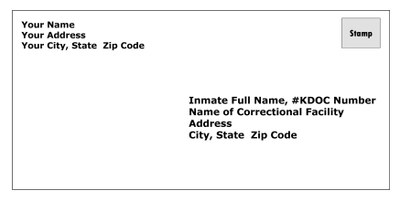
<p class="ARBodyText" style="padding-left: 30px; "><strong>Please remember to include the resident’s full name and KDOC number in the address with all correspondence or the mail will not be delivered. The envelope also must contain the sender’s full name and address as well or the letter will not be delivered. Please note that all mail is subject to search.  </strong></p>
<p style="padding-left: 30px; ">Example:</p>
<p class="ARBodyText" style="padding-left: 30px; "><span><span><span><img class="image-inline" src="../../images/KDOC%20Envelope.jpg/@@images/image/preview" /></span></span></span></p>
<p style="padding-left: 30px; ">For more information about resident mail, please review <a href="http://www.dc.state.ks.us/kdoc-policies/kar/Article12.pdf/">Kansas Administrative Regulation (K.A.R.) 44-12-601, Inmate Writing and Other Inmate Communications or Publications</a>. Also, <a href="http://www.dc.state.ks.us/kdoc-policies/impp/chapter-12/12120.pdf/">Internal Management Policy and Procedure (IMPP) 12-120 Secuirty and Control: Control of Inmate Personal Property</a> provides additional information.</p>
<p class="ARBodyText" style="text-align: center; "><span><span><span></span></span></span>___________________________________________________________________________</p>
<h3 class="ARBodyText"><span><span><span><br />Telephone and Emergencies<a name="Telephone and Emergencies"></a></span></span></span></h3>
<ul>
<li>
<div class="ARBodyText"><strong>Can an inmate make phone calls while in RDU?<br /></strong>Yes. residents are permitted telephone privileges to make collect/pre-paid calls shortly after the reception process begins. Residents cannot receive calls. Upon admission, the resident fills out a phone list of those numbers that the resident would like to call. The resident will update the phone list every 120 days thereafter. Every number that a resident requests be added to the call list will be contacted by staff, verified and asked if the person wants to be on the resident's call list. The numbers are then activated through the facility’s phone system in approximately one week. Residents may establish a telephone list of up to 20 individual phone numbers.</div>
</li>
</ul>
<p>If you need additional information on theresident telephone process including how to establish an account, please visit the <a class="internal-link" href="../inmate-communications/inmate-telephone">Resident Communications section </a>and/or review <a href="../../kdoc-policies/impp/chapter-10/10111.pdf/">Internal Management Policy and Procedure (IMPP) 10-111 Programs and Services: Inmate Access to Facility and Coinless Telephones</a>.  </p>
<ul>
<ul>
<li><strong>How can I reach a resident in an emergency?</strong><br />In the event of a verifiable emergency such as a serious illness or death in the family, you may call the facility. Callers must provide a call back number and their relation to the inmate. Staff will also need the nature of the emergency, the name of the person who is sick or has passed away, the person’s relation to the resident and the name and contact information for the hospital or funeral home.</li>
Before the message will be given to the resident, facility staff will contact the hospital or funeral home to verify the information that you have provided concerning the emergency. Once the message is verified, the resident will be notified. Staff may discuss options with you for notifying the resident including if you would like to tell the resident or if you prefer a chaplain or counselor relay the information. </ul>
</ul>
<p></p>
<p class="ARBodyText" style="text-align: center; "><span><span><span></span></span></span>___________________________________________________________________________</p>
<ul></ul>
<ul></ul>
<ul></ul>
<ul></ul>
<ul></ul>
<ul></ul>
<ul></ul>
<ul></ul>
<h3><br />Other General RDU Questions<a name="Other Questions"></a></h3>
<ul>
<li> <strong>How does the KDOC determine where a resident will be housed?</strong></li>
</ul>
<p class="ARBodyText" style="padding-left: 30px; ">When bed space and programming slots become available in coordination with medical consultation, a resident’s facility placement is determined. If an offender is a recent parolee or post-release violator and not a new commitment to the KDOC, theresident could be placed wherever space is available in the KDOC system based on an resident’s classification status.</p>
<ul>
<li><strong>How can an resident address his/her questions while in RDU?<br /></strong>A form, called a Form-9,  is available to the resident as a formal procedure to address any questions or concerns. After the form is completed, theresident must turn it in to the security staff. After receiving the Form-9, the staff will have 10 days to respond to the resident’s request. </li>
<li><strong>What medical/dental/mental health services are available at RDU?<br /></strong>Within the first three days at RDU, the resident will be assessed for medical needs. Within seven days of being newly admitted and within 30 days for parole violators, each resident receives a dental exam. If major dental work is required, this will be done once the resident is transferred out of RDU to a permanent facility. Mental health services also are available. </li>
</ul>
<p class="ARBodyText" style="text-align: center; "><span><span><span></span></span></span>___________________________________________________________________________</p>]]></content:encoded>
    <dc:publisher>No publisher</dc:publisher>
    <dc:creator>Nancy Burghart</dc:creator>
    <dc:rights></dc:rights>
    <dc:date>2014-01-08T22:10:00Z</dc:date>
    <dc:type>Page</dc:type>
  </item>


  <item rdf:about="https://www.doc.ks.gov/facilities/faq/faq">
    <title>Frequently Asked Questions</title>
    <link>https://www.doc.ks.gov/facilities/faq/faq</link>
    <description>FAQs for friends and family of inmates in the custody of the Kansas Department of Corrections</description>
    <content:encoded xmlns:content="http://purl.org/rss/1.0/modules/content/"><![CDATA[<ul class="buttonList" style="text-align: center; ">
<ul class="buttonList" style="text-align: center; ">
<li style="text-align: left; "></li>
<li style="text-align: left; "><b></b></li>
</ul>
</ul>
<p style="text-align: center; "><b><a class="internal-link internal" href="index"><br />Facilities</a>  </b>|  <b><a class="internal-link internal" href="inmate-communications">Resident Communications</a></b><b>  </b>| <b><a class="internal-link internal" href="inmate-banking">Resident Banking<br /></a></b><b><a class="internal-link internal" href="prea">PREA</a></b><b>  </b>|  <b><a class="internal-link internal" href="../publications/kdoc-facilities-management">Publications</a></b><b>  </b>|  <b><a class="internal internal-link" href="../canteen">Canteen</a> </b></p>
<p style="text-align: center; "></p>
<p><span style="text-align: justify; ">This section is designed to answer basic questions about the Kansas Department of Corrections (KDOC) and is prepared for informational purposes only. It serves as a general resource in understanding the rules, regulations and policies that govern Kansas state correctional facilities. Information provided here is subject to change and KDOC policies, procedures, regulations and general orders supersede the information provided here.</span></p>
<p class="indent" style="text-align: justify; ">If you have questions that are not covered, you may <a class="internal-link" href="../index">contact the correctional facility </a>directly.</p>
<p class="indent" style="text-align: left; padding-left: 90px; "><strong>CONTENTS:</strong></p>
<ol><ol><ol><ol><ol><ol>
<li style="text-align: right; ">
<div class="indent" style="text-align: left; "><strong><a class="internal-link" href="locating">Locating a resident</a></strong></div>
</li>
<li>
<div class="indent" style="text-align: left; "><strong><a class="internal-link" href="custody">Custody Classification</a></strong></div>
</li>
<li>
<div class="indent"><strong><a class="internal-link" href="incentive">Incentive Levels</a></strong></div>
</li>
<li>
<div class="indent"><strong><a class="internal-link" href="rdu">Admission: Reception &amp; Diagnostic Unit (RDU)</a></strong></div>
</li>
<li>
<div class="indent" style="text-align: left; "><strong><a class="internal-link" href="safe">Resident Safety</a></strong></div>
</li>
<li>
<div class="indent" style="text-align: left; "><strong><a class="internal-link" href="communication">Communication</a></strong></div>
</li>
<li>
<div class="indent" style="text-align: left; "><strong><a class="internal-link" href="banking">Resident Trust Accounts</a></strong></div>
</li>
<li>
<div class="indent" style="text-align: left; "><strong><a class="internal-link" href="contraband">Contraband</a></strong></div>
</li>
<li>
<div class="indent" style="text-align: left; "><strong><a class="internal-link" href="visits">Visiting</a></strong></div>
</li>
<li>
<div class="indent" style="text-align: left; "><strong><a class="internal-link" href="medical">Health</a></strong></div>
</li>
<li>
<div class="indent"><strong><a class="internal-link" href="dr">Disciplinary &amp; Grievance Procedures</a></strong></div>
</li>
<li>
<div class="indent"><strong><a class="internal-link" href="questions">General Questions</a></strong></div>
</li>
<li><a class="internal-link" href="../out-of-state-inmates"><strong>Out-of-State resident Information</strong></a></li>
</ol></ol></ol></ol></ol></ol>
<p></p>
<p class="indent" style="text-align: center; ">__________________________________________________________________</p>]]></content:encoded>
    <dc:publisher>No publisher</dc:publisher>
    <dc:creator>Nancy Burghart</dc:creator>
    <dc:rights></dc:rights>
    <dc:date>2014-01-08T22:10:00Z</dc:date>
    <dc:type>Page</dc:type>
  </item>


  <item rdf:about="https://www.doc.ks.gov/facilities/canteen/canteen">
    <title>Adult Correctional Facilities: Canteen</title>
    <link>https://www.doc.ks.gov/facilities/canteen/canteen</link>
    <description>Kansas Correctional Industries Commissary Menus</description>
    <content:encoded xmlns:content="http://purl.org/rss/1.0/modules/content/"><![CDATA[<p>  </p>
<p></p>
<ul class="buttonList" style="text-align: center; ">
<li><b></b></li>
<li><b></b></li>
<li><b></b></li>
<li><b><a class="internal-link internal" href="index">Facilities</a></b></li>
<li><b><a class="internal-link internal" href="inmate-communications">Inmate Communications</a></b></li>
<li><b><a class="internal-link internal" href="inmate-banking">Inmate Banking</a></b></li>
<li><b><a class="internal-link internal" href="prea">PREA Data</a></b></li>
<li><b><a class="internal-link internal" href="../publications/kdoc-facilities-management">Publications</a></b></li>
<li><b><a class="internal internal-link" href="canteen">Canteen Lists</a></b></li>
<li><b><a class="internal internal-link" href="faq">FAQs</a><br /><br /></b></li>
</ul>
<p></p>
<p></p>
<h2 style="text-align: center; "><strong><span class="st"></span></strong> <strong><span class="st">Commissary menus are provided for informational purposes only </span></strong></h2>
<p style="text-align: center; "><strong><span class="st">The items and prices listed here are <em>subject to change</em> without notice.<br /></span></strong></p>
<table class="plain" style="width: 515px;">
<thead></thead>
<tbody></tbody>
<tbody>
<tr>
<td colspan="2">
<h3 style="text-align: center; "><strong>Males</strong></h3>
<p style="text-align: center; "><em>(NOTE: Larned State Correctional Facility is listed separately. Click <strong><a class="anchor-link" href="#LCMHF List">here</a></strong>.)</em></p>
</td>
</tr>
<tr>
<td>
<ul>
<li><b><a class="internal-link" href="kdoc-male-canteen-october-2023">KDOC Male Cantee</a>n</b></li>
</ul>
</td>
</tr>
<tr>
<td>
<ul>
<li><strong><a class="internal-link" href="male-exempt-10.2023">Exempt Items</a> </strong>(Male)</li>
</ul>
</td>
</tr>
<tr>
<td>
<h3 style="text-align: center; "><strong>Females</strong></h3>
</td>
</tr>
<tr>
<td>
<ul>
<li><strong><a class="internal-link" href="tcf-menu-10.2023">Topeka Correctional Facility</a><a class="internal-link" href="commissary-menus/tcf"> </a></strong>(Female)</li>
</ul>
</td>
</tr>
<tr>
<td>
<h3 style="text-align: center; "><a name="LCMHF List"></a>Larned State Correctional Facility (LSCF)</h3>
</td>
</tr>
<tr>
<td>
<ul>
<li><strong><a class="internal-link" href="commissary-menus/lcmhf-general">LSCF General Population </a></strong>(Central Unit)</li>
<ul>
<li><em><span id="result_box"><a class="internal-link" href="commissary-menus/lcmhf-cgp-spanish">E<span class="hps">n español: Población General</span></a></span></em></li>
</ul>
</ul>
</td>
</tr>
<tr>
<td>
<ul>
<li><strong><a class="internal-link" href="commissary-menus/lcmhf-ad-seg">LSCF Administrative Segregation</a></strong></li>
<ul>
<li><em><span id="result_box"><span class="hps"><a class="internal-link" href="commissary-menus/lcmhf-adseg-spanish">En español: Segregación Administrativa</a></span></span></em></li>
</ul>
</ul>
</td>
</tr>
<tr>
<td>
<ul>
<li><strong><a class="internal-link" href="commissary-menus/lcmhf-disc-seg">LSCF Disciplinary Segregation</a></strong></li>
<ul>
<li><em><span id="result_box"><a class="internal-link" href="commissary-menus/lcmhf-dseg-spanish"><span class="hps">En español: </span><span class="hps">Segregación Disciplinaria</span></a></span></em></li>
</ul>
</ul>
</td>
</tr>
</tbody>
</table>
<p style="text-align: center; "> </p>]]></content:encoded>
    <dc:publisher>No publisher</dc:publisher>
    <dc:creator>Nancy Burghart</dc:creator>
    <dc:rights></dc:rights>
    <dc:date>2014-01-08T22:05:00Z</dc:date>
    <dc:type>Page</dc:type>
  </item>


  <item rdf:about="https://www.doc.ks.gov/facilities/lcf/programs/programs">
    <title>Programs</title>
    <link>https://www.doc.ks.gov/facilities/lcf/programs/programs</link>
    <description>The following are programs and services available at Lansing Correctional Facility: 

</description>
    <content:encoded xmlns:content="http://purl.org/rss/1.0/modules/content/"><![CDATA[<p><b><a class="external-link" href="http://www.kancorind.com/shop/">Kansas Correctional Industries</a></b></p>
<p><strong><a class="internal-link" href="private">Private Industries</a></strong></p>
<p><b>Life Skills Enhancement Program</b></p>
<ul>
<li>has two components: academic education and vocational training;</li>
<li>literacy and the General Equivalency Diploma (GED) programs are provided as well as vocational training programs such as commercial food service and welding; and,</li>
<li>includes the employability program, which provides guidance on seeking employment, and is provided to all residents enrolled in a program.</li>
 </ul>
<p><b>Therapeutic Community Program</b></p>
<ul>
<li>began in 1996 in the maximum-security unit under direction of the Douglas County Citizens Committee on Alcoholism (DCCCA) of Lawrence;</li>
<li>the program’s goal is to create a positive peer culture and facilitate overall lifestyle changes;</li>
<li>each resident in the program is expected to leave the primary treatment program having acquired basic recovery skills;</li>
<li>residents assigned to this program are in the therapeutic community 24 hours a day; and,</li>
<li>the resident will remain in the program for 9 - 12 months depending on the needs of each individual resident.</li>
 </ul>
<p><b>Sex Offenders Treatment Program (SOTP) Program</b></p>
<ul>
<li>treatment for the male sex offenders;</li>
<li>the program is 20 hours per week for 18 months and is contracted through DCCCA of Lawrence;</li>
<li>the program’s goal is to habilitate offenders toward emotional health and successful transition back into the community; and,</li>
<li>the program provides psycho-educational classes with group therapy and individual sessions.</li>
</ul>
<p><b><br />Vehicle Maintenance</b></p>
<ul>
<li>a staff of ten resident employees and two staff equipment mechanics oversee the care of more than 100 vehicles, and</li>
<li>maintenance includes everything from washing the vehicles to major overhauls and body work. Department employees are responsible for a large inventory of parts, supplies, and equipment.</li>
 </ul>
<p><b>Chaplaincy Department</b></p>
<ul>
<li>oversees coordinating resident religious support and coordinating volunteer services;</li>
<li>religious support is provided to a variety of faith groups which include many Christian denominations, Jewish, Islamic, Moorish Science, Native American, Bhuddist, Asatru, Thelemic and Wiccan faith groups;</li>
<li>coordinates special holiday events that support LCF residents and their families; and,</li>
<li>relies on a dedicated group of <a class="internal-link" href="../volunteers">volunteers to assist in addressing inmate religious and activities </a>needs.</li>
</ul>
<p> </p>
<p><b>Activities Support</b></p>
<ul>
<li>includes variety of resident activities including individual health and fitness activities, arts and crafts, music groups and resident self-improvement groups, and</li>
<li>normally led by volunteers from the greater Kansas City area, resident groups meet a diverse array of resident interests and needs, such as Alcoholics and Narcotics Anonymous, African Awareness, El Chicano (Hispanic awareness), Jaycees, Lifer's Club and several other organizations.</li>
</ul>
<p style="text-align: center; "><span class="internal"></span> </p>
<p style="text-align: center; "><span class="internal"><a class="internal-link" href="../volunteers/overview-1">Overview</a> </span>| <a class="internal-link" href="../volunteers/visit">Visitor Information<span class="internal"> </span></a>|<span class="internal"> <a class="internal-link" href="../volunteers/programs">Programs</a> </span>| <a class="internal-link" href="../volunteers/volunteers">Volunteers</a> | <a class="internal-link" href="../volunteers/history-1">History</a><span class="internal"> </span>| <a class="internal" href="warden"><span class="internal">Warden</span><br /></a>____________________________________________________________________________</p>]]></content:encoded>
    <dc:publisher>No publisher</dc:publisher>
    <dc:creator>Nancy Burghart</dc:creator>
    <dc:rights></dc:rights>
    <dc:date>2014-01-08T16:55:00Z</dc:date>
    <dc:type>Page</dc:type>
  </item>


  <item rdf:about="https://www.doc.ks.gov/facilities/ncf/visit/holiday">
    <title>Holiday Visitation</title>
    <link>https://www.doc.ks.gov/facilities/ncf/visit/holiday</link>
    <description>Information about visitation during holidays</description>
    <content:encoded xmlns:content="http://purl.org/rss/1.0/modules/content/"><![CDATA[<p>Inmate visitation at Kansas correctional facilities will be provided on the following four state holidays:  Christmas Day, Memorial Day, Fourth of July and Thanksgiving Day. If either Christmas Day or the Fourth of July holiday falls on a Saturday or a Sunday, or other day where a facility has regularly scheduled visitation, the holiday will be incorporated within the regular visitation schedule and an additional visitation day will NOT be scheduled.</p>
<p style="text-align: justify; ">Inmate visitation will NOT be provided on the following state holidays, unless the holiday falls on a Saturday or Sunday, or other day where the facility has regularly scheduled visitation:  New Year’s Day, Martin Luther King, Jr. Day, Labor Day, Veterans Day and the day after Thanksgiving.</p>
<p style="text-align: center; "><span class="internal"><a class="internal" href="overview">Overview</a> </span>| <a class="internal internal-link" href="visit">Visitor Information<span class="internal"> </span></a>|<span class="internal"> <a class="internal" href="programs-1">Programs</a> </span>| <a class="internal-link" href="../history"><span class="internal">History</span></a><span class="internal"> </span>| <a class="internal" href="warden"><span class="internal">Warden</span><br /></a>____________________________________________________________________________</p>]]></content:encoded>
    <dc:publisher>No publisher</dc:publisher>
    <dc:creator>cherylca</dc:creator>
    <dc:rights></dc:rights>
    <dc:date>2014-01-08T16:55:00Z</dc:date>
    <dc:type>Page</dc:type>
  </item>


  <item rdf:about="https://www.doc.ks.gov/facilities/lcmhf/visit/holiday-visitation">
    <title>Holiday Visitation</title>
    <link>https://www.doc.ks.gov/facilities/lcmhf/visit/holiday-visitation</link>
    <description>Information about visitation during holidays</description>
    <content:encoded xmlns:content="http://purl.org/rss/1.0/modules/content/"><![CDATA[<p>Inmate visitation at Kansas correctional facilities will be provided on the following four state holidays:  Christmas Day, Memorial Day, Fourth of July and Thanksgiving Day. If either Christmas Day or the Fourth of July holiday falls on a Saturday or a Sunday, or other day where a facility has regularly scheduled visitation, the holiday will be incorporated within the regular visitation schedule and an additional visitation day will NOT be scheduled.</p>
<p style="text-align: justify; ">Inmate visitation will NOT be provided on the following state holidays, unless the holiday falls on a Saturday or Sunday, or other day where the facility has regularly scheduled visitation:  New Year’s Day, Martin Luther King, Jr. Day, Labor Day, Veterans Day and the day after Thanksgiving.</p>
<p style="text-align: center; "><span class="internal"><a class="internal-link" href="../overview-1">Overview</a> </span>| <a class="internal" href="../../../undefined/facilities/lcmhf/visit">Visitor Information</a><span class="internal"> </span>|<span class="internal"> <a class="internal" href="../programs">Programs</a> </span>| <a class="internal" href="../history">History</a><span class="internal"> </span>| <span class="internal"><a class="internal" href="warden">Warden</a><br /></span>____________________________________________________________________________</p>]]></content:encoded>
    <dc:publisher>No publisher</dc:publisher>
    <dc:creator>cherylca</dc:creator>
    <dc:rights></dc:rights>
    <dc:date>2014-01-08T16:55:00Z</dc:date>
    <dc:type>Page</dc:type>
  </item>


</rdf:RDF>