<?xml version="1.0" encoding="utf-8" ?>
<rdf:RDF xmlns:rdf="http://www.w3.org/1999/02/22-rdf-syntax-ns#" xmlns:dc="http://purl.org/dc/elements/1.1/" xmlns:syn="http://purl.org/rss/1.0/modules/syndication/" xmlns="http://purl.org/rss/1.0/">


<channel rdf:about="https://www.doc.ks.gov/search_rss">
  <title>public</title>
  <link>https://www.doc.ks.gov</link>

  <description>
    
            These are the search results for the query, showing results 8 to 22.
        
  </description>


  <image rdf:resource="https://www.doc.ks.gov/logo.png"/>

  <items>
    <rdf:Seq>
      
        <rdf:li rdf:resource="https://www.doc.ks.gov/facilities/faq/visits"/>
      
      
        <rdf:li rdf:resource="https://www.doc.ks.gov/facilities/faq/rdu"/>
      
      
        <rdf:li rdf:resource="https://www.doc.ks.gov/facilities/edcf/programs"/>
      
      
        <rdf:li rdf:resource="https://www.doc.ks.gov/facilities/tcf/visit-1/handbook"/>
      
      
        <rdf:li rdf:resource="https://www.doc.ks.gov/newsroom/stories/pdfs/asca-assessment-of-topeka-correctional-facility"/>
      
      
        <rdf:li rdf:resource="https://www.doc.ks.gov/reentry/OWDS/intro"/>
      
      
        <rdf:li rdf:resource="https://www.doc.ks.gov/reentry/OWDS/curriculum-2012"/>
      
      
        <rdf:li rdf:resource="https://www.doc.ks.gov/facilities/wcf/visit/general-visiting-rules"/>
      
      
        <rdf:li rdf:resource="https://www.doc.ks.gov/publications/Reports/Archived/fy-2010-kdoc-annual-report"/>
      
      
        <rdf:li rdf:resource="https://www.doc.ks.gov/publications/CFS/community-corrections-publications/risk-reduction-initiative-report-sb14-archived/2008-risk-reduction-initiative-report-sb14"/>
      
      
        <rdf:li rdf:resource="https://www.doc.ks.gov/publications/CFS/community-corrections-publications/risk-reduction-initiative-report-sb14-archived/2009-risk-reduction-initiative-report-sb14"/>
      
      
        <rdf:li rdf:resource="https://www.doc.ks.gov/community-corrections/news/2009-risk-reduction-initiative-report-sb14"/>
      
      
        <rdf:li rdf:resource="https://www.doc.ks.gov/community-corrections/news/2008-risk-reduction-initiative-report-sb14"/>
      
      
        <rdf:li rdf:resource="https://www.doc.ks.gov/newsroom/releases/archive/2010-news-releases/Letter%20to%20Secretary%20Werholtz.pdf"/>
      
      
        <rdf:li rdf:resource="https://www.doc.ks.gov/newsroom/releases/archive/2010-news-releases/NIC%20Report.pdf"/>
      
    </rdf:Seq>
  </items>

</channel>


  <item rdf:about="https://www.doc.ks.gov/facilities/faq/visits">
    <title>Visiting</title>
    <link>https://www.doc.ks.gov/facilities/faq/visits</link>
    <description>In-Person Visitation Frequently Asked Questions
</description>
    <content:encoded xmlns:content="http://purl.org/rss/1.0/modules/content/"><![CDATA[<p class="indent" style="text-align: justify; ">Once a resident is eligible for visiting privileges, the resident is responsible for ensuring that his/her visitors receive the necessary paperwork to register as visitors. For more information, please review <span class="external"><a class="external-link" href="../../kdoc-policies/AdultIMPP/chapter-10/10-113d-eff-8-24-21.pdf">IMPP 10-113D: Offender Visitation</a></span>.</p>
<p class="ARBodyText">The resident obtains the request form from the unit counselor and mails it to those he/she wishes to place on his/her visiting list. The prospective visitor will need to complete the form and mail it back to the facility for review and approval. A criminal background check is completed on all visitors. The visiting rules are sent out with the request form.</p>
<p class="ARBodyText">Each resident may have a maximum of 20 visitors on his/her list.</p>
<p class="ARBodyText">No visitors will be allowed into a correctional facility until the application has been approved. </p>
<p><strong>How are visiting privileges determined?<br /></strong>Visitation privileges are determined by the incentive level assigned to each inmate in the following manner. Those inmates assigned to the following incentive levels are provided the following privileges:</p>
<ul>
<li>Intake Level: limited to visits from attorneys, clergy and law enforcement.</li>
<li>Level I: limited to visits from attorneys, clergy, law enforcement, a primary visitor and immediate family members.</li>
<li>Levels II &amp; III: allowed visits from any approved visitors.</li>
</ul>
<p><br />Immediate family members are defined as parents, step-parents, siblings, spouses of siblings, half-siblings, step-siblings, children, spouses of children, step-children, grandchildren, step-grandchildren, great grandchildren, great step-grandchildren, spouse, parents of spouse, grandparents, or any person who filled the role of a parent de facto with respect to the offender as confirmed by the warden/superintendent upon review of the social history.</p>
<p class="ARBodyText">residents, who are married by license or common law, must list their spouse as their primary visitor. Unmarried, residents may declare any person as their primary visitor as long as the person is at least 18 years of age and is not listed as the primary visitor for any other resident. residents may change their primary visitor every six months.</p>
<p class="ARBodyText">Approved lists are transferable to each facility and remain in effect unless revised by the resident or for administrative cause. Please review all visiting rules supplied by the facility prior to visiting.</p>
<p><strong>What are the visiting hours and rules?<br /></strong>After you have received notification that you have been approved as a visitor, please check with the correctional facility for visiting hours and specific visiting rules. </p>
<p><strong>Can children under 18 years of age visit an </strong>resident<strong>?<br /></strong>Minor children are permitted to visit if they are approved to be on the resident’s visitation list. The adult who brings the minor child must also be an approved visitor and be the child’s parent or legal guardian. Minor children may not be allowed to visit if the resident is being managed as a sex offender. </p>
<p><strong>Can I be on more than one </strong>resident<strong>’s visitation list?<br /></strong>Visitors may be on more than one resident’s visiting list if the visitor is an immediate family member to each resident. </p>
<p><strong>Why would my visiting privileges be suspended?<br /></strong>Visits may be denied, suspended or terminated by the shift supervisor on duty for:</p>
<ul>
<li>Visitor under the influence of drugs or alcohol</li>
<li>Insufficient space available</li>
<li>Refusal of visitor to submit to search per IMPP 12-115, “Search of Visitors”</li>
<li>Refusal or failure to provide sufficient identification or falsifying information</li>
<li>Violation of facility rules</li>
<li>Failure to properly supervise children</li>
<li>Excessive physical contact</li>
<li>Visitor or visitor’s child appears ill</li>
<li>Reasons necessary to preserve security of the facility and reasonable order in the visiting area</li>
</ul>
<p class="ARBodyText">Please note: visitors can be searched to prevent the introduction of any item considered to be contraband if taken into or from a facility. This includes cell phones and all tobacco and tobacco-related items.</p>
<p><strong>What if I am a victim of the </strong>resident<strong> but I would like to visit the </strong>resident<strong>?<br /></strong>This does not mean that you will not be allowed to visit. If you are a victim of the resident, you must indicate this on your visiting application. The Office of Victim Services (OVS) will contact you for more information. If you have questions about this process, please call OVS toll free at (866) 404-6732. </p>
<p><strong>How do I remove my name from a visitor’s list?<br /></strong>Send a letter with your request for removal, include the resident’s name and KDOC number, to the Visitation Clerk at the correctional facility. For mailing address, visit the <a class="internal-link" href="../index">facility index page</a>. Visitors removed from a list by their own request or by the resident’s request may not re-apply for visitation for a minimum of 180 days. </p>
<p><strong>What if I’m traveling from out of state to visit but I am not on the list?<br /></strong>Under certain circumstances, the Warden or his designee may authorize a special visit. Requests for special visits are initiated by the resident through the resident's unit team via the Form-9. Circumstances under which special visits may be granted include, but are not limited to:</p>
<ul>
<li>Requests for a single visit prior to background verification and approval of subsequent visits;</li>
<li>The visitor has traveled a distance of 150 miles (one way) or more; or,</li>
<li>The visit is in the best interest of the resident's rehabilitative needs or other correctional goals.</li>
 </ul>
<p><strong> What kind of identification should I bring with me during my visit?<br /></strong>Visitors must properly identify themselves with picture identification issued by a government agency, such as a driver's license or a state identification card. A copy of an official state-issued birth certificate is acceptable for persons under the age of 16 who cannot produce photo identification. </p>
<p>Non-U.S. citizens who do not have a United States or state government agency picture ID will be required to show a valid passport or visa.<b> </b><b></b></p>
<p><strong>Are </strong>resident<strong>s permitted furloughs for funeral/bedside visits?<br /></strong>No. </p>
<p><strong>Is physical contact allowed during a visit?<br /></strong>Contact during visits is limited to a brief embrace or kiss at the beginning and end of the visit. Hand holding is not allowed. Please see <a class="internal-link" href="../../kdoc-policies/AdultIMPP/chapter-10/10-113d-eff-8-24-21.pdf">IMPP 10-113</a> for additional information. </p>
<p style="text-align: center; "><a class="internal-link" href="../../kdoc-policies/AdultIMPP/chapter-10/10-113d-eff-8-24-21.pdf">______________</a>______________________________________________________________</p>
<p style="text-align: center; "></p>
<p style="text-align: left; "><a class="internal-link" href="Visitation_KDOC_ICS20210329.pdf">ICS Solutions Visitation Information</a></p>
<p style="text-align: left; "><a class="internal-link" href="Visitation_Family_ICS20210329.pdf">ICS Solutions Instruction Guide</a></p>]]></content:encoded>
    <dc:publisher>No publisher</dc:publisher>
    <dc:creator>Carol Pitts</dc:creator>
    <dc:rights></dc:rights>
    <dc:date>2014-01-08T22:10:00Z</dc:date>
    <dc:type>Page</dc:type>
  </item>


  <item rdf:about="https://www.doc.ks.gov/facilities/faq/rdu">
    <title>Admission RDU</title>
    <link>https://www.doc.ks.gov/facilities/faq/rdu</link>
    <description>What is RDU?</description>
    <content:encoded xmlns:content="http://purl.org/rss/1.0/modules/content/"><![CDATA[<h2></h2>
<h2>Overview<a name="Overview"></a></h2>
<p class="ARBodyText">Upon admission, all residents are photographed, fingerprinted and placed in the Reception &amp; Diagnostic Unit (RDU). All residents are assigned to the intake level upon admission.</p>
<p class="ARBodyText">Male residents are initially housed at El Dorado Correctional Facility’s (EDCF) RDU. All female residents are housed at Topeka Correctional Facility (TCF) where the intake process occurs for females.</p>
<p class="ARBodyText">Residents are searched, showered and provided with a health evaluation. The resident's property will be inventoried and either issued to the resident or returned with officers transporting the resident to KDOC custody. Residents complete the RDU process in approximately two weeks though this time may vary. A permanent facility placement  for male residents may take up to two months. The initial classification process includes several tests, an interview and an evaluation of court documents and other information including physical, family and criminal history.</p>
<p class="ARBodyText">The process will determine the resident’s:</p>
<ul>
<li>Custody level</li>
<li>Service needs</li>
<li>Program needs including education</li>
<li>Facility placement.</li>
</ul>
<p><br />Residents also will undergo orientation. The resident will be provided with information about KDOC rules and regulations, behavioral expectations and the disciplinary process. Residents also are advised as to how to access medical, mental health, religious and educational services and programs. A staff member also will work with the resident on establishing a visiting and telephone list to communicate with family and friends.</p>
<p class="ARBodyText" style="text-align: center; "><span><span><span></span></span></span>___________________________________________________________________________ </p>
<ul>
<ul>
<ul>
<ul>
<ul>
<ul>
<ul>
<ul>
<ul>
<ul>
<li style="text-align: left; "><strong><a class="anchor-link" href="#Admission Property">Admission Property</a></strong></li>
<li style="text-align: left; "><strong><a class="anchor-link" href="#Visiting and Mail">Visiting &amp; Mail</a></strong></li>
<li style="text-align: left; "><strong><a class="anchor-link" href="#Telephone and Emergencies">Telephone &amp; Emergencies</a></strong></li>
<li style="text-align: left; "><a class="anchor-link" href="#Other Questions"><strong>Other General RDU Questions</strong><br /></a></li>
</ul>
</ul>
</ul>
</ul>
</ul>
</ul>
</ul>
</ul>
</ul>
</ul>
<p class="ARBodyText" style="text-align: center; "><span><span><span></span></span></span>_________________________________________________________________________</p>
<h3><strong><br />Admission Property:</strong> <a class="external-link" href="../../kdoc-policies/AdultIMPP/chapter-12/12120.pdf">Attachment H, IMPP 12-120</a><a name="Admission Property"></a></h3>
<p class="ARBodyText">Upon admission to the KDOC, residents are assigned to Intake Level. <a class="external" href="../../kdoc-policies/AdultIMPP/chapter-12/12120.pdf">Attachment H, IMPP 12-120</a> lists what items may be retained by resident when they are taken in to the custody of the KDOC. All other items are considered contraband.</p>
<p class="ARBodyText">Items not allowed by the KDOC will be subject to the policies and procedures of the facility from where the resident was held prior to KDOC custody, per IMPP 12-120, Security and Control: Control of Inmate Personal Property.</p>
<ul>
<li>
<div class="ARBodyText"><strong>What items are issued to an resident in RDU?</strong><br />Each inmate is provided with clean, durable and presentable clothing of the proper size that is suitable to climatic conditions, and basic hygiene items and shower shoes. Each resident also receives four pre-paid envelopes in their intake package. </div>
</li>
<li>
<div class="ARBodyText"><strong>What happens to the money that an inmate brings with him/her to RDU?</strong><br />If an inmate is in possession of any money, the funds will be placed in the inmate’s trust fund account. More information about sending money to an inmate can be found in the <a class="internal-link" href="../inmate-banking">Inmate Banking Section</a>. </div>
</li>
</ul>
<p class="ARBodyText" style="text-align: center; "><span><span><span></span></span></span>___________________________________________________________________________</p>
<h3 class="ARBodyText"><br />Visiting and Mail<a name="Visiting and Mail"></a> </h3>
<ul>
<ul>
<li>
<div class="ARBodyText"><strong>Can family members visit a resident in RDU?<br /></strong>No. All residents in the RDU process are at the Intake Level and have not yet earned visiting privileges. Visits are limited to attorneys, clergy and law enforcement until the resident earns a promotion to Incentive Level 1. While in RDU, a resident fills out a visitation form with the names he/she would like to be granted permission for visits when the resident has moved to the next incentive level. The resident is responsible for ensuring potential visitors receive visiting applications that must be approved before visitors will be allowed in to a correctional facility. The list will be valid for 45 days after leaving RDU. More information about the application process is available in the <a class="internal-link" href="visits">FAQs visiting section</a>.</div>
</li>
</ul>
</ul>
<div></div>
<div class="ARBodyText">
<ul>
<ul>
<li><strong>Can a resident send/receive mail while in RDU?<br /></strong><span>Yes. </span><span>You may send letters to a resident in the RDU; however, packages are not allowed</span><span>. Residents receive four pre-paid envelopes in their intake package. </span><span>Residents may not receive stamps through the mail.</span><span> </span><span>Stamps, envelopes and paper can be purchased through the facility’s canteen, a </span><span>store through which residents are provided an opportunity to purchase allowable items.</span></li>
</ul>
</ul>
<span><br />To contact a male resident in the RDU, you may write to him at the following address until his approved phone list is activated:<br /></span><span> </span></div>
<p class="ARBodyText" style="padding-left: 60px; "><span>Resident’s Full Name,  KDOC# </span><span>XXXXX<br /></span><span>El Dorado Correctional Facility<br /></span><span>P.O. Box 311<br /></span><span>El Dorado, KS 67042</span><span> </span></p>
<p class="ARBodyText" style="padding-left: 30px; "><span></span><span>Female inmates may receive mail at:</span><span> </span></p>
<p class="ARBodyText" style="padding-left: 60px; "><span>Resident’s Full Name,  KDOC# </span><span>XXXXX<br /></span><span>Topeka Correctional Facility<br /></span><span>815 S.E. Rice Road<br /></span><span>Topeka, KS 66607</span></p>
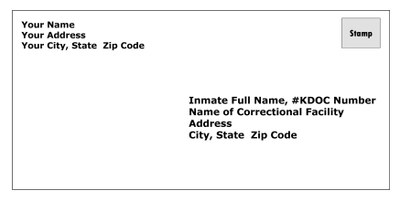
<p class="ARBodyText" style="padding-left: 30px; "><strong>Please remember to include the resident’s full name and KDOC number in the address with all correspondence or the mail will not be delivered. The envelope also must contain the sender’s full name and address as well or the letter will not be delivered. Please note that all mail is subject to search.  </strong></p>
<p style="padding-left: 30px; ">Example:</p>
<p class="ARBodyText" style="padding-left: 30px; "><span><span><span><img class="image-inline" src="../../images/KDOC%20Envelope.jpg/@@images/image/preview" /></span></span></span></p>
<p style="padding-left: 30px; ">For more information about resident mail, please review <a href="http://www.dc.state.ks.us/kdoc-policies/kar/Article12.pdf/">Kansas Administrative Regulation (K.A.R.) 44-12-601, Inmate Writing and Other Inmate Communications or Publications</a>. Also, <a href="http://www.dc.state.ks.us/kdoc-policies/impp/chapter-12/12120.pdf/">Internal Management Policy and Procedure (IMPP) 12-120 Secuirty and Control: Control of Inmate Personal Property</a> provides additional information.</p>
<p class="ARBodyText" style="text-align: center; "><span><span><span></span></span></span>___________________________________________________________________________</p>
<h3 class="ARBodyText"><span><span><span><br />Telephone and Emergencies<a name="Telephone and Emergencies"></a></span></span></span></h3>
<ul>
<li>
<div class="ARBodyText"><strong>Can an inmate make phone calls while in RDU?<br /></strong>Yes. residents are permitted telephone privileges to make collect/pre-paid calls shortly after the reception process begins. Residents cannot receive calls. Upon admission, the resident fills out a phone list of those numbers that the resident would like to call. The resident will update the phone list every 120 days thereafter. Every number that a resident requests be added to the call list will be contacted by staff, verified and asked if the person wants to be on the resident's call list. The numbers are then activated through the facility’s phone system in approximately one week. Residents may establish a telephone list of up to 20 individual phone numbers.</div>
</li>
</ul>
<p>If you need additional information on theresident telephone process including how to establish an account, please visit the <a class="internal-link" href="../inmate-communications/inmate-telephone">Resident Communications section </a>and/or review <a href="../../kdoc-policies/impp/chapter-10/10111.pdf/">Internal Management Policy and Procedure (IMPP) 10-111 Programs and Services: Inmate Access to Facility and Coinless Telephones</a>.  </p>
<ul>
<ul>
<li><strong>How can I reach a resident in an emergency?</strong><br />In the event of a verifiable emergency such as a serious illness or death in the family, you may call the facility. Callers must provide a call back number and their relation to the inmate. Staff will also need the nature of the emergency, the name of the person who is sick or has passed away, the person’s relation to the resident and the name and contact information for the hospital or funeral home.</li>
Before the message will be given to the resident, facility staff will contact the hospital or funeral home to verify the information that you have provided concerning the emergency. Once the message is verified, the resident will be notified. Staff may discuss options with you for notifying the resident including if you would like to tell the resident or if you prefer a chaplain or counselor relay the information. </ul>
</ul>
<p></p>
<p class="ARBodyText" style="text-align: center; "><span><span><span></span></span></span>___________________________________________________________________________</p>
<ul></ul>
<ul></ul>
<ul></ul>
<ul></ul>
<ul></ul>
<ul></ul>
<ul></ul>
<ul></ul>
<h3><br />Other General RDU Questions<a name="Other Questions"></a></h3>
<ul>
<li> <strong>How does the KDOC determine where a resident will be housed?</strong></li>
</ul>
<p class="ARBodyText" style="padding-left: 30px; ">When bed space and programming slots become available in coordination with medical consultation, a resident’s facility placement is determined. If an offender is a recent parolee or post-release violator and not a new commitment to the KDOC, theresident could be placed wherever space is available in the KDOC system based on an resident’s classification status.</p>
<ul>
<li><strong>How can an resident address his/her questions while in RDU?<br /></strong>A form, called a Form-9,  is available to the resident as a formal procedure to address any questions or concerns. After the form is completed, theresident must turn it in to the security staff. After receiving the Form-9, the staff will have 10 days to respond to the resident’s request. </li>
<li><strong>What medical/dental/mental health services are available at RDU?<br /></strong>Within the first three days at RDU, the resident will be assessed for medical needs. Within seven days of being newly admitted and within 30 days for parole violators, each resident receives a dental exam. If major dental work is required, this will be done once the resident is transferred out of RDU to a permanent facility. Mental health services also are available. </li>
</ul>
<p class="ARBodyText" style="text-align: center; "><span><span><span></span></span></span>___________________________________________________________________________</p>]]></content:encoded>
    <dc:publisher>No publisher</dc:publisher>
    <dc:creator>Nancy Burghart</dc:creator>
    <dc:rights></dc:rights>
    <dc:date>2014-01-08T22:10:00Z</dc:date>
    <dc:type>Page</dc:type>
  </item>


  <item rdf:about="https://www.doc.ks.gov/facilities/edcf/programs">
    <title>Programs</title>
    <link>https://www.doc.ks.gov/facilities/edcf/programs</link>
    <description>The following are programs and services available at El Dorado Correctional Facility: 
</description>
    <content:encoded xmlns:content="http://purl.org/rss/1.0/modules/content/"><![CDATA[<p>The programs division provides oversight for risk reduction, reentry and case management initiatives at EDCF. The division ensures effective programming is offered to provide rehabilitative treatment to assist inmates for return to society. These programs include academic and vocational education, cognitive skills, self-help groups and mental health services. Programs to enhance work ethics, relapse prevention and goal setting are also available. </p>
<p style="text-align: justify; ">Within the program division, unit teams manage the inmate population assigned to each housing unit. A unit team manager is responsible for the day-to-day operation of the housing unit. Uniformed staff and corrections counselors are also part of each unit team. The unit team's purpose is to decentralize programs and operations to provide more individual attention to the inmate population and to respond to the needs of individual inmates. </p>
<p style="text-align: justify; ">An individualized treatment program is developed, implemented and maintained for each inmate by unit team staff. The unit teams provide services to inmates in the form of work assignments, progress reviews, attitudinal and adjustment counseling, release counseling and other matters. For unit teams, release planning for all inmates is vital to an inmate’s successful transition into society. An inmate employment assessment and job assignment program is utilized to ensure inmates are assigned jobs commensurate with their technical skills. Inmates are also assigned to work crews to obtain on-the-job training which allows them to develop work skills and assist them with reintegration into society. The records office is responsible for providing clerical support for the unit teams and for updating records of inmates received, processed and transferred into and from EDCF.</p>
<p style="text-align: justify; ">Contract services, including medical, mental health and education programs are also overseen by the deputy warden of programs.</p>
<p style="text-align: justify; "><strong>NON-CONTRACTED PROGRAMS </strong></p>
<p style="text-align: justify; "><strong>Facility/Parole Interaction</strong><b><br /></b>Facility/parole interaction meetings convene on a monthly basis for parole and facility staff to make presentations to inmates who will be releasing in 30 to 60 days. Discussions occur surrounding the 12 standard conditions of parole to dispel common myths and beliefs about post release supervision. In Phase 2, conference calls occur between inmates, facility staff (IPO, Unit Manager, Counselor, Release Planner, etc.) inmate family members or home plan sponsor and other appropriate participants.</p>
<p style="text-align: justify; "><strong>SKIP </strong><b><br /></b>The Kansas Strengthening Kids of Incarcerated Parents (KS-SKIP) program is a model program designed to connect incarcerated parents to their children prior to release from prison. The initial phase of the KS-SKIP program is a 13-week parenting class that focuses on increasing the father's understanding of their role as a parent, in spite of incarceration. The goal is to strengthen the father-child relationship prior to release and to prepare fathers to reconnect with their child/children. The second phase is Play and Learn groups. The groups are mobile preschool environments where parents and children gather to play and learn together under the supervision of trained facilitators. Each week for 8-12 weeks, fathers turn an adult space into a playgroup environment for their children. When children arrive at the facility, fathers become the primary caregiver for that hour and a half session. The program's third phase includes support to the caregivers. Concurrent to the Play and Learn group, a support group is offered for the caregivers of the children.</p>
<p style="text-align: justify; "><strong>FLIP </strong><b><br /></b>Directed at segregation inmates, FLIP (Fundamental Lessons in Psychology) consists of various psychological topics including: anger management, anxiety, assertiveness, cognitive self-change, depression, general mental health, grief, loss and forgiveness, men’s issues/adjustment and self-esteem. </p>
<p style="text-align: justify; "><strong>Chaplaincy</strong><b><br /></b>EDCF has two full time chaplains who facilitate, coordinate, and oversee religious programs for the Central Unit. There are over 24 different groups facilitated by the Chaplain's office including Alcoholics and Narcotics Anonymous, Asatru, Assembly of Yahweh, Buddhist, Church of Christ Study, House of Yahweh, Innerchange, Islamic Study, Jehovah's Witnessess, Jewish Study, Latter Day Saints, Mennonite Study, Moorish Science Temple, Native Americans, Pentecostal Worship, Non-Catholic Christian Study, Sunday Services, Rastafarian, Roman Catholic Study/Mass, Seventh Day Adventists, Spanish Speaking Bible Study and Wicca.  The Chaplain's office provides greeting cards and reading materials to inmates as they are provided by donations.  This office also provides premarital counseling, grief counseling, memorial services and emergency notification for families of inmates.  Additionally, counseling is provided for inmates with families, and counseling and assistance is provided to staff as needed and requested.  The chaplains coordinate volunteer services for approximately 250 volunteers, provide training to both volunteers and facility staff, work with local community leaders and clergy and lead worship services for inmates.</p>
<p style="text-align: justify; "><strong>Spritual Life Center<br /></strong>Opened in June 2010, the Spiritual Life Center is an 11,500 sq. foot structure designed to support the spiritual needs of inmates. Constructed primarily through the efforts of inmate labor, volunteers, and facility staff, project funding, furnishings, and equipment have come exclusively from donations received from individuals, corporations and foundation grants. The Spiritual Life Center provides space to an increased number of inmates to attend religious services along with housing support groups such as AA and Life Skills training.  The building contains a large chapel area, a multi-purpose room, five classrooms, a library, two chaplain's offices and a conference room.  </p>
<p style="text-align: justify; "><strong>Transitional Segregation Program (Segregation to Society (STS)) <br /></strong>Aimed at long-term segregation inmates who have 12 to 16 months until release, the program provides a number of tools necessary for the transition to the community. Inmates in this setting have been more restricted in their movement and access to others and have not been able to attend release and re-entry classes. In-cell assignments are conducted through handouts, workbooks, manuals, etc. Instruction is provided directly to inmates by trained staff.<strong> </strong></p>
<p style="text-align: justify; "><strong>Behavior Modification Program (BMP)</strong><b><br /></b>The BMP is a program designed to deal with transitioning segregation inmates in a stratified behavior modification program based on increased steps of privileges for demonstrated appropriate behavior and program compliance. The nine-month, cognitive-based program integrates inmates in a 3-step process that includes portions of Thinking for a Change, Motivation for Change, PAD (Positive Attitude Development), and Anger Management programs.</p>
<ul>
<li>
<div style="text-align: justify; "><span>Step 1: C</span>onsists of the Positive Attitude Development program (9 weeks) and the Positive Communication Development (3 weeks).</div>
</li>
<li>
<div style="text-align: justify; "><span>Step 2: Consists of the </span>Positive Communication Development (12 weeks) and the Self Actualization program (12 weeks).</div>
</li>
<li>
<div style="text-align: justify; "><span>Step 3:</span> Consists of inmates participating in at least two general population groups per week. The programs are Road to Recovery, Life Skills, FLIP: Fundamental Lessons in Psychology, Meditation, Crochet and Communication.</div>
</li>
</ul>
<p style="text-align: justify; ">Added to the program is an additional three months of monitoring under intensive supervision. </p>
<p style="text-align: justify; "><strong>Offender Workforce Development (OWDS)</strong><b><br /></b>OWDS works with inmates to address internal and external barriers and assesses individual interests and skills in preparation for job readiness. OWDS assists with developing such job search skills as developing a resume, completing an application, conducting a job search, honing interview skills and discussing how to address the inmate's felony conviction.</p>
<p style="text-align: center; "><span class="internal"><a class="internal" href="overview">Overview</a> </span>| <a class="internal" href="visit">Visitor Information</a><span class="internal"> </span>|<span class="internal"> <a class="internal-link" href="programs">Programs</a> </span>| <a class="internal" href="history">History</a><span class="internal"> </span>|  <a class="internal" href="warden"><span class="internal">Warden</span><span class="internal"></span></a><a class="internal" href="visit/holiday"><br /></a>____________________________________________________________________________</p>]]></content:encoded>
    <dc:publisher>No publisher</dc:publisher>
    <dc:creator>cherylca</dc:creator>
    <dc:rights></dc:rights>
    <dc:date>2013-12-03T16:25:00Z</dc:date>
    <dc:type>Page</dc:type>
  </item>


  <item rdf:about="https://www.doc.ks.gov/facilities/tcf/visit-1/handbook">
    <title>Visitor Handbook</title>
    <link>https://www.doc.ks.gov/facilities/tcf/visit-1/handbook</link>
    <description>Information for visitors</description>
    
    <dc:publisher>No publisher</dc:publisher>
    <dc:creator>cherylca</dc:creator>
    <dc:rights></dc:rights>
    <dc:date>2013-12-02T16:40:00Z</dc:date>
    <dc:type>File</dc:type>
  </item>


  <item rdf:about="https://www.doc.ks.gov/newsroom/stories/pdfs/asca-assessment-of-topeka-correctional-facility">
    <title>ASCA Assessment of Topeka Correctional Facility </title>
    <link>https://www.doc.ks.gov/newsroom/stories/pdfs/asca-assessment-of-topeka-correctional-facility</link>
    <description>ASCA Assessment of Topeka Correctional Facility </description>
    
    <dc:publisher>No publisher</dc:publisher>
    <dc:creator>cherylca</dc:creator>
    <dc:rights></dc:rights>
    <dc:date>2013-04-12T20:01:00Z</dc:date>
    <dc:type>File</dc:type>
  </item>


  <item rdf:about="https://www.doc.ks.gov/reentry/OWDS/intro">
    <title>OWDS Introduction Module </title>
    <link>https://www.doc.ks.gov/reentry/OWDS/intro</link>
    <description>Here is a pdf copy of the Introduction Module.  This module contains information about this course. </description>
    
    <dc:publisher>No publisher</dc:publisher>
    <dc:creator>Zachary Burgoon</dc:creator>
    <dc:rights></dc:rights>
    <dc:date>2013-02-11T13:50:00Z</dc:date>
    <dc:type>File</dc:type>
  </item>


  <item rdf:about="https://www.doc.ks.gov/reentry/OWDS/curriculum-2012">
    <title>OWDS Curriculum (1/17/2012)</title>
    <link>https://www.doc.ks.gov/reentry/OWDS/curriculum-2012</link>
    <description>This is the curriculum used in the Offender Workforce Development groups.</description>
    
    <dc:publisher>No publisher</dc:publisher>
    <dc:creator>Zachary Burgoon</dc:creator>
    <dc:rights></dc:rights>
    <dc:date>2012-08-08T19:15:49Z</dc:date>
    <dc:type>File</dc:type>
  </item>


  <item rdf:about="https://www.doc.ks.gov/facilities/wcf/visit/general-visiting-rules">
    <title>Visiting - General Rules</title>
    <link>https://www.doc.ks.gov/facilities/wcf/visit/general-visiting-rules</link>
    <description></description>
    <content:encoded xmlns:content="http://purl.org/rss/1.0/modules/content/"><![CDATA[<h2><b><span>CONTRABAND NOTICE</span></b></h2>
<h3>Persons entering facility grounds are subject to search for contraband in accordance with applicable statutes.</h3>
<p><b><br />KSA 21-5914. Traffic in contraband in a correctional institution.</b></p>
<p style="text-align: justify; ">(a) Traffic in contraband in a correctional institution is introducing or attempting to introduce into or upon the grounds of any correctional institution or taking, sending, attempting to take or attempting to send from any correctional institution or any unauthorized possession while in any correctional institution or distributing within any correctional institution, any item without the consent of the administrator of the correctional institution.</p>
<p style="text-align: justify; ">(c) (1) Traffic in contraband in a correctional institution of firearms, ammunition, explosives or a controlled substance which is defined in KSA 2009 Supp 21-36.01 and amendments thereto, is a severity level 5, non-person felony.</p>
<p style="text-align: justify; ">(2) Traffic in any contraband, as defined by rules and regulations adopted by the secretary, in a correctional institution by an employee of a correctional institution is a severity level 5, non-person felony.<b></b></p>
<p style="text-align: justify; ">Tobacco, tobacco products (such as lighters, chewing tobacco, etc.), cell phones, pagers, cameras, etc., are considered contraband and must be secured in vehicles. <b>Visitors who bring these items into the visiting building will be denied a visit for that visiting period.</b></p>
<h2><b>Facility Location</b></h2>
<p style="text-align: justify; ">The facility is located on the north end of Winfield. From 9<sup>th</sup> and Main streets, travel east to College Street then turn north. At the Veteran’s Cemetery, turn east. Stay to the left around the cemetery.  At the top of the hill, where the flags are located, keep to the left. Travel past the Administration Building and park on the north side of that building in the visitor parking area. The visiting center is located on the first floor of Fern Building. </p>
<ul style="text-align: justify; ">
<ul>
<li>The facility address is: WCF, 1806 Pinecrest Circle, Winfield, KS. 67156.</li>
<li>The facility telephone number is (620) 221-6660.</li>
</ul>
</ul>
<p style="text-align: justify; "><br />For directions, follow this link to Map Quest, where you can type in your address and the facility's address for detailed driving and distance information: <a href="http://www.mapquest.com/">http://www.mapquest.com</a></p>
<p style="text-align: center; "><img class="image-inline" src="../images/WCFinWinfield.gif/@@images/image/preview" /></p>
<h2><b>Public Transportation</b></h2>
<p style="text-align: justify; ">There is no dependable public transportation service such as a taxi cab or bus system in the Winfield area.</p>
<p style="text-align: justify; ">All WCF visitors are advised to pre-arrange transportation to and from the facility grounds. There is no waiting area for persons providing transportation. All vehicles are to be secured while on facility grounds. Anyone who is not visiting is required to exit facility grounds. Upon conclusion of the visiting period, visitors will be asked to depart the facility grounds. Please ensure transportation arrangements are made accordingly.</p>
<h2 style="text-align: justify; "><strong>Entering Facility Grounds for Visitation</strong></h2>
<p style="text-align: justify; ">Visitors park their vehicle in visitor's parking area located northeast of the visiting area. Please lock all vehicle doors and proceed to the visitors center in Fern Building. Visitors receive additional instructions for check in procedures at that location.<b></b></p>
<h2 style="text-align: justify; "><b>Handicap Assistance</b></h2>
<p style="text-align: justify; ">Visitors who are handicapped and need assistance with a wheelchair, walker, etc., should have someone with them notify the visiting officer who will ensure that proper assistance is obtained. If the visitor is alone, the visitor should notify the patrol officer.</p>
<h2 style="text-align: justify; "><b>Check-in Process</b></h2>
<p style="text-align: justify; ">Visitors must arrive on WCF property no earlier than 15 minutes before scheduled visiting hours begin and must check in to the visiting center no later than 60 minutes before visiting hours end.</p>
<p style="text-align: justify; ">Please enter through the south door of Fern Building.</p>
<p style="text-align: center; "><img class="image-inline" src="../images/fern-building/@@images/image/preview" /></p>
<h3 style="text-align: justify; "><b>All visitors must produce valid picture identification</b></h3>
<p style="text-align: justify; ">All visitors must produce a valid picture I.D. Picture Identification may include a driver’s license, passport or other form of government I.D. Children under the age of 18 may utilize an official birth certificate issued by the department of vital statistics from the state they were born as proof of identification. <b>Visitors without proper </b><b>identification will not be allowed to visit.</b></p>
<p style="text-align: justify; ">Upon approval of the visit, visitors are required to secure their coat and other personal belongings.</p>
<ul style="text-align: justify; ">
<li>Hats, coats, jackets, shawls, wraps, etc., must be hung on the coat rack.</li>
<li>Purses, bags and other loose property must be secured in provided lockers.</li>
<li>Visitors are not allowed to remove items from lockers after securing their personal belongings until they have completed the visit. </li>
<li>Visitors are permitted to retain a maximum of $30 in change and bills for vending machines. <b>Tokens are not utilized at WCF. </b></li>
<li>All items purchased from vending machines must be consumed during the visit or disposed of at the conclusion of the visit.</li>
<li>Food removed from the visiting area will not be allowed back into the visiting area at a later time.</li>
<li>Visitors are required to submit to a search of their person and property.</li>
<li>Visitors must first clear a walk-through metal detector in three attempts. </li>
<li>If unable to do so, a handheld wand will be used, which must be cleared.</li>
<li>Visitors with non-removable medical devices must provide documentation from a physician and such documentation will be made a part of their visiting record.   </li>
<li>Failure to clear search process will result in denial of visiting privileges for that session.</li>
<li>Visitors may be required to submit to more intrusive searches if they are suspected of trafficking contraband into the facility.  <strong>Refusal to submit to any search may result in a suspension of visiting privileges for up to a year. </strong></li>
</ul>
<ul style="text-align: justify; ">
<li>Visiting registration must be completed and personal items secured before the offender will be called to visit<em>.</em></li>
</ul>
<p style="text-align: justify; "></p>
<p class="callout" style="text-align: justify; "><span class="discreet"><strong>Any person refusing to comply with any part of the check-in process and/or any person making a disturbance during check-in, will be subject to the suspension of visiting privileges pursuant to KAR 44-7-104. </strong></span></p>
<h2 style="text-align: justify; "><strong>Who May Visit?</strong></h2>
<p style="text-align: justify; ">Relatives and friends on a resident's approved visiting list may visit in accordance with the following:</p>
<ul style="text-align: justify; ">
<li>No one under the age of 18 is permitted to visit unless this person is a member of the resident's immediate family.</li>
 </ul>
<p class="visualClear" style="text-align: justify; "><span class="visualHighlight"><strong>Immediate Family</strong> is defined as: parents, step-parents, siblings, spouses of siblings, half siblings, step-siblings, children, spouses of children, step-children, grandchildren, step-grandchildren, spouse, parents of spouse, grandparents or any person filled the role of parents de facto with respect to the inmate as confirmed by the Warden or designee upon review of the social history. </span><span class="visualHighlight">Nieces, nephews, aunts or uncles are not considered immediate family.</span></p>
<ul style="text-align: justify; ">
<li>Level I residents and residents on restriction may only visit with immediate family and the person approved as a primary visitor.</li>
<li>Those under 18 who are immediate family members to the resident shall be accompanied by parent or legal guardian.  (Other than the resident)<span> </span></li>
<li>If the parent or legal guardian of a minor child/children is not able to accompany the minor child, he/she will be required to provide an affidavit/notarized statement authorizing an adult to transport and supervise the minor child on the premises of the facility for the purpose of visiting a resident.</li>
 </ul>
<h2 style="text-align: justify; "><b>Visitors Dress Code</b></h2>
<p style="text-align: justify; ">All visitors allowed to visit this facility must be dressed appropriately.  The following type of clothing <span>will not</span> be considered appropriate attire for visiting: </p>
<ul style="text-align: justify; ">
<ul>
<li>See-through clothing</li>
<li>Tank tops</li>
<li>Midriff, strapless or backless garments such as stretch tube tops and halter-tops.<span></span></li>
<li>Bare feet</li>
<li>Braless attire (females must wear bras)</li>
<li>High-slit skirts or dresses</li>
<li>Low cut necklines</li>
<li>Unbuttoned shirts</li>
<li>Skirts and shorts ending more than <i>6” above the knee when seated</i><span></span></li>
<li>Attire with objectionable slogans or logos</li>
<li>Tight fitting clothing or clothing made from spandex</li>
</ul>
</ul>
<p style="text-align: justify; "><b><em>The Shift Supervisor has the authority to deny a visit if the attire is determined to be unsuitable for wear in a correctional facility.</em></b><b><em></em></b></p>
<h2 style="text-align: justify; "><b>Offender Mail/Personal Property: </b></h2>
<p style="text-align: justify; ">Cards, letters and pictures must be addressed and mailed to:</p>
<p style="text-align: justify; padding-left: 60px; "><b>Resident's Full Name, KDOC#XXXXX<br />Winfield Correctional Facility<br /></b><b>Living Unit (if known)<br />1806 Pinecrest Circle<br />Winfield, KS 67156</b></p>
<p style="text-align: justify; ">To send funds to an resident, please see the <b><a class="internal" href="../inmate-banking">Inmate Banking</a></b> page on this site.</p>
<p style="text-align: justify; ">Offenders may not receive any items of personal property from visitors, to include mail, pictures, money, etc. Offenders are not allowed to access the vending machines or vending machine area.</p>
<p style="text-align: justify; ">Personal property being sent out by the resident and received by visitors must be processed through the visiting officer and must be picked up at the end of the visit. It is the resident’s responsibility to make these arrangements with the property officers in advance of the visiting period.</p>
<h2 style="text-align: justify; "><b>Personal Contact</b></h2>
<p style="text-align: justify; ">No close physical contact between visitor(s) and inmate(s) is permitted other than a short embrace/kiss at the beginning and end of the visit. </p>
<ul style="text-align: justify; ">
<li><b>Kisses</b> are limited to <b>five seconds</b> in length.</li>
<li>Stroking and fondling is prohibited. (back rubs, neck rubs, inter-tangling of legs while sitting, etc.)</li>
<li>Hand holding - <b>above the table</b> - is the only physical contact authorized during visits.</li>
<li>Visitors and residents must not obscure themselves and must remain in full view of the visiting officer.</li>
<li>Visitors must remain in the visiting center until they are ready to terminate their visit.</li>
<ul>
<li>A visitor’s departure is a termination of the visit and the visitor will not be allowed to return for the remainder of that day.<span></span></li>
</ul>
<li>Physical contact between residents and children is limited to that which is considered appropriate given the child’s age and relationship to the resident.</li>
<li>Parents/Guardians are responsible for the supervision and behavior of children. Children are not to be left unattended. Visits may be terminated if children are being disruptive.</li>
<li> Only residents with children in the play area are allowed in the play area</li>
<li> Resident contact with visitors other than those on their approved list is prohibited.</li>
<li>Tables and chairs are not to be moved without the authorization of visiting staff.</li>
 </ul>
<h2 style="text-align: justify; "><b>Restroom Usage and Vending Machines </b></h2>
<div style="text-align: justify; ">Visitors and residents must use designated rest rooms in the visiting area with permission from the visiting officer.</div>
<ul style="text-align: justify; ">
<li>Restrooms shall be open to residents at the top of the hour for the first ten minutes</li>
<li>Parents or guardians (other than the resident) must accompany minor children to the rest room and/or vending machines.</li>
<li>Residents are prohibited from entering or accessing the vending machine and/or visitor restroom areas.</li>
</ul>
<p style="text-align: justify; "></p>
<h2 style="text-align: justify; "><strong>Private Visiting</strong></h2>
<p style="text-align: justify; ">A visiting area is provided for private consultation by attorneys, clergy and/or other persons having a statutory right of privileged communication to permit confidential conversation. Arrangements for this type of visit may be made during normal working hours by contacting the unit team 24 hours prior to the requested day of visit and subject to unit team approval.</p>
<h2 style="text-align: justify; ">Special Visits</h2>
<ul style="text-align: justify; ">
<ul>
<li>
<p>Must be requested by the resident to his unit team counselor at least four working days in advance. </p>
</li>
<li>Limited to immediate family or primary visitor.</li>
</ul>
</ul>
<ul style="text-align: justify; ">
<ul>
<li>Limited to one special visit every 120 days.</li>
</ul>
</ul>
<p style="text-align: justify; "></p>
<h2 style="text-align: justify; "><strong>Limited and Non-Contact Visiting</strong></h2>
<ul style="text-align: justify; ">
<li>Some residents may be restricted from contact visits. When this occurs, residents are notified of the reason.</li>
<li>Visiting space is limited.</li>
<li>Residents are responsible for scheduling limited and non-contact visits in advance of the visit and for notifying visitors of the non-contact schedule.</li>
<li>A maximum of four visitors are allowed per limited and non-contact visiting session.</li>
<li>Food and beverages are prohibited during limited and non-contact visiting.</li>
<li>Physical contact is strictly prohibited during non-contact visiting and limited during limited-contact visiting.</li>
 </ul>
<p class="callout" style="text-align: justify; "><span class="discreet"><strong>Violation of visiting regulations may result in suspension of visiting privileges pursuant to KAR 44-7-104.</strong></span></p>
<p style="text-align: justify; "><strong>In the event of any problems or difficulties while visiting, please request assistance from the visiting officer to ask to see the shift supervisor on duty.</strong></p>
<p style="text-align: center; "><span class="internal"><a class="internal" href="overview">Overview </a></span>| <a class="internal" href="visit">Visitor Information<span class="internal"> </span></a>|<span class="internal"> <a class="internal" href="programs-1">Programs </a></span>|<a class="internal-link" href="../history"> History<span class="internal"> </span></a>| <a class="internal" href="warden"><span class="internal">Warden</span><br /></a>____________________________________________________________________________</p>]]></content:encoded>
    <dc:publisher>No publisher</dc:publisher>
    <dc:creator>cherylca</dc:creator>
    <dc:rights></dc:rights>
    <dc:date>2012-02-08T20:50:00Z</dc:date>
    <dc:type>Page</dc:type>
  </item>


  <item rdf:about="https://www.doc.ks.gov/publications/Reports/Archived/fy-2010-kdoc-annual-report">
    <title>FY 2011 KDOC Annual Report</title>
    <link>https://www.doc.ks.gov/publications/Reports/Archived/fy-2010-kdoc-annual-report</link>
    <description>An overview of the Department’s activities throughout the Fiscal Year 2011.
</description>
    
    <dc:publisher>No publisher</dc:publisher>
    <dc:creator>cherylca</dc:creator>
    <dc:rights></dc:rights>
    <dc:date>2012-01-27T17:00:00Z</dc:date>
    <dc:type>File</dc:type>
  </item>


  <item rdf:about="https://www.doc.ks.gov/publications/CFS/community-corrections-publications/risk-reduction-initiative-report-sb14-archived/2008-risk-reduction-initiative-report-sb14">
    <title>2008 Risk Reduction Initiative Report - SB14</title>
    <link>https://www.doc.ks.gov/publications/CFS/community-corrections-publications/risk-reduction-initiative-report-sb14-archived/2008-risk-reduction-initiative-report-sb14</link>
    <description></description>
    
    <dc:publisher>No publisher</dc:publisher>
    <dc:creator>Vickie Brungardt</dc:creator>
    <dc:rights></dc:rights>
    <dc:date>2011-09-23T19:43:30Z</dc:date>
    <dc:type>File</dc:type>
  </item>


  <item rdf:about="https://www.doc.ks.gov/publications/CFS/community-corrections-publications/risk-reduction-initiative-report-sb14-archived/2009-risk-reduction-initiative-report-sb14">
    <title>2009 Risk Reduction Initiative Report - SB14</title>
    <link>https://www.doc.ks.gov/publications/CFS/community-corrections-publications/risk-reduction-initiative-report-sb14-archived/2009-risk-reduction-initiative-report-sb14</link>
    <description></description>
    
    <dc:publisher>No publisher</dc:publisher>
    <dc:creator>Vickie Brungardt</dc:creator>
    <dc:rights></dc:rights>
    <dc:date>2011-09-23T19:43:31Z</dc:date>
    <dc:type>File</dc:type>
  </item>


  <item rdf:about="https://www.doc.ks.gov/community-corrections/news/2009-risk-reduction-initiative-report-sb14">
    <title>2009 Risk Reduction Initiative Report - SB14</title>
    <link>https://www.doc.ks.gov/community-corrections/news/2009-risk-reduction-initiative-report-sb14</link>
    <description></description>
    
    <dc:publisher>No publisher</dc:publisher>
    <dc:creator>Vickie Brungardt</dc:creator>
    <dc:rights></dc:rights>
    <dc:date>2011-09-23T19:43:31Z</dc:date>
    <dc:type>File</dc:type>
  </item>


  <item rdf:about="https://www.doc.ks.gov/community-corrections/news/2008-risk-reduction-initiative-report-sb14">
    <title>2008 Risk Reduction Initiative Report - SB14</title>
    <link>https://www.doc.ks.gov/community-corrections/news/2008-risk-reduction-initiative-report-sb14</link>
    <description></description>
    
    <dc:publisher>No publisher</dc:publisher>
    <dc:creator>Vickie Brungardt</dc:creator>
    <dc:rights></dc:rights>
    <dc:date>2011-09-23T19:43:30Z</dc:date>
    <dc:type>File</dc:type>
  </item>


  <item rdf:about="https://www.doc.ks.gov/newsroom/releases/archive/2010-news-releases/Letter%20to%20Secretary%20Werholtz.pdf">
    <title>Governor Parkinson's Letter to Secretary Werholtz Regarding NIC Report (Jan 2010)</title>
    <link>https://www.doc.ks.gov/newsroom/releases/archive/2010-news-releases/Letter%20to%20Secretary%20Werholtz.pdf</link>
    <description>National Institute of Corrections (“NIC”) report dated December 7-9, 2009</description>
    
    <dc:publisher>No publisher</dc:publisher>
    <dc:creator>David Cook</dc:creator>
    <dc:rights></dc:rights>
    <dc:date>2011-08-17T16:53:41Z</dc:date>
    <dc:type>* Do not use</dc:type>
  </item>


  <item rdf:about="https://www.doc.ks.gov/newsroom/releases/archive/2010-news-releases/NIC%20Report.pdf">
    <title>National Institute of Corrections Technical Assistance Report: Kansas Department of Corrections (Jan 2010)</title>
    <link>https://www.doc.ks.gov/newsroom/releases/archive/2010-news-releases/NIC%20Report.pdf</link>
    <description>Kansas Governor Mark Parkinson requested assistance from the National Institute of Corrections (NIC) to review the policies and training procedures related to staff sexual misconduct and cross gender supervision in the Kansas Department of Corrections, and in particular at the Topeka Correctional Facility. The report follows.</description>
    
    <dc:publisher>No publisher</dc:publisher>
    <dc:creator>David Cook</dc:creator>
    <dc:rights></dc:rights>
    <dc:date>2011-08-17T16:53:41Z</dc:date>
    <dc:type>* Do not use</dc:type>
  </item>


</rdf:RDF>