|
|
|
|
---------------------------------------------------------------------------------------
]]>
|
|
|
|
---------------------------------------------------------------------------------------
]]>Inmates deposit 10 percent of their incoming money less any outstanding obligations into a forced savings account. Use of saved funds is restricted to payment of garnishment, identifications (birth certificate, driver's license, and social security card), civil filing fees, transcript fees, subpoena fees or other Warden-approved uses that facilitate an inmate’s re-entry back in to the community.
All forced savings account funds, plus interest, are returned to the inmate upon release.
For information about sending funds to an inmate, please visit the inmate banking section.
Can I find out how much money an inmate has in his/her account?
No. The KDOC does not share any information (e.g. account balance or how the inmate spent the funds) on an inmate’s trust account. To confirm whether an inmate has received money, you may contact Centralized Inmate Banking at 785-746-7630. You will be asked to supply the date the funds were sent, the method used to send the funds, the amount of funds sent and the sender’s name.
What happens if an inmate has no money or very little in his account?
Indigent status is defined as an inmate whose inmate bank account, during the previous month, has a cumulative spendable amount of less than $12. Inmates who are indigent will be supplied with essential items including writing supplies, postage and personal hygiene items such as a toothbrush, toothpaste, disposable razor (general population inmates only), comb or pick and soap.
What can inmates do with their money?
Each facility has a canteen, a store through which inmates purchase allowable items. Inmates can purchase postage, snacks, personal products, radios, TVs, other electronic equipment, handicraft materials, shoes and other approved items depending upon an inmate’s incentive level. Inmates also may request disbursements for expenses such as medical co-pays, copies, magazine/newspaper subscriptions and legal fees. Court-ordered or statutorily mandated disbursements such as restitution, child support and room/board costs also can be collected.
May family or friends provide glasses, shoes or other items?
No. The KDOC’s medical contractor will provide for items that are deemed necessary, such as glasses.
Can inmates work?
Inmates must work unless they have a medical condition or other approved reason that will not allow for work assignments.
Examples of facility work assignment areas are food service, laundry and custodial work. Other employment possibilities include work release programs, traditional correctional industries, which are operated directly by KDOC staff, and private correctional industries programs where the KDOC enters into agreements with private firms.
Inmates in traditional industries receive incentive pay ranging from $0.25-$0.60 per hour. This compares to a maximum of $1.05 per day that inmates may receive for facility work assignments. Through KDOC partnerships with private industries, inmates earn at least federal minimum wage. Traditional/private industries program inmates pay 25 percent of their gross wages in partial reimbursement for room and board.
In addition to other KDOC administrative fees, inmates pay court-ordered restitution, child support and federal and state taxes. More employment information is available in the FAQ's employment section.
____________________________________________________________________________
]]>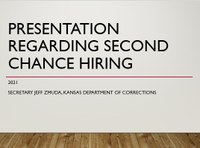
Jeff Zmuda, Kansas Secretary of Corrections, shares his thoughts on the wide-ranging benefits of "second chance hiring." KDOC residents in our correctional facilities provide a skilled, dependable workforce to solve labor shortages, gaining essential skills they need to be successful post-release.
Second Change Hiring, 2021, presentation by Secretary of Corrections Jeff Zmuda
In January 2021 an evaluation of the Kansas Correctional Industries (KCI) and KDOC's Private Industry Program was completed by Eric J. Lichtenberger, Ph.D. The study explored the impact on post-release employment and recidivism.
An Evaluation of Kansas Correctional Industries/Private Industries (KCI/PI) Programs, January 2021
Findings in a 2008 research conducted by the Urban Institute Justice Policy Center found:
Prison Policy Initiative examined rates of unemployment among formerly incarcerated people finding they are almost five times more likely than the general public to be unemployed, and many who are employed remain relegated to the most insecure jobs.
Citation: https://www.prisonpolicy.org/reports/outofwork.html
Rand Corporation had conducted research on educational needs recognizing that individuals who leave federal and state prisons return to communities where they have to compete with others for jobs.
“As already noted, according to RAND’s research, inmates who participate in correctional education programs have a 13-percentage-point reduction in their risk of returning to prison; this indicates that every $1 invested in education can reduce future incarceration costs in the near term. More concretely, we estimated that every dollar invested in prison education programs saves taxpayers, on average, between $4 and $5 in three-year reincarceration costs.”
Citation: https://www.rand.org/pubs/perspectives/PE342.html
The Second Chance Business Coalition promotes the benefits of second change employment and provides employers with resources to hire and provide career advancement to people with criminal records.
The Prison Post #30 Jeff Korzenik, Author of Untapped Talent https://t.co/KttpH3l0Ne?amp=1
Untapped Talent, Jeff Korzenik https://www.youtube.com/channel/UCOm5WTn246GMBIBG1JeJb9w
Second Chance Project — Dave's Killer Bread https://www.youtube.com/channel/UC1R2v6Us7MEEWn91Pnd8u9w
Google Small Business Stories: Nehemiah Manufacturing Company https://www.youtube.com/watch?v=9-0yWGWcupg
Nehemiah Company Culture https://www.youtube.com/watch?v=QxraJmzPlZg
Koch Industries Editorial Take a chance on second-chance hiring | Washington Examiner
]]>Education
The KDOC contracts with Southeast Kansas Education Service Center (Greenbush) to provide educational and vocational services.
Medical
ECF's medical services encompass many areas of resident medical needs. In addition to the 24-hour nursing care that is available, a physician is on site 20 hours per week and a dentist is on site 30 hours each week. Services include medical screenings and physical exams; dental exams and prophylaxis with treatment that include oral surgery and limited prosthetics; optometry needs for prescribing and fitting of eye wear; ancillary services for laboratory values and x-rays; referral entities for specialty needs of brace/limb prosthetics; orthopedic consultations and surgeries; neurosurgical and neurological consultations; ophthalmological consultations for general surgical conditions; general medical diagnosis and treatments; internal medicine diagnosis and treatments; and other specialty referrals subject to approval of the state medical director. The chronic care clinic currently provides services in the following areas: pulmonary, hypertension, diabetic, cardiac, epileptic, positive HIV, TB prophylaxis, past positive TB prophylaxis and hyperthyroidism.
Mental Health
The mental health department’s overall goal is to provide services that encourage and assist the resident in making positive changes and meeting his individual needs. The mental health therapy program provides a variety of services which include mental health group counseling, intensive groups, individual counseling, psychiatric intervention, crisis intervention, psychological evaluations, activity therapy, discharge planning, tele-psychiatry to assist in the management of inmates on psychotropic drugs and on-call services. In addition, mental health professionals provide staff instruction on the assessment and management of the resident population.
Inmate Responsibility and Accountability Model (RAM) Training
The desired result of this training is that the participants will utilize the tools in their daily life. They can also apply the tools when they are released and strengthen their ability to remain on post-release supervision. The focus is on the behavior cycle, errors in thinking, thinking reports and problem resolution techniques. The course has been re-configured as a therapeutic group and targets those who successfully completed a previous group. The group meets once a week for 24 weeks.
NON-CONTRACTED PROGRAMS
Religion
The goal and objective of chaplaincy services is to assist inmates in achieving individual spiritual growth. Services are held weekly for Catholic, protestant, Muslim, Moorish Science Temple of America, Jehovah Witness, United Tribes, Wicca, Buddhist, Assembly of Yahweh, Latter Day Saints, Judaism, Rastafarian and Asatru studies for inmates wishing to attend. A Native American Sweat Lodge ceremony is held on the third Sunday of each month and a pow wow is held quarterly. A variety of counseling services are available, including marriage, crisis, family, individual sessions and Alcoholics Anonymous/Narcotics Anonymous.
Numerous volunteers conduct religious services, bible studies and assist with other inmate activities.
To further support this mission, a free-standing Spiritual Life Center (SLC) has been constructed at ECF. The total cumulative cost of this capital improvement funding project was approximately $361,000. This project was accomplished primarily through the efforts of volunteers and facility staff using inmate labor. Project funding came exclusively from donations received from churches, individuals, corporations and grants from private foundations.
Reentry
CKRP primary objective is to ensure inmates have the opportunity to improve their probability of a successful return to society. The program utilizes partnerships with corrections agencies, law enforcement, victim services, mental health services, medical health providers, political and community representatives, employers and employment agencies, landlords, housing authorities and faith-based organizations.
CKRP’s target population consists of inmates who are assessed with high risks and needs in specific areas of their lives, are releasing to the Central Kansas area within a 90-minute radius of the Ellsworth Correctional Facility and who are within 12-14 months from their scheduled release. Once assessed for needs in their high risk-to-reoffend areas, these individuals are referred to groups, classes and workshops designed around their case management plan to target their specific needs. The primary areas of focus include but are not limited to:
Pro-social supports are also a highlight of CKRP. Families attend quarterly family workshops in the community to speak with reentry and parole staff regarding release planning and community transitions.Providing community supports to individuals assures the best chance for their success. Reentry staff will continue working with the individual and their parole supervisor post-release offering services and mediation as needed until societal stability is achieved and the individual advances through the commencement process.
Bicycle Refurbishing Program
Established in 1999, the program employs 12 inmates who repair and refurbish bicycles that are then donated to less fortunate individuals in Kansas communities and throughout the United States. The bicycle parts and materials are obtained through donations by individuals, law enforcement agencies and civic organizations.
Recreation
Inmates participate in recreational or leisure time activities depending upon their physical ability, fitness and acceptable behavior. The program targets physical and mental fitness, promotes productive leisure time, and includes intramural, social and cultural programming in addition to special events. The gym and yard are open seven days a week for inmate use.
Community Access Network (CAN), Inc.
Implemented in 2003, this project is a not-for-profit collaborative initiative comprised of representatives from various Kansas government organizations and community partners. The purpose of CAN is to develop an online resource to promote social issues, identify available services, and provide community statistics surrounding social issues and services.
Wheels for the World
Established in 1993, this outreach program for Joni and Friends Ministries refurbishes used wheelchairs that are distributed throughout the world. ECF’s program also manugactures universal footrests that are shipped to other distribution centers. Additionally, the program produced a new all-terrain attachment which allows individuals in various areas of the world to maneuver a wheelchair in rough terrain. The program's ECF supervisors are often called upon to lend their support in training and technical advice to setup similar programs in other states and countries. The program contracts with Personal Energy Transportation Kansas from Moundridge, Kan., to build parts for hand-cranked carts that are needed by those who lost the use of their legs due to polio, landmine injuries or amputation.
Library
The library provides recreational, educational, legal and other information resources contributing to the development of the inmates in their physical, intellectual, moral and spiritual well-being. The library has approximately 12,000 books, receives about 30 newspapers and magazines and provides reference collection of encyclopedias, dictionaries, directories and other ready reference books. The collection is supplemented by an efficient, state-wide inter-library loan service. Inmates are provided access to all the legal documents, cases, statutes, administrative rules and case notes through the computerized LexisNexis system. The library also provides photocopying services and typewriters for inmates doing legal work.
Canine Assistance Rehabilitation Education and Services (CARES), Inc.
Since 1999, the CARES group has worked with ECF inmates who teach puppies basic obedience and socialization skills during a three- to six-month period.Once these skills are mastered, the dogs are placed with individuals who have a variety of challenges (physical, mental or emotional).
Work Programs
ECF’s policy is to provide inmates with a variety of meaningful work/program assignments patterned after a typical workday in the community. Assignments are designed to encourage inmates to develop desirable work habits and skills while engaging in work projects for ECF and the State of Kansas.
An inmate employment assessment and job assignment program has been established at ECF which is utilized to ensure inmates are assigned jobs commensurate with their technical skills and to encourage inmates to possess positive behavioral characteristics. In addition, inmates are assigned to work crews to obtain on-the-job training which allows them to develop their work skills and assist them with reintegration into society.
Overview | Visitor Information | Programs | History | Warden
____________________________________________________________________________
]]>Programs
Pre-Release Vocational (Aramark) GED
Correctional Industries
Aramark.................................. 6 slots
Pioneer Balloon....................... 12 slots
Community Service Work
Inmates at Winfield Correctional Facility provide thousands of hours of community service work each year to non-profit entities after certification that the service work will not displace community-available jobs. This program provides labor for those approved agencies and provides inmates with valuable job skills and work ethics that they can utilize upon release. Long-term community service work includes:
Other Programs
Inmates also can participate in Reaching Out from Within, al self-help program for inmates who are committed to change and to giving back to the community.
Reaching Out From Within is a Kansas City-based non-profit organization founded in 1982 by violence prevention advocate and author SuEllen Fried. The program is dedicated to providing programs that prevent violence in our community. By breaking the cycle of violence, participants become contributing members of their families and society. Incarcerated men and women lead meetings using a curriculum written by offenders that teaches life skills and encourages them to make positive changes in their lives.
The WCF program began in 1994. Meetings, which are open to every inmate in the facility, are held two nights each week. During the meetings, inmates work with various materials and reference books that help in their quest to learn new ways to meet life's challenges and change their behavior. Select program participants, who have met special criteria, routinely speak to students and other groups in their community about choices and consequences.
Giving back to society in a meaningful way is one of the core beliefs of the program. The group gives back to society by supporting charities.
For more information, see the Reaching Out From Within website at http://www.rofw.org.
Overview | Visitor Information | Programs | History | Warden
____________________________________________________________________________
While services for medical and education are contracted for through private vendors, the facility's food service is supported by the Larned State Hospital. However staffing at LSCF is contractual. Meals are prepared at the state hospital kitchen and transported to the LSCF for serving to the Central Unit inmates. South Unit inmates eat their meals under LSCF staff supervision at the state hospital cafeteria.
Chaplaincy Services
The facility provides opportunities for inmates to practice their respective religious faiths. A full-time chaplain is the liaison for religious services and volunteers in the community.
Reeentry
Reentry services provide programming, such as Thinking for a Change courses and support for offenders based on the inmate’s specific risk and need areas as defined by screening and offender behavior.
Private Industries
Inmate employee positions are available in non-prison based industries programs for minimum-custody West Unit inmates. These programs are designed to help inmates learn and practice the pro-social skills and good work habits required to be self-sufficient, productive citizens ready to practice responsible crime-free behavior.
Overview | Visitor Information | Programs | History
____________________________________________________________________________
Within the program division, unit teams manage the inmate population assigned to each housing unit. A unit team manager is responsible for the day-to-day operation of the housing unit. Uniformed staff and corrections counselors are also part of each unit team. The unit team's purpose is to decentralize programs and operations to provide more individual attention to the inmate population and to respond to the needs of individual inmates.
An individualized treatment program is developed, implemented and maintained for each inmate by unit team staff. The unit teams provide services to inmates in the form of work assignments, progress reviews, attitudinal and adjustment counseling, release counseling and other matters. For unit teams, release planning for all inmates is vital to an inmate’s successful transition into society. An inmate employment assessment and job assignment program is utilized to ensure inmates are assigned jobs commensurate with their technical skills. Inmates are also assigned to work crews to obtain on-the-job training which allows them to develop work skills and assist them with reintegration into society. The records office is responsible for providing clerical support for the unit teams and for updating records of inmates received, processed and transferred into and from EDCF.
Contract services, including medical, mental health and education programs are also overseen by the deputy warden of programs.
NON-CONTRACTED PROGRAMS
Facility/Parole Interaction
Facility/parole interaction meetings convene on a monthly basis for parole and facility staff to make presentations to inmates who will be releasing in 30 to 60 days. Discussions occur surrounding the 12 standard conditions of parole to dispel common myths and beliefs about post release supervision. In Phase 2, conference calls occur between inmates, facility staff (IPO, Unit Manager, Counselor, Release Planner, etc.) inmate family members or home plan sponsor and other appropriate participants.
SKIP
The Kansas Strengthening Kids of Incarcerated Parents (KS-SKIP) program is a model program designed to connect incarcerated parents to their children prior to release from prison. The initial phase of the KS-SKIP program is a 13-week parenting class that focuses on increasing the father's understanding of their role as a parent, in spite of incarceration. The goal is to strengthen the father-child relationship prior to release and to prepare fathers to reconnect with their child/children. The second phase is Play and Learn groups. The groups are mobile preschool environments where parents and children gather to play and learn together under the supervision of trained facilitators. Each week for 8-12 weeks, fathers turn an adult space into a playgroup environment for their children. When children arrive at the facility, fathers become the primary caregiver for that hour and a half session. The program's third phase includes support to the caregivers. Concurrent to the Play and Learn group, a support group is offered for the caregivers of the children.
FLIP
Directed at segregation inmates, FLIP (Fundamental Lessons in Psychology) consists of various psychological topics including: anger management, anxiety, assertiveness, cognitive self-change, depression, general mental health, grief, loss and forgiveness, men’s issues/adjustment and self-esteem.
Chaplaincy
EDCF has two full time chaplains who facilitate, coordinate, and oversee religious programs for the Central Unit. There are over 24 different groups facilitated by the Chaplain's office including Alcoholics and Narcotics Anonymous, Asatru, Assembly of Yahweh, Buddhist, Church of Christ Study, House of Yahweh, Innerchange, Islamic Study, Jehovah's Witnessess, Jewish Study, Latter Day Saints, Mennonite Study, Moorish Science Temple, Native Americans, Pentecostal Worship, Non-Catholic Christian Study, Sunday Services, Rastafarian, Roman Catholic Study/Mass, Seventh Day Adventists, Spanish Speaking Bible Study and Wicca. The Chaplain's office provides greeting cards and reading materials to inmates as they are provided by donations. This office also provides premarital counseling, grief counseling, memorial services and emergency notification for families of inmates. Additionally, counseling is provided for inmates with families, and counseling and assistance is provided to staff as needed and requested. The chaplains coordinate volunteer services for approximately 250 volunteers, provide training to both volunteers and facility staff, work with local community leaders and clergy and lead worship services for inmates.
Spritual Life Center
Opened in June 2010, the Spiritual Life Center is an 11,500 sq. foot structure designed to support the spiritual needs of inmates. Constructed primarily through the efforts of inmate labor, volunteers, and facility staff, project funding, furnishings, and equipment have come exclusively from donations received from individuals, corporations and foundation grants. The Spiritual Life Center provides space to an increased number of inmates to attend religious services along with housing support groups such as AA and Life Skills training. The building contains a large chapel area, a multi-purpose room, five classrooms, a library, two chaplain's offices and a conference room.
Transitional Segregation Program (Segregation to Society (STS))
Aimed at long-term segregation inmates who have 12 to 16 months until release, the program provides a number of tools necessary for the transition to the community. Inmates in this setting have been more restricted in their movement and access to others and have not been able to attend release and re-entry classes. In-cell assignments are conducted through handouts, workbooks, manuals, etc. Instruction is provided directly to inmates by trained staff.
Behavior Modification Program (BMP)
The BMP is a program designed to deal with transitioning segregation inmates in a stratified behavior modification program based on increased steps of privileges for demonstrated appropriate behavior and program compliance. The nine-month, cognitive-based program integrates inmates in a 3-step process that includes portions of Thinking for a Change, Motivation for Change, PAD (Positive Attitude Development), and Anger Management programs.
Added to the program is an additional three months of monitoring under intensive supervision.
Offender Workforce Development (OWDS)
OWDS works with inmates to address internal and external barriers and assesses individual interests and skills in preparation for job readiness. OWDS assists with developing such job search skills as developing a resume, completing an application, conducting a job search, honing interview skills and discussing how to address the inmate's felony conviction.
Overview | Visitor Information | Programs | History | Warden
____________________________________________________________________________
]]>The Parole Process
Public Comment Sessions
The Prisoner Review Board conducts monthly Public Comment Sessions in the cities of Derby, Topeka and Kansas City. The sessions provide an opportunity for Board members to receive written and oral input from victims, victims’ families, inmates’ families, community members and other interested persons regarding the possible parole of inmates. Notice of the Public Comment Sessions and a list of relevant inmates are available at: Public Comment Sessions.
Parole Eligibility
Inmates under the indeterminate sentencing structure become parole eligible after serving the minimum sentence, less good time credits. The good time credits are calculated according to statute. Currently, good time is earned at a rate of one day for every day served for sentences with a minimum of two years. In other words, an individual will become eligible at half of his/her minimum sentence if all good time is earned. For sentences with a one-year minimum, parole eligibility is reached after serving nine months.
The Parole Hearing
By statute, the Board must conduct a parole hearing during the month prior to the inmate’s parole eligibility date with the inmate present if he/she is incarcerated in Kansas. This appearance does not necessarily mean that the inmate will be released on parole. Parole eligibility is viewed by the Board as distinctly different from parole suitability.
During the parole hearing the inmate is given an opportunity to:
- Present to the Board the inmate’s version of the offense and any mitigating or precipitating factors;
- Discuss the inmate’s prior criminal history;
- Discuss the progress the inmate has made and the programs that have been completed, including those that are a part of the inmate’s Program Agreement;
- Discuss the precipitating or mitigating factors of any Disciplinary Reports the inmate has received while incarcerated;
- Discuss the inmate’s problems and needs;
- Present and discuss a parole plan;
- Discuss other matters that are pertinent to consideration of parole release;
- Present other reasons the inmate believes makes him/her ready for parole.
Parole hearings provide the Board an opportunity to review all available reports and material pertinent to the case, as well as to question the inmate directly about relevant issues and to make an assessment of the inmate and his/her readiness for parole.
The Parole Decision-Making Process
Kansas Law stipulates that the Board may release on parole those inmates who have satisfactorily completed the Program Agreement, required by the K.S.A. 75-5210a, whom the Board believes are able and willing to fulfill the obligations of a law-abiding citizen, and when the Board is of the opinion that there is a reasonable probability that the inmate can be released without detriment to the community or to the inmate. (K.S.A. 22-3717 (e)).
In conjunction with K.S.A. 22-3717 (h), the following non-exhaustive factors are considered when determining parole suitability:
- Circumstances of the offense
- Previous criminal record and social history of the inmate
- Programs and program participation
- Conduct, employment, attitude, disciplinary history during incarceration
- Reports of physical/mental examinations, including but not limited to risk factors revealed by any risk assessment
- Comments from public officials, victims or their family, offender family or friends, or any other interested member of the general public
- Capacity of state correctional institutions
- Input from staff where offender is housed
- Proportionality of time served to the sentence that would have been received under the Kansas sentencing guidelines for the conduct that resulted in the inmate's incarceration
- Presentence report
In addition to soliciting comments from violent crime victims, comments are solicited from public officials regarding the inmate’s possible parole. These officials include the Prosecuting Attorney, Sheriff’s Department, Police Department and the Sentencing Judge from the county or counties in which the inmate was convicted. This information is made available to the Board at the inmate’s hearing.
These considerations take into account the welfare of the community and public safety in determining the optimum period of time for parole release of an individual inmate. The parole decision is representative of the criminal justice system and governmental guidelines and is an attempt to reflect the general attitude and opinions of law enforcement and the community at large. Before granting parole, the Board determines whether or not an offender has demonstrated appropriate behavior which ensures a reasonable opportunity to succeed socially and economically. The Board takes into consideration the individuality of offenders on a case-by-case basis.
The Board can make one of three basic decisions at a parole hearing. These decisions are
- parole
- continue
- pass
The Board can decide to “parole” when it believes the inmate is suitable for release.
Secondly, the Parole Board can decide to “continue,” which is to postpone making a decision to parole or pass the inmate. This action is made to facilitate further deliberation or receipt of information, when it requires a more in-depth review or discussion of the case. The Board may also continue for additional votes necessary for a majority decision. Other times, it may continue for the inmates to undergo an evaluation to assess the inmate’s mental health. Once the reason for the continuation is satisfied, a determination as to whether or not to release the inmate is made.
The third decision is to “pass” for a particular period of time, which is a denial of parole. The maximum period for which the Prisoner Review Board may pass offenders convicted of A or B felonies or off-grid offenses is ten years, if the Board can provide reasons as to why it is not believed that the inmate would have been granted parole otherwise. Previously, offenders convicted of such offenses could only be passed for up to 3 years.
For offenders convicted of offenses other than A or B felonies or off-grid offenses, the Board may issue a pass for a period up to three years, provided the Board can give reasons as to why it is not believed that the inmate would have been granted parole otherwise. Previously, offenders convicted of such offenses could only be passed for up to one year.
Appeal
An inmate has the right to appeal a parole decision under authority of K.A.R. 45-200-2(b), when he/she can present “new evidence which was unavailable at the prior hearing.” The appeal must be made in writing and specify the new evidence upon which the inmate relies. Those that meet the outlined criteria are reviewed by the Prisoner Review Board so that a decision can be made regarding the appeal. Once a decision has been reached, the offender is notified of the decision by the Board.
Conditional Release
A conditional release is the date when an inmate under an indeterminate sentence must be released, because he/she has served half of the maximum sentence. Good time for conditional release is calculated in the same manner as for parole eligibility. Therefore, for sentences with a maximum of two years or more an inmate must serve one-half of the maximum before being conditionally released. For example, on a three-to-ten year sentence, an inmate will reach his/her conditional release after serving five years and must be released at that time, provided he/she has lost no good time. When an inmate reaches his/her conditional release, the Prisoner Review Board reviews the inmate’s file and establishes conditions with which the inmate must comply. The offender is then placed on conditional release and supervised until the maximum sentence date or granted an early discharge by the Board.
Post-Release Supervision
The Kansas Legislature imposed a Sentencing Guideline Sentencing structure for individuals whose crimes were committed on or after July 1, 1993. This system is determinate in nature, in that the inmate’s period of incarceration is predetermined at sentencing. Post-release supervision is similar to conditional release. Post-release supervision begins when an inmate has served the maximum sentence, less good time credits. Each sentence has its own predetermined period of supervision and the inmate may earn good time in an amount no greater than 15-20 percent (depending on when the crime occurred) of the sentence, thereby reducing the portion of the sentence that must be served in prison. This amount of time, however, will then be added to the period of post-release supervision, so that the entirety of the term will not be affected or reduced. Therefore, since the inmate’s release date is predetermined, the Prisoner Review Board’s role at release is to set the conditions of the supervision period. Once the individual reaches the expiration date of his/her supervision period, the individual’s obligation to the state has been satisfied.
Parole, Conditional Release, and Post-Release Revocation Hearings
In general, after an inmate has been released on parole, conditional release or post-release supervision, the Secretary of Corrections may issue a warrant when a violation of parole, conditional release or post-release supervision has been established. This process is initiated by an offender’s Parole Officer, not by the Prisoner Review Board. If the Parole Officer wishes to pursue revocation proceedings, a probable cause/ preliminary hearing is conducted by the field parole staff and an impartial hearing officer. If probable cause is found, the inmate may be returned to the Department of Corrections’ custody. The offender is then scheduled for a revocation hearing before the Prisoner Review Board. The inmate has the right to have witnesses present who may have information relevant to the alleged violation. If the violation is established to the satisfaction of the Board, it may revoke the parole, conditional release or post-release or take any other appropriate action. In the case that the release is revoked, this action could include assessment of a penalty in the nature of further time which the inmate must serve before again being considered by the Board for release.
For offenders under post-release supervision, the Board is limited in the length of time it can order offenders to serve on a condition violation. For these offenders, depending on when their original conviction occurred, the Board may only revoke for up to 90 days or for 180 days. The exception to these limits is if the violation results from a conviction for a new felony or misdemeanor. Prior to July 1, 2013, upon revocation for a new felony conviction the inmate was required to serve the entire remaining balance of the period of post-release supervision even if the new conviction did not result in the imposition of a new term of imprisonment. As a result of FY2013 legislation that amended K.S.A. 75-5217 (c) the Board, beginning July 1, 2013, has the discretion to require an offender to serve a revocation period up to the date of sentence discharge when revocation is predicated on either a new felony or misdemeanor conviction.
Waiver of Final Prisoner Review Board Hearing
During the FY 1999 legislative session, K.S.A. 75-5217 (b) was amended to provide post-release supervision violators the option of waiving their final hearing before the Prisoner Review Board. Following arrest, an offender is served documents regarding the pending revocation and has the option to admit guilt and sign a waiver of their right to a hearing before the Board. In doing so, the revocation process for the offender begins at that point, and the revocation period of either 90 or 180 days begins immediately, rather than after the offender appears in person before the Board at a revocation hearing. Offenders who have been granted a parole release are not eligible to waive their final hearing before the Board.
Discharge from Supervision
An inmate under the indeterminate release system can be maintained on supervision up to the expiration of his/her maximum sentence. There is a minimum requirement of one year of supervision before discharge may be requested. This action may be initiated by the offender’s supervising Parole Officer, the Prisoner Review Board or the offender. A poor performance under supervision could result in causing the inmate to remain under supervision for a longer period of time than one or two years. If an inmate’s adjustment has been satisfactory, the Parole Officer may submit a written report, summarizing the offender’s conduct while under supervision, which outlines for the Board issues such as employment, compliance with conditions and law enforcement contact. The Request for Discharge must be accompanied by an approval by the Parole Officer’s supervisor and is then considered by the Board. Without regard to his/her conduct, an inmate must be released from supervision at the maximum sentence expiration date in the absence of an early discharge.
During the FY 2013 legislative session, K.S.A. 22-3717 (d) (2) was amended to allow offenders serving 12, 24 or 36 months of post release supervision to petition the Board for early discharge if they have paid court ordered restitution.
Maximum Release
In the event an inmate under the indeterminate release system has had his/her Conditional Release revoked and/or serves to the maximum, he/she shall be released from prison at that time as the offender’s sentence has been satisfied. The Board has no authority to set any conditions upon the release or to have any control over the offender’s conduct. The Department of Corrections, similarly, cannot provide any supervision. Once an offender reaches his/her maximum date the offender’s obligation to the State has been satisfied and the Board records this with the issuance of a maximum sentence discharge certificate.
Executive Clemency
Executive Clemency is an extraordinary method of relief and is not regarded as a substitute for parole. An inmate who believes that he/she has a deserving case for executive clemency may request the necessary applications from institutional staff. Once completed by the inmate, these forms are submitted to the Board, along with the inmate’s reasons for applying for clemency. As required by law, a notice of the inmate’s application is forwarded to the official county newspaper in the area of conviction so that interested parties may offer comments. In the event the inmate does not have sufficient funds for the cost of this publication, the Department of Corrections bears the cost. Comments are solicited from the sentencing judge and the prosecuting attorney. After the formalities have been accomplished, the Board conducts a file review to determine if a personal interview with the inmate is warranted. After reviewing the file, and conducting a hearing (if needed), the Board then submits a recommendation to the Pardon Attorney in the Governor’s office for the Governor’s final action.