<?xml version="1.0" encoding="utf-8" ?>
<rdf:RDF xmlns:rdf="http://www.w3.org/1999/02/22-rdf-syntax-ns#" xmlns:dc="http://purl.org/dc/elements/1.1/" xmlns:syn="http://purl.org/rss/1.0/modules/syndication/" xmlns="http://purl.org/rss/1.0/">


<channel rdf:about="https://www.doc.ks.gov/search_rss">
  <title>public</title>
  <link>https://www.doc.ks.gov</link>

  <description>
    
            These are the search results for the query, showing results 93 to 107.
        
  </description>


  <image rdf:resource="https://www.doc.ks.gov/logo.png"/>

  <items>
    <rdf:Seq>
      
        <rdf:li rdf:resource="https://www.doc.ks.gov/facilities/wcf/programs-1/programs"/>
      
      
        <rdf:li rdf:resource="https://www.doc.ks.gov/facilities/wcf/history"/>
      
      
        <rdf:li rdf:resource="https://www.doc.ks.gov/facilities/ncf/overview"/>
      
      
        <rdf:li rdf:resource="https://www.doc.ks.gov/juvenile-services/supervision-standards/jias/standards/jias-04-103"/>
      
      
        <rdf:li rdf:resource="https://www.doc.ks.gov/victim-services/publications/newsletters/fall-2013-newsletter"/>
      
      
        <rdf:li rdf:resource="https://www.doc.ks.gov/facilities/lcmhf/programs"/>
      
      
        <rdf:li rdf:resource="https://www.doc.ks.gov/facilities/lcmhf/history"/>
      
      
        <rdf:li rdf:resource="https://www.doc.ks.gov/facilities/faq/medical"/>
      
      
        <rdf:li rdf:resource="https://www.doc.ks.gov/facilities/faq/visits"/>
      
      
        <rdf:li rdf:resource="https://www.doc.ks.gov/facilities/faq/contraband"/>
      
      
        <rdf:li rdf:resource="https://www.doc.ks.gov/facilities/faq/dr"/>
      
      
        <rdf:li rdf:resource="https://www.doc.ks.gov/facilities/faq/banking"/>
      
      
        <rdf:li rdf:resource="https://www.doc.ks.gov/facilities/faq/communication/phone"/>
      
      
        <rdf:li rdf:resource="https://www.doc.ks.gov/facilities/faq/communication/messages"/>
      
      
        <rdf:li rdf:resource="https://www.doc.ks.gov/facilities/faq/rdu"/>
      
    </rdf:Seq>
  </items>

</channel>


  <item rdf:about="https://www.doc.ks.gov/facilities/wcf/programs-1/programs">
    <title>Programs</title>
    <link>https://www.doc.ks.gov/facilities/wcf/programs-1/programs</link>
    <description>The following are programs and services available at Winfield Correctional Facility: 
</description>
    <content:encoded xmlns:content="http://purl.org/rss/1.0/modules/content/"><![CDATA[<p style="text-align: justify; ">As with other facilities under the management of the Secretary of Corrections, education, health services and food services are provided through contracts with private vendors. </p>
<p><b><i>Programs</i></b><b></b></p>
<p>Pre-Release                    Vocational (Aramark)                    GED</p>
<p><b><i>Correctional Industries</i></b><b></b></p>
<p>Aramark.................................. 6 slots<br />Pioneer Balloon....................... 12 slots  </p>
<p><b><i>Community Service Work</i></b><b></b></p>
<p style="text-align: justify; ">Inmates at Winfield Correctional Facility provide thousands of hours of community service work each year to non-profit entities after certification that the service work will not displace community-available jobs. This program provides labor for those approved agencies and provides inmates with valuable job skills and work ethics that they can utilize upon release. Long-term community service work includes:</p>
<ul>
<li>Butler County</li>
<li>City of Arkansas City</li>
<li>City of El Dorado</li>
<li>City of Wichita   </li>
<li>City of Winfield    </li>
<li>Cowley County Humane Society</li>
<li>Lion’s Club Sight Project                  </li>
<li>Kansas Department of Transportation </li>
<li>Kansas Department of Wildlife and Parks</li>
<li>Strother Field</li>
<li>USD 465</li>
</ul>
<p> </p>
<p><b><i>Other Programs</i></b></p>
<p style="text-align: justify; ">Inmates also can participate in <em>Reaching Out from Within</em>, al self-help program for inmates who are committed to change and to giving back to the community.</p>
<p style="text-align: justify; ">Reaching Out From Within is a Kansas City-based non-profit organization founded in 1982 by violence prevention advocate and author SuEllen Fried. The program is dedicated to providing programs that prevent violence in our community. By breaking the cycle of violence, participants become contributing members of their families and society. Incarcerated men and women lead meetings using a curriculum written by offenders that teaches life skills and encourages them to make positive changes in their lives.</p>
<p style="text-align: justify; ">The WCF program began in 1994. Meetings, which are open to every inmate in the facility, are held two nights each week. During the meetings, inmates work with various materials and reference books that help in their quest to learn new ways to meet life's challenges and change their behavior. Select program participants, who have met special criteria, routinely speak to students and other groups in their community about choices and consequences.</p>
<p style="text-align: justify; ">Giving back to society in a meaningful way is one of the core beliefs of the program. The group gives back to society by supporting charities.</p>
<blockquote>
<blockquote>
<blockquote>
<p style="text-align: justify; ">For more information, see the Reaching Out From Within website at <a href="http://www.rofw.org">http://www.rofw.org</a>.</p>
</blockquote>
</blockquote>
</blockquote>
<p style="text-align: center; "><span class="internal"><a class="internal" href="overview">Overview </a></span>| <a class="internal" href="visit">Visitor Information<span class="internal"> </span></a>|<span class="internal"> <a class="internal" href="programs-1">Programs </a></span>| <a class="internal-link" href="../history">History<span class="internal"> </span></a>| <a class="internal" href="warden"><span class="internal">Warden</span><br /></a>____________________________________________________________________________</p>]]></content:encoded>
    <dc:publisher>No publisher</dc:publisher>
    <dc:creator>cherylca</dc:creator>
    <dc:rights></dc:rights>
    <dc:date>2014-01-21T22:15:00Z</dc:date>
    <dc:type>Page</dc:type>
  </item>


  <item rdf:about="https://www.doc.ks.gov/facilities/wcf/history">
    <title>History</title>
    <link>https://www.doc.ks.gov/facilities/wcf/history</link>
    <description>WCF History</description>
    <content:encoded xmlns:content="http://purl.org/rss/1.0/modules/content/"><![CDATA[<p></p>
<p></p>
<p></p>
<p></p>
<div class="columns"><strong><br /></strong></div>
<table class="plain" style="width: 560px;">
<thead>
<tr>
<td colspan="2" style="text-align: center; "><strong>History</strong></td>
</tr>
</thead>
<tbody></tbody>
<tbody>
<tr>
<td><strong>1984</strong></td>
<td>Winfield Pre-Release Center opened on the grounds of the Winfield State Hospital, providing primarily pre-release programming services. The population capacity was 141 inmates.</td>
</tr>
<tr>
<td><strong>1989</strong></td>
<td>Having expanded both in terms of size and facility mission, the name of the facility was changed to Winfield Correctional Facility. The population capacity was 290 inmates.</td>
</tr>
<tr>
<td><strong>1996</strong></td>
<td>Winfield State Hospital closed. As a result, Winfield Correctional Facility absorbed many buildings and the infrastructure and support units from the hospital. During the transition, an additional dorm was added, increasing the capacity to 522 inmates. In September, the administrations of Winfield Correctional Facility and  Wichita Work Release Facility were combined.</td>
</tr>
<tr>
<td><strong>1998</strong></td>
<td>A therapeutic community substance abuse treatment program was implemented.</td>
</tr>
<tr>
<td><strong>2000</strong></td>
<td>InnerChange Freedom Initiative (IFI), a 12-18 month, values-based pre-release program, began operation in March with the capacity to serve 158 inmates.</td>
</tr>
<tr>
<td><strong>2002</strong></td>
<td>In June, IFI was transferred from Winfield to Ellsworth Correctional Facility.</td>
</tr>
<tr>
<td><strong>2003</strong></td>
<td>The therapeutic community program was closed effective January 31, 2003.</td>
</tr>
<tr>
<td><strong>2004</strong></td>
<td>The population capacity was increased to 556 inmates.</td>
</tr>
<tr>
<td><strong>2007</strong></td>
<td>Due to renovations, the capacity decreased to 554 inmates.</td>
</tr>
<tr>
<td><strong>2009</strong></td>
<td>Due to budget constraints, B Unit was closed in early 2009, reducing the capacity to 378.  It was re-opened in June 2009, bringing the capacity back to 554 inmates.</td>
</tr>
<tr>
<td><strong>2010</strong></td>
<td>Pioneer Balloon opened a private industry onsite, employing up to 12 inmates at minimum wage jobs.</td>
</tr>
<tr>
<td><strong>2011</strong></td>
<td>WCF contracts with the Cowley County Jail to house up to 50 inmates in response to population increases within the KDOC.</td>
</tr>
<tr>
<td><strong>2013</strong></td>
<td>The Cowley County Jail contract ended.</td>
</tr>
</tbody>
</table>
<blockquote>
<p style="text-align: center; "><span class="internal"><a class="internal" href="overview">Overview </a></span>| <a class="internal" href="visit">Visitor Information<span class="internal"> </span></a>|<span class="internal"> <a class="internal" href="programs-1">Programs </a></span>| <a class="internal" href="../history">History<span class="internal"> </span></a>| <a class="internal" href="warden"><span class="internal">Warden</span><br /></a>____________________________________________________________________________</p>
</blockquote>]]></content:encoded>
    <dc:publisher>No publisher</dc:publisher>
    <dc:creator>cherylca</dc:creator>
    <dc:rights></dc:rights>
    <dc:date>2014-01-21T22:10:00Z</dc:date>
    <dc:type>Page</dc:type>
  </item>


  <item rdf:about="https://www.doc.ks.gov/facilities/ncf/overview">
    <title>Overview</title>
    <link>https://www.doc.ks.gov/facilities/ncf/overview</link>
    <description></description>
    <content:encoded xmlns:content="http://purl.org/rss/1.0/modules/content/"><![CDATA[<p>At the close of 2013, NCF’s capacity was 835 adult male inmates. Capacity at the main-custody compound was 707 adult male inmates, with 539 medium-security beds and 168 minimum-security beds. NCF’s satellite unit at Stockton’s had a capacity of 128 minimum-security beds.</p>
<p>As with other facilities under the management of the Secretary of Corrections, education, health services and food services are provided through contracts with private vendors. </p>
<p style="text-align: center; "><span class="internal"><a class="internal" href="overview">Overview</a> </span>| <a class="internal-link" href="visit">Visitor Information</a><span class="internal"> </span>|<span class="internal"> <a class="internal" href="programs-1">Programs</a> </span>| <a class="internal" href="history">History</a><span class="internal"> </span>| <a class="internal" href="warden"><span class="internal">Warden</span><br /></a>____________________________________________________________________________</p>]]></content:encoded>
    <dc:publisher>No publisher</dc:publisher>
    <dc:creator>cherylca</dc:creator>
    <dc:rights></dc:rights>
    <dc:date>2014-01-16T22:15:00Z</dc:date>
    <dc:type>Page</dc:type>
  </item>


  <item rdf:about="https://www.doc.ks.gov/juvenile-services/supervision-standards/jias/standards/jias-04-103">
    <title>JIAS-04-103</title>
    <link>https://www.doc.ks.gov/juvenile-services/supervision-standards/jias/standards/jias-04-103</link>
    <description>JIAS-04-103</description>
    
    <dc:publisher>No publisher</dc:publisher>
    <dc:creator>cherylca</dc:creator>
    <dc:rights></dc:rights>
    <dc:date>2014-01-16T16:55:00Z</dc:date>
    <dc:type>File</dc:type>
  </item>


  <item rdf:about="https://www.doc.ks.gov/victim-services/publications/newsletters/fall-2013-newsletter">
    <title>Fall 2013 Newsletter </title>
    <link>https://www.doc.ks.gov/victim-services/publications/newsletters/fall-2013-newsletter</link>
    <description>See the latest from the Office of Victims Services in the Fall edition of THE BEACON.</description>
    
    <dc:publisher>No publisher</dc:publisher>
    <dc:creator>Kimberly_Marotta</dc:creator>
    <dc:rights></dc:rights>
    <dc:date>2014-01-15T20:37:29Z</dc:date>
    <dc:type>File</dc:type>
  </item>


  <item rdf:about="https://www.doc.ks.gov/facilities/lcmhf/programs">
    <title>Programs</title>
    <link>https://www.doc.ks.gov/facilities/lcmhf/programs</link>
    <description>The following are programs and services available at Larned State  Correctional   Facility: 
</description>
    <content:encoded xmlns:content="http://purl.org/rss/1.0/modules/content/"><![CDATA[<p><b>Food Service</b></p>
<p>While services for medical and education are contracted for through private vendors, the facility's food service is supported by the Larned State Hospital. However staffing at LSCF is contractual. Meals are prepared at the state hospital kitchen and transported to the LSCF for serving to the Central Unit inmates. South Unit inmates eat their meals under LSCF staff supervision at the state hospital cafeteria.</p>
<p><b>Chaplaincy Services</b></p>
<p>The facility<b> </b>provides opportunities for inmates to practice their respective religious faiths. A full-time chaplain is the liaison for religious services and volunteers in the community.</p>
<p><b>Reeentry</b></p>
<p>Reentry services provide programming, such as Thinking for a Change courses and support for offenders based on the inmate’s specific risk and need areas as defined by screening and offender behavior.</p>
<p><b>Private Industries</b></p>
<p>Inmate employee positions are available in non-prison based industries programs for minimum-custody West Unit inmates. These programs are designed to help inmates learn and practice the pro-social skills and good work habits required to be self-sufficient, productive citizens ready to practice responsible crime-free behavior.</p>
<p style="text-align: center; "><span class="internal"><a class="internal-link" href="overview-1">Overview</a> </span>| <a class="internal" href="visit">Visitor Information</a><span class="internal"> </span>|<span class="internal"> <a class="internal" href="programs">Programs</a> </span>| <a class="internal" href="history">History</a><span class="internal"></span><span class="internal"><br /></span>____________________________________________________________________________</p>]]></content:encoded>
    <dc:publisher>No publisher</dc:publisher>
    <dc:creator>Nancy Burghart</dc:creator>
    <dc:rights></dc:rights>
    <dc:date>2014-01-09T22:20:00Z</dc:date>
    <dc:type>Page</dc:type>
  </item>


  <item rdf:about="https://www.doc.ks.gov/facilities/lcmhf/history">
    <title>History</title>
    <link>https://www.doc.ks.gov/facilities/lcmhf/history</link>
    <description>LSCF History</description>
    <content:encoded xmlns:content="http://purl.org/rss/1.0/modules/content/"><![CDATA[<p style="text-align: justify; "> </p>
<p style="text-align: justify; ">The Larned State Correctional Facility (LSCF) was built in response to a 1989 federal court order which directed the KDOC to meet the long-term needs of mentally ill residents. Construction of the 150-bed facility began on the grounds of the Larned State Hospital (LSH) in 1991 and the facility was dedicated in December of that same year.  The facility received its first inmates on January 22, 1992. </p>
<p style="text-align: justify; ">The name of the facility was officially changed on April 27, 2023 from Larned Correctional Mental Health Facility to the Larned State Correctional Facility.</p>
<p> </p>
<p style="text-align: center; "><span class="internal"><a class="internal-link" href="overview-1">Overview</a> </span>| <a class="internal" href="visit">Visitor Information</a><span class="internal"> </span>|<span class="internal"> <a class="internal" href="programs">Programs</a> </span>| <a class="internal" href="history">History</a><span class="internal"><br class="internal" /></span>____________________________________________________________________________</p>]]></content:encoded>
    <dc:publisher>No publisher</dc:publisher>
    <dc:creator>cherylca</dc:creator>
    <dc:rights></dc:rights>
    <dc:date>2014-01-09T22:20:00Z</dc:date>
    <dc:type>Page</dc:type>
  </item>


  <item rdf:about="https://www.doc.ks.gov/facilities/faq/medical">
    <title>Medical</title>
    <link>https://www.doc.ks.gov/facilities/faq/medical</link>
    <description></description>
    <content:encoded xmlns:content="http://purl.org/rss/1.0/modules/content/"><![CDATA[<p class="indent" style="text-align: justify; "></p>
<p class="ARBodyText">The KDOC provides comprehensive health care through private companies under contract with the KDOC. Routine sick calls are conducted five days a week and each facility provides 24-hour emergency medical, dental and mental health care for inmates. This includes on-site emergency first aid and crisis intervention, use of designated hospital room or appropriate health facilities, emergency on-call physician, dentist and mental health professional services when the emergency health facility is not located nearby. Each facility also provides for mental health services and routine dental examinations and treatment services.</p>
<p><strong>What medical and mental health services are available?<br /></strong>Each facility provides a physician on site. Nurse practitioners and physician assistants also are available. Non-essential medical services and procedures, including elective surgery, will not be routinely provided to inmates. Access to mental health services is determined based upon assessments. </p>
<p><strong>What dental services are available?<br /></strong>Routine dental examinations and treatment services are provided to each inmate under the direction and supervision of a licensed dentist. Arrangements for consultation with dental specialists and emergency dental services are made by the facility dentist and approved by the Departmental Health Authority. Elective procedures and dental prostheses will not be routinely provided. The preventive benefits of fluorides may be made available to inmates in the form and amount determined appropriate to the individual by the dentist. Dental procedures considered elective and not routinely offered will include, but are not limited to:</p>
<ol><ol>
<li>Precious metal work;</li>
<li>
<div class="ARBodyText">Long-range periodontics; and,</div>
</li>
<li>
<div class="ARBodyText">Orthodontics</div>
</li>
</ol></ol>
<p> <br /><strong>Can I find out about an inmate’s health status?<br /></strong>All medical and mental health records are confidential and handled in accordance with state and federal statutes and regulations regarding confidentiality and privacy. The release of confidential medical and mental health care information requires documented consent. An authorization for release of medical information is available in <a class="external-link" href="../../kdoc-policies/AdultIMPP/chapter-5/05107.pdf">IMPP 5-107 Information Technology and Records: Confidentiality/Release of Medical and Mental Health Information, Attachment A</a>.</p>
<p><strong> How does an inmate see a doctor?<br /></strong>An inmate must complete a sick call slip and will be charged a $2 fee for the initial visit. If the inmate needs to be seen for a follow-up visit or has been determined to have a chronic illness, the inmate will not be charged the $2 fee. If an inmate has a chronic illness and the symptoms are not related to the chronic illness, there will be a $2 charge. </p>
<p><strong>Will someone notify me of an inmate’s medical emergency?<br /></strong>Assigned facility staff will notify the emergency contact designated by the inmate in the event of serious illness or injury affecting the inmate, which requires hospitalization, or in the event of the inmate's death. </p>
<p style="text-align: center; ">____________________________________________________________________________</p>]]></content:encoded>
    <dc:publisher>No publisher</dc:publisher>
    <dc:creator>Nancy Burghart</dc:creator>
    <dc:rights></dc:rights>
    <dc:date>2014-01-08T22:10:00Z</dc:date>
    <dc:type>Page</dc:type>
  </item>


  <item rdf:about="https://www.doc.ks.gov/facilities/faq/visits">
    <title>Visiting</title>
    <link>https://www.doc.ks.gov/facilities/faq/visits</link>
    <description>In-Person Visitation Frequently Asked Questions
</description>
    <content:encoded xmlns:content="http://purl.org/rss/1.0/modules/content/"><![CDATA[<p class="indent" style="text-align: justify; ">Once a resident is eligible for visiting privileges, the resident is responsible for ensuring that his/her visitors receive the necessary paperwork to register as visitors. For more information, please review <span class="external"><a class="external-link" href="../../kdoc-policies/AdultIMPP/chapter-10/10-113d-eff-8-24-21.pdf">IMPP 10-113D: Offender Visitation</a></span>.</p>
<p class="ARBodyText">The resident obtains the request form from the unit counselor and mails it to those he/she wishes to place on his/her visiting list. The prospective visitor will need to complete the form and mail it back to the facility for review and approval. A criminal background check is completed on all visitors. The visiting rules are sent out with the request form.</p>
<p class="ARBodyText">Each resident may have a maximum of 20 visitors on his/her list.</p>
<p class="ARBodyText">No visitors will be allowed into a correctional facility until the application has been approved. </p>
<p><strong>How are visiting privileges determined?<br /></strong>Visitation privileges are determined by the incentive level assigned to each inmate in the following manner. Those inmates assigned to the following incentive levels are provided the following privileges:</p>
<ul>
<li>Intake Level: limited to visits from attorneys, clergy and law enforcement.</li>
<li>Level I: limited to visits from attorneys, clergy, law enforcement, a primary visitor and immediate family members.</li>
<li>Levels II &amp; III: allowed visits from any approved visitors.</li>
</ul>
<p><br />Immediate family members are defined as parents, step-parents, siblings, spouses of siblings, half-siblings, step-siblings, children, spouses of children, step-children, grandchildren, step-grandchildren, great grandchildren, great step-grandchildren, spouse, parents of spouse, grandparents, or any person who filled the role of a parent de facto with respect to the offender as confirmed by the warden/superintendent upon review of the social history.</p>
<p class="ARBodyText">residents, who are married by license or common law, must list their spouse as their primary visitor. Unmarried, residents may declare any person as their primary visitor as long as the person is at least 18 years of age and is not listed as the primary visitor for any other resident. residents may change their primary visitor every six months.</p>
<p class="ARBodyText">Approved lists are transferable to each facility and remain in effect unless revised by the resident or for administrative cause. Please review all visiting rules supplied by the facility prior to visiting.</p>
<p><strong>What are the visiting hours and rules?<br /></strong>After you have received notification that you have been approved as a visitor, please check with the correctional facility for visiting hours and specific visiting rules. </p>
<p><strong>Can children under 18 years of age visit an </strong>resident<strong>?<br /></strong>Minor children are permitted to visit if they are approved to be on the resident’s visitation list. The adult who brings the minor child must also be an approved visitor and be the child’s parent or legal guardian. Minor children may not be allowed to visit if the resident is being managed as a sex offender. </p>
<p><strong>Can I be on more than one </strong>resident<strong>’s visitation list?<br /></strong>Visitors may be on more than one resident’s visiting list if the visitor is an immediate family member to each resident. </p>
<p><strong>Why would my visiting privileges be suspended?<br /></strong>Visits may be denied, suspended or terminated by the shift supervisor on duty for:</p>
<ul>
<li>Visitor under the influence of drugs or alcohol</li>
<li>Insufficient space available</li>
<li>Refusal of visitor to submit to search per IMPP 12-115, “Search of Visitors”</li>
<li>Refusal or failure to provide sufficient identification or falsifying information</li>
<li>Violation of facility rules</li>
<li>Failure to properly supervise children</li>
<li>Excessive physical contact</li>
<li>Visitor or visitor’s child appears ill</li>
<li>Reasons necessary to preserve security of the facility and reasonable order in the visiting area</li>
</ul>
<p class="ARBodyText">Please note: visitors can be searched to prevent the introduction of any item considered to be contraband if taken into or from a facility. This includes cell phones and all tobacco and tobacco-related items.</p>
<p><strong>What if I am a victim of the </strong>resident<strong> but I would like to visit the </strong>resident<strong>?<br /></strong>This does not mean that you will not be allowed to visit. If you are a victim of the resident, you must indicate this on your visiting application. The Office of Victim Services (OVS) will contact you for more information. If you have questions about this process, please call OVS toll free at (866) 404-6732. </p>
<p><strong>How do I remove my name from a visitor’s list?<br /></strong>Send a letter with your request for removal, include the resident’s name and KDOC number, to the Visitation Clerk at the correctional facility. For mailing address, visit the <a class="internal-link" href="../index">facility index page</a>. Visitors removed from a list by their own request or by the resident’s request may not re-apply for visitation for a minimum of 180 days. </p>
<p><strong>What if I’m traveling from out of state to visit but I am not on the list?<br /></strong>Under certain circumstances, the Warden or his designee may authorize a special visit. Requests for special visits are initiated by the resident through the resident's unit team via the Form-9. Circumstances under which special visits may be granted include, but are not limited to:</p>
<ul>
<li>Requests for a single visit prior to background verification and approval of subsequent visits;</li>
<li>The visitor has traveled a distance of 150 miles (one way) or more; or,</li>
<li>The visit is in the best interest of the resident's rehabilitative needs or other correctional goals.</li>
 </ul>
<p><strong> What kind of identification should I bring with me during my visit?<br /></strong>Visitors must properly identify themselves with picture identification issued by a government agency, such as a driver's license or a state identification card. A copy of an official state-issued birth certificate is acceptable for persons under the age of 16 who cannot produce photo identification. </p>
<p>Non-U.S. citizens who do not have a United States or state government agency picture ID will be required to show a valid passport or visa.<b> </b><b></b></p>
<p><strong>Are </strong>resident<strong>s permitted furloughs for funeral/bedside visits?<br /></strong>No. </p>
<p><strong>Is physical contact allowed during a visit?<br /></strong>Contact during visits is limited to a brief embrace or kiss at the beginning and end of the visit. Hand holding is not allowed. Please see <a class="internal-link" href="../../kdoc-policies/AdultIMPP/chapter-10/10-113d-eff-8-24-21.pdf">IMPP 10-113</a> for additional information. </p>
<p style="text-align: center; "><a class="internal-link" href="../../kdoc-policies/AdultIMPP/chapter-10/10-113d-eff-8-24-21.pdf">______________</a>______________________________________________________________</p>
<p style="text-align: center; "></p>
<p style="text-align: left; "><a class="internal-link" href="Visitation_KDOC_ICS20210329.pdf">ICS Solutions Visitation Information</a></p>
<p style="text-align: left; "><a class="internal-link" href="Visitation_Family_ICS20210329.pdf">ICS Solutions Instruction Guide</a></p>]]></content:encoded>
    <dc:publisher>No publisher</dc:publisher>
    <dc:creator>Carol Pitts</dc:creator>
    <dc:rights></dc:rights>
    <dc:date>2014-01-08T22:10:00Z</dc:date>
    <dc:type>Page</dc:type>
  </item>


  <item rdf:about="https://www.doc.ks.gov/facilities/faq/contraband">
    <title>Contraband</title>
    <link>https://www.doc.ks.gov/facilities/faq/contraband</link>
    <description>All cell phone and tobacco products are prohibited. These items must be secured in your vehicle before entering a correctional facility.</description>
    <content:encoded xmlns:content="http://purl.org/rss/1.0/modules/content/"><![CDATA[<p class="indent" style="text-align: justify; "></p>
<p class="ARBodyText">Bringing contraband in to a correctional facility can have serious consequences. To ensure the safety of visitors, staff and inmates, the items that can be brought in are severely restricted.</p>
<p class="ARBodyText">Traffic in contraband in a penal institution is a severity level 5 or 6, non-person felony. Traffic in contraband is defined as introducing or attempting to introduce anything not specifically allowed by the Warden of the facility. Contraband includes drugs, needles, weapons, explosives, intoxicating beverages, currency, written communication, cell phones, and more. KDOC correctional facilities do not allow tobacco and tobacco-related items such as lighters, matches, smokeless tobacco, etc.</p>
<p class="ARBodyText">Anyone attempting to bring in contraband of any type into a KDOC correctional facility will be arrested and prosecuted to the fullest extent of the law.</p>
<p class="ARBodyText"><strong>Searches<br /></strong>Every person entering correctional facility grounds is subject to search. Every visitor may be required to clear both a metal detector and a parcel x-ray machine search. Any visitor who is unable to clear a walk-through metal detector after three attempts, will be subject to a search using a hand-held device. Any visitor who then is unable to clear the hand held metal detector will not be allowed to visit that day. Even though a visitor clears the metal detector and parcel x-ray machine search, the visitor may still be requested to submit to a pat down search and/or a strip search if reasonable suspicion is present that the visitor is in the possession of contraband.</p>
<p class="ARBodyText">Trained detection dogs also may be used, based on a random schedule determined by the Warden or designee, to screen and/or search any area of the facility, any person attempting to enter into a facility and vehicles entering into or parked on the facility grounds.</p>
<p class="ARBodyText">If you refuse a search, you may not visit that day and will also lose your visiting privileges. If you have a medical condition that does not allow you to clear through the metal detector, you will need to bring a letter from your doctor documenting your condition. </p>
<p style="text-align: center; ">____________________________________________________________________________</p>]]></content:encoded>
    <dc:publisher>No publisher</dc:publisher>
    <dc:creator>Nancy Burghart</dc:creator>
    <dc:rights></dc:rights>
    <dc:date>2014-01-08T22:10:00Z</dc:date>
    <dc:type>Page</dc:type>
  </item>


  <item rdf:about="https://www.doc.ks.gov/facilities/faq/dr">
    <title>Disciplinary Reports &amp; Grievances</title>
    <link>https://www.doc.ks.gov/facilities/faq/dr</link>
    <description>What is a DR?</description>
    <content:encoded xmlns:content="http://purl.org/rss/1.0/modules/content/"><![CDATA[<p class="ARBodyText">DR stands for disciplinary report, a written notice that an inmate receives after committing a disciplinary infraction. Receiving DRs may result in loss of good time and/or loss of other incentives. </p>
<p>If an inmate violates a rule, a staff member writes a DR or issues a summary judgment citation.</p>
<p class="ARBodyText">The inmate may enter a plea of not guilty, guilty or no contest when the report is served to him/her. Each inmate also is entitled to:</p>
<ul>
<li>receive advance written notice of the charge and a fair hearing by an impartial hearing officer;</li>
<li>be present at the hearing;</li>
<li>present documentary evidence;</li>
<li>testify on the inmate's own behalf;</li>
<li>have witnesses, subject to considerations of facility safety and security.</li>
<li>confront and cross-examine witnesses against the inmate; and</li>
<li>be furnished with staff assistance according to K.A.R. 44-13-408.</li>
</ul>
<p class="ARBodyText"><br />Disciplinary proceedings are conducted in a similar manner to how municipal court cases in your own community are conducted. If found guilty, the inmate’s sentence depends upon the severity of the offense. Disciplinary sentencing is mandated by Kansas regulations and consists of a wide range of consequences from being placed in disciplinary segregation to receiving a verbal reprimand. </p>
<p class="ARBodyText">The inmate also is permitted to appeal Class I and Class II convictions to the Secretary of Corrections’ designee whose decision is final. </p>
<p class="ARBodyText">The disciplinary process is explained in the Inmate Rule Book which is given to every inmate during the intake process. Inmates are strongly urged to read the book because rule infractions may adversely affect their incarceration and good time, if eligible. More information is available in <a class="external-link" href="../../kdoc-policies/AdultKAR/Article13.pdf">KAR 44-13-101 </a>and  <a class="external-link" href="../../kdoc-policies/AdultIMPP/chapter-11/11119.pdf">IMPP 11-119 Decision Making: Documentation of the Disciplinary Process</a>.</p>
<p class="ARBodyText"><strong>How does an inmate address grievances?<br /></strong>Before utilizing the grievance procedure, the inmate should try to reach an informal resolution with staff who work with the inmate on a direct or daily basis. Inmate request forms should be used to document this process. If this informal resolution attempt fails, the first level of the grievance system may then be used. If an emergency exists and a resolution could not be obtained by going to the unit team, the inmate may go directly to the grievance process. The grievance procedure incorporates several levels of problem solving to ensure solution at the lowest administrative level possible before moving to the next step:</p>
<ul>
<li>
<div class="ARBodyText">Level 1: The inmate submits a grievance report form to an unit team member.</div>
</li>
<li>
<div class="ARBodyText">Level 2: If not resolved, the inmate submits the grievance report form to the Warden</div>
</li>
<li>
<div class="ARBodyText">Level 3: If not resolved, the inmate submits the grievance report form to the Secretary of Corrections.</div>
</li>
</ul>
<p style="text-align: center; ">____________________________________________________________________________</p>]]></content:encoded>
    <dc:publisher>No publisher</dc:publisher>
    <dc:creator>Nancy Burghart</dc:creator>
    <dc:rights></dc:rights>
    <dc:date>2014-01-08T22:10:00Z</dc:date>
    <dc:type>Page</dc:type>
  </item>


  <item rdf:about="https://www.doc.ks.gov/facilities/faq/banking">
    <title>Resident Trust Accounts</title>
    <link>https://www.doc.ks.gov/facilities/faq/banking</link>
    <description></description>
    <content:encoded xmlns:content="http://purl.org/rss/1.0/modules/content/"><![CDATA[<p class="indent" style="text-align: justify; "></p>
<p class="ARBodyText" style="text-align: justify; ">Inmates deposit 10 percent of their incoming money less any outstanding obligations into a forced savings account. Use of saved funds is restricted to payment of garnishment, identifications (birth certificate, driver's license, and social security card), civil filing fees, transcript fees, subpoena fees or other Warden-approved uses that facilitate an inmate’s re-entry back in to the community.</p>
<p class="ARBodyText" style="text-align: justify; ">All forced savings account funds, plus interest, are returned to the inmate upon release.</p>
<p class="ARBodyText" style="text-align: justify; ">For information about sending funds to an inmate, please visit the <a class="internal-link" href="../inmate-banking">inmate banking section</a>.</p>
<p style="text-align: justify; "><strong>Can I find out how much money an inmate has in his/her account?<br /></strong>No. The KDOC does not share any information (e.g. account balance or how the inmate spent the funds) on an inmate’s trust account. To confirm whether an inmate has received money, you may contact Centralized Inmate Banking at 785-746-7630. You will be asked to supply the date the funds were sent, the method used to send the funds, the amount of funds sent and the sender’s name. </p>
<p style="text-align: justify; "><strong>What happens if an inmate has no money or very little in his account?<br /></strong>Indigent status is defined as an inmate whose inmate bank account, during the previous month, has a cumulative spendable amount of less than $12. Inmates who are indigent will be supplied with essential items including writing supplies, postage and personal hygiene items such as a toothbrush, toothpaste, disposable razor (general population inmates only), comb or pick and soap. </p>
<p style="text-align: justify; "><strong>What can inmates do with their money?<br /></strong>Each facility has a canteen, a store through which inmates purchase allowable items. Inmates can purchase postage, snacks, personal products, radios, TVs, other electronic equipment, handicraft materials, shoes and other approved items depending upon an inmate’s incentive level. Inmates also may request disbursements for expenses such as medical co-pays, copies, magazine/newspaper subscriptions and legal fees. Court-ordered or statutorily mandated disbursements such as restitution, child support and room/board costs also can be collected. </p>
<p style="text-align: justify; "><strong>May family or friends provide glasses, shoes or other items?<br /></strong>No. The KDOC’s medical contractor will provide for items that are deemed necessary, such as glasses. </p>
<p style="text-align: justify; "><strong>Can inmates work?<br /></strong>Inmates must work unless they have a medical condition or other approved reason that will not allow for work assignments.</p>
<p class="ARBodyText" style="text-align: justify; ">Examples of facility work assignment areas are food service, laundry and custodial work. Other employment possibilities include work release programs, traditional correctional industries, which are operated directly by KDOC staff, and private correctional industries programs where the KDOC enters into agreements with private firms.</p>
<p class="ARBodyText" style="text-align: justify; ">Inmates in traditional industries receive incentive pay ranging from $0.25-$0.60 per hour. This compares to a maximum of $1.05 per day that inmates may receive for facility work assignments. Through KDOC partnerships with private industries, inmates earn at least federal minimum wage. Traditional/private industries program inmates pay 25 percent of their gross wages in partial reimbursement for room and board.</p>
<p class="ARBodyText" style="text-align: justify; ">In addition to other KDOC administrative fees, inmates pay court-ordered restitution, child support and federal and state taxes. More employment information is available in the FAQ's employment section.</p>
<p class="ARBodyText" style="text-align: center; ">____________________________________________________________________________</p>]]></content:encoded>
    <dc:publisher>No publisher</dc:publisher>
    <dc:creator>Nancy Burghart</dc:creator>
    <dc:rights></dc:rights>
    <dc:date>2014-01-08T22:10:00Z</dc:date>
    <dc:type>Page</dc:type>
  </item>


  <item rdf:about="https://www.doc.ks.gov/facilities/faq/communication/phone">
    <title>Telephone</title>
    <link>https://www.doc.ks.gov/facilities/faq/communication/phone</link>
    <description>Do inmates have access to a telephone?
</description>
    <content:encoded xmlns:content="http://purl.org/rss/1.0/modules/content/"><![CDATA[<p><br />Yes. Inmates are permitted telephone privileges to place collect or prepaid telephone calls. Inmates cannot receive calls.</p>
<p class="ARBodyText">Inmates have access to coinless telephones at various times throughout the day during yard periods. Each living unit also has specified periods when inmates are allowed to make phone calls during the evening hours. Inmates may establish a telephone list of up to twenty individual phone numbers that they wish to call. They may add or delete numbers on this list only during their 120-day review. Inmate phones, with the exception of conversations with attorneys, are subject to monitoring.</p>
<p><strong>How do I establish an account to telephone an inmate?<br /></strong>The process begins with the inmate who must submit a form at the correctional facility with the numbers the inmate would like to call. The inmate must submit the following information:</p>
<ol><ol>
<li>
<div class="ARBodyText">The area code and telephone number;</div>
</li>
<li>
<div class="ARBodyText">The complete name of the person to be called;</div>
</li>
<li>
<div class="ARBodyText">The complete address of the person to be called; and,</div>
</li>
<li>
<div class="ARBodyText">The relationship of the person to be called to the inmate.</div>
</li>
</ol></ol>
<p class="ARBodyText"><br />Every new number must be verified and activated before the inmate is allowed to call. Numbers with missing information will not be entered into the telephone calling service computer system.</p>
<p class="ARBodyText">Friends and family may establish accounts by contacting the inmate telephone service provider, ICS Corrections, Inc., to establish a pre-paid account at 1-<span>888-506-8407 </span><span>or accounts may be set up online at no cost at </span><a href="http://www.icscorrections.com/">ICS Corrections, Inc.</a></p>
<p class="ARBodyText"><span>Inmates cannot call cell phones unless a pre-paid account is established. This may be done by the family by calling ICS at </span><span>1-</span><span>888-506-8407 </span><span>to set up a pre-paid collect account for their cell phone. Please call </span><span>1-</span><span>888-506-8407 </span><span>for other phone questions (i.e., accidental blocks, etc.,).</span></p>
<p class="ARBodyText">Chain dialing, 3-way calling, call forwarding, and/or dialing extra digits is not permitted.</p>
<p><strong>Can I provide a calling card?<br /></strong>No. Calling cards are not part of the contract with the inmate telephone service provider.</p>
<p><strong>How can I reach an inmate in an emergency?<br /></strong>In the event of a verifiable emergency, such as a serious illness or death in the family, you may call the facility. During regular business hours, you will be forwarded to the inmate counselor’s office where you can relay the emergency message, and the counselor will speak with the inmate. After hours or on weekends and holidays, verified emergencies will be passed on to the inmate at the earliest possible time.</p>
<p><strong>How do I get my telephone number removed from an inmate’s call list?<br /></strong>Please contact the correctional facility where the inmate is currently housed and report that you would like your number removed. If you are receiving threatening calls from an inmate, please contact the correctional facility and report the calls.</p>
<p><strong>Can I be on an inmate’s call or visiting list if I once worked for the KDOC?<br /></strong>Former employees, former volunteers and former contract workers cannot be added to an inmate’s phone or visiting list within two years of the severance of the individual’s relationship with a correctional facility. Approval of visits after two years is at the discretion of the Warden.</p>
<p>If you need additional information on the inmate telephone process including how to establish an account, please visit the <a class="internal" href="../inmate-communications/inmate-telephone">Inmate Communications section </a>and/or review <a href="../../kdoc-policies/impp/chapter-10/10111.pdf/">Internal Management Policy and Procedure (IMPP) 10-111 Programs and Services: Inmate Access to Facility and Coinless Telephones</a>.</p>
<p style="text-align: center; ">____________________________________________________________________________</p>]]></content:encoded>
    <dc:publisher>No publisher</dc:publisher>
    <dc:creator>cherylca</dc:creator>
    <dc:rights></dc:rights>
    <dc:date>2014-01-08T22:10:00Z</dc:date>
    <dc:type>Page</dc:type>
  </item>


  <item rdf:about="https://www.doc.ks.gov/facilities/faq/communication/messages">
    <title>Electronic Messages</title>
    <link>https://www.doc.ks.gov/facilities/faq/communication/messages</link>
    <description>Can I send electronic messages?
</description>
    <content:encoded xmlns:content="http://purl.org/rss/1.0/modules/content/"><![CDATA[<p><br />Yes, you can correspond with an inmate through electronic messaging by going to <a class="external-link" href="https://www.gettingout.com/">www.gettingout.com</a> and <span>establishing an account and identifying the inmate(s) with whom you wish to correspond. </span></p>
<p><span>An inmate can correspond with you in either one of two ways: by replying to an electronic message you have sent to him/her; or by having the system send you a form letter requesting permission for him/her to be able to correspond.</span></p>
<p class="ARBodyText">If you approve the request he/she can then write messages to you. If you deny the request or simply do not respond, he/she cannot write to you. If you have questions about how to use the electronic mail, please call 1-800-574-5729.</p>
<p><strong>Does this mean that inmates have access to the Internet?<br /></strong>No. The kiosk and tables used by the inmates to read their messages do not give access to the Internet. The entire process is electronic unless the inmate elects to pay to have the message printed for an extra cost.</p>
<p><strong>Do all inmates have access to electronic messaging?<br /></strong>Electronic messaging may not be available to all inmates depending upon their security status and other factors related to their incarceration. Inmates in administrative segregation or disciplinary segregation status do not have access.</p>
<p class="ARBodyText">The restrictions and limitations which may apply to traditional paper mail apply to electronic messaging based on an individual inmate’s incentive level, custody classification or other security issues.</p>
<p class="ARBodyText">All electronic messages will be screened by the computer software for words and phrases that may represent a risk to the facility security or the public safety. All attached photos will be viewed by staff before they can be accessed by the inmate. All Kansas Administrative Regulations regarding inmate correspondence will apply. For more information, please see <a class="external-link" href="../../../kdoc-policies/AdultKAR/Article12.pdf">K.A.R. 44-12-601 (Mail)</a>.</p>
<p class="ARBodyText"><strong>What if I no longer want an inmate to e-mail me?<br /></strong>You may request to be removed from the inmate’s approved correspondence list at any time by contacting the facility or e-mailing your request to <a class="mail-link" href="mailto:kdoc_pub@ks.gov">kdoc_pub@ks.gov</a>.</p>
<p><strong>Does it cost the inmate money to receive or print out the message?<br /></strong>The cost is paid by the person who is sending the e-mail, whether it is the inmate or the writer on the outside. Each electronic message costs one stamp. Each attachment costs one stamp. It does not cost the inmate to view an electronic message. If the inmate wants a copy of the message printed, the inmate would incur cost of paper and printing supplies.</p>
<p><strong>Can I send photographs as attachments?<br /></strong>Yes. Inbound messages can contain up to five attachments of one megabyte each. Photographs sent as attachments do not count toward an inmate’s limit of 50 allowable photographs unless the inmate has them printed. There is no limit on the number of emails that can be sent.</p>
<p style="text-align: center; ">____________________________________________________________________________</p>]]></content:encoded>
    <dc:publisher>No publisher</dc:publisher>
    <dc:creator>cherylca</dc:creator>
    <dc:rights></dc:rights>
    <dc:date>2014-01-08T22:10:00Z</dc:date>
    <dc:type>Page</dc:type>
  </item>


  <item rdf:about="https://www.doc.ks.gov/facilities/faq/rdu">
    <title>Admission RDU</title>
    <link>https://www.doc.ks.gov/facilities/faq/rdu</link>
    <description>What is RDU?</description>
    <content:encoded xmlns:content="http://purl.org/rss/1.0/modules/content/"><![CDATA[<h2></h2>
<h2>Overview<a name="Overview"></a></h2>
<p class="ARBodyText">Upon admission, all residents are photographed, fingerprinted and placed in the Reception &amp; Diagnostic Unit (RDU). All residents are assigned to the intake level upon admission.</p>
<p class="ARBodyText">Male residents are initially housed at El Dorado Correctional Facility’s (EDCF) RDU. All female residents are housed at Topeka Correctional Facility (TCF) where the intake process occurs for females.</p>
<p class="ARBodyText">Residents are searched, showered and provided with a health evaluation. The resident's property will be inventoried and either issued to the resident or returned with officers transporting the resident to KDOC custody. Residents complete the RDU process in approximately two weeks though this time may vary. A permanent facility placement  for male residents may take up to two months. The initial classification process includes several tests, an interview and an evaluation of court documents and other information including physical, family and criminal history.</p>
<p class="ARBodyText">The process will determine the resident’s:</p>
<ul>
<li>Custody level</li>
<li>Service needs</li>
<li>Program needs including education</li>
<li>Facility placement.</li>
</ul>
<p><br />Residents also will undergo orientation. The resident will be provided with information about KDOC rules and regulations, behavioral expectations and the disciplinary process. Residents also are advised as to how to access medical, mental health, religious and educational services and programs. A staff member also will work with the resident on establishing a visiting and telephone list to communicate with family and friends.</p>
<p class="ARBodyText" style="text-align: center; "><span><span><span></span></span></span>___________________________________________________________________________ </p>
<ul>
<ul>
<ul>
<ul>
<ul>
<ul>
<ul>
<ul>
<ul>
<ul>
<li style="text-align: left; "><strong><a class="anchor-link" href="#Admission Property">Admission Property</a></strong></li>
<li style="text-align: left; "><strong><a class="anchor-link" href="#Visiting and Mail">Visiting &amp; Mail</a></strong></li>
<li style="text-align: left; "><strong><a class="anchor-link" href="#Telephone and Emergencies">Telephone &amp; Emergencies</a></strong></li>
<li style="text-align: left; "><a class="anchor-link" href="#Other Questions"><strong>Other General RDU Questions</strong><br /></a></li>
</ul>
</ul>
</ul>
</ul>
</ul>
</ul>
</ul>
</ul>
</ul>
</ul>
<p class="ARBodyText" style="text-align: center; "><span><span><span></span></span></span>_________________________________________________________________________</p>
<h3><strong><br />Admission Property:</strong> <a class="external-link" href="../../kdoc-policies/AdultIMPP/chapter-12/12120.pdf">Attachment H, IMPP 12-120</a><a name="Admission Property"></a></h3>
<p class="ARBodyText">Upon admission to the KDOC, residents are assigned to Intake Level. <a class="external" href="../../kdoc-policies/AdultIMPP/chapter-12/12120.pdf">Attachment H, IMPP 12-120</a> lists what items may be retained by resident when they are taken in to the custody of the KDOC. All other items are considered contraband.</p>
<p class="ARBodyText">Items not allowed by the KDOC will be subject to the policies and procedures of the facility from where the resident was held prior to KDOC custody, per IMPP 12-120, Security and Control: Control of Inmate Personal Property.</p>
<ul>
<li>
<div class="ARBodyText"><strong>What items are issued to an resident in RDU?</strong><br />Each inmate is provided with clean, durable and presentable clothing of the proper size that is suitable to climatic conditions, and basic hygiene items and shower shoes. Each resident also receives four pre-paid envelopes in their intake package. </div>
</li>
<li>
<div class="ARBodyText"><strong>What happens to the money that an inmate brings with him/her to RDU?</strong><br />If an inmate is in possession of any money, the funds will be placed in the inmate’s trust fund account. More information about sending money to an inmate can be found in the <a class="internal-link" href="../inmate-banking">Inmate Banking Section</a>. </div>
</li>
</ul>
<p class="ARBodyText" style="text-align: center; "><span><span><span></span></span></span>___________________________________________________________________________</p>
<h3 class="ARBodyText"><br />Visiting and Mail<a name="Visiting and Mail"></a> </h3>
<ul>
<ul>
<li>
<div class="ARBodyText"><strong>Can family members visit a resident in RDU?<br /></strong>No. All residents in the RDU process are at the Intake Level and have not yet earned visiting privileges. Visits are limited to attorneys, clergy and law enforcement until the resident earns a promotion to Incentive Level 1. While in RDU, a resident fills out a visitation form with the names he/she would like to be granted permission for visits when the resident has moved to the next incentive level. The resident is responsible for ensuring potential visitors receive visiting applications that must be approved before visitors will be allowed in to a correctional facility. The list will be valid for 45 days after leaving RDU. More information about the application process is available in the <a class="internal-link" href="visits">FAQs visiting section</a>.</div>
</li>
</ul>
</ul>
<div></div>
<div class="ARBodyText">
<ul>
<ul>
<li><strong>Can a resident send/receive mail while in RDU?<br /></strong><span>Yes. </span><span>You may send letters to a resident in the RDU; however, packages are not allowed</span><span>. Residents receive four pre-paid envelopes in their intake package. </span><span>Residents may not receive stamps through the mail.</span><span> </span><span>Stamps, envelopes and paper can be purchased through the facility’s canteen, a </span><span>store through which residents are provided an opportunity to purchase allowable items.</span></li>
</ul>
</ul>
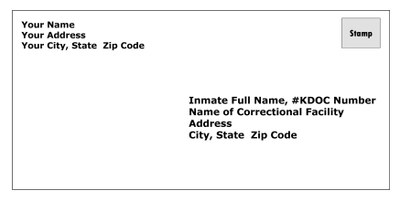
<span><br />To contact a male resident in the RDU, you may write to him at the following address until his approved phone list is activated:<br /></span><span> </span></div>
<p class="ARBodyText" style="padding-left: 60px; "><span>Resident’s Full Name,  KDOC# </span><span>XXXXX<br /></span><span>El Dorado Correctional Facility<br /></span><span>P.O. Box 311<br /></span><span>El Dorado, KS 67042</span><span> </span></p>
<p class="ARBodyText" style="padding-left: 30px; "><span></span><span>Female inmates may receive mail at:</span><span> </span></p>
<p class="ARBodyText" style="padding-left: 60px; "><span>Resident’s Full Name,  KDOC# </span><span>XXXXX<br /></span><span>Topeka Correctional Facility<br /></span><span>815 S.E. Rice Road<br /></span><span>Topeka, KS 66607</span></p>
<p class="ARBodyText" style="padding-left: 30px; "><strong>Please remember to include the resident’s full name and KDOC number in the address with all correspondence or the mail will not be delivered. The envelope also must contain the sender’s full name and address as well or the letter will not be delivered. Please note that all mail is subject to search.  </strong></p>
<p style="padding-left: 30px; ">Example:</p>
<p class="ARBodyText" style="padding-left: 30px; "><span><span><span><img class="image-inline" src="../../images/KDOC%20Envelope.jpg/@@images/image/preview" /></span></span></span></p>
<p style="padding-left: 30px; ">For more information about resident mail, please review <a href="http://www.dc.state.ks.us/kdoc-policies/kar/Article12.pdf/">Kansas Administrative Regulation (K.A.R.) 44-12-601, Inmate Writing and Other Inmate Communications or Publications</a>. Also, <a href="http://www.dc.state.ks.us/kdoc-policies/impp/chapter-12/12120.pdf/">Internal Management Policy and Procedure (IMPP) 12-120 Secuirty and Control: Control of Inmate Personal Property</a> provides additional information.</p>
<p class="ARBodyText" style="text-align: center; "><span><span><span></span></span></span>___________________________________________________________________________</p>
<h3 class="ARBodyText"><span><span><span><br />Telephone and Emergencies<a name="Telephone and Emergencies"></a></span></span></span></h3>
<ul>
<li>
<div class="ARBodyText"><strong>Can an inmate make phone calls while in RDU?<br /></strong>Yes. residents are permitted telephone privileges to make collect/pre-paid calls shortly after the reception process begins. Residents cannot receive calls. Upon admission, the resident fills out a phone list of those numbers that the resident would like to call. The resident will update the phone list every 120 days thereafter. Every number that a resident requests be added to the call list will be contacted by staff, verified and asked if the person wants to be on the resident's call list. The numbers are then activated through the facility’s phone system in approximately one week. Residents may establish a telephone list of up to 20 individual phone numbers.</div>
</li>
</ul>
<p>If you need additional information on theresident telephone process including how to establish an account, please visit the <a class="internal-link" href="../inmate-communications/inmate-telephone">Resident Communications section </a>and/or review <a href="../../kdoc-policies/impp/chapter-10/10111.pdf/">Internal Management Policy and Procedure (IMPP) 10-111 Programs and Services: Inmate Access to Facility and Coinless Telephones</a>.  </p>
<ul>
<ul>
<li><strong>How can I reach a resident in an emergency?</strong><br />In the event of a verifiable emergency such as a serious illness or death in the family, you may call the facility. Callers must provide a call back number and their relation to the inmate. Staff will also need the nature of the emergency, the name of the person who is sick or has passed away, the person’s relation to the resident and the name and contact information for the hospital or funeral home.</li>
Before the message will be given to the resident, facility staff will contact the hospital or funeral home to verify the information that you have provided concerning the emergency. Once the message is verified, the resident will be notified. Staff may discuss options with you for notifying the resident including if you would like to tell the resident or if you prefer a chaplain or counselor relay the information. </ul>
</ul>
<p></p>
<p class="ARBodyText" style="text-align: center; "><span><span><span></span></span></span>___________________________________________________________________________</p>
<ul></ul>
<ul></ul>
<ul></ul>
<ul></ul>
<ul></ul>
<ul></ul>
<ul></ul>
<ul></ul>
<h3><br />Other General RDU Questions<a name="Other Questions"></a></h3>
<ul>
<li> <strong>How does the KDOC determine where a resident will be housed?</strong></li>
</ul>
<p class="ARBodyText" style="padding-left: 30px; ">When bed space and programming slots become available in coordination with medical consultation, a resident’s facility placement is determined. If an offender is a recent parolee or post-release violator and not a new commitment to the KDOC, theresident could be placed wherever space is available in the KDOC system based on an resident’s classification status.</p>
<ul>
<li><strong>How can an resident address his/her questions while in RDU?<br /></strong>A form, called a Form-9,  is available to the resident as a formal procedure to address any questions or concerns. After the form is completed, theresident must turn it in to the security staff. After receiving the Form-9, the staff will have 10 days to respond to the resident’s request. </li>
<li><strong>What medical/dental/mental health services are available at RDU?<br /></strong>Within the first three days at RDU, the resident will be assessed for medical needs. Within seven days of being newly admitted and within 30 days for parole violators, each resident receives a dental exam. If major dental work is required, this will be done once the resident is transferred out of RDU to a permanent facility. Mental health services also are available. </li>
</ul>
<p class="ARBodyText" style="text-align: center; "><span><span><span></span></span></span>___________________________________________________________________________</p>]]></content:encoded>
    <dc:publisher>No publisher</dc:publisher>
    <dc:creator>Nancy Burghart</dc:creator>
    <dc:rights></dc:rights>
    <dc:date>2014-01-08T22:10:00Z</dc:date>
    <dc:type>Page</dc:type>
  </item>


</rdf:RDF>