<?xml version="1.0" encoding="utf-8" ?>
<rdf:RDF xmlns:rdf="http://www.w3.org/1999/02/22-rdf-syntax-ns#" xmlns:dc="http://purl.org/dc/elements/1.1/" xmlns:syn="http://purl.org/rss/1.0/modules/syndication/" xmlns="http://purl.org/rss/1.0/">


<channel rdf:about="https://www.doc.ks.gov/search_rss">
  <title>public</title>
  <link>https://www.doc.ks.gov</link>

  <description>
    
            These are the search results for the query, showing results 99 to 113.
        
  </description>


  <image rdf:resource="https://www.doc.ks.gov/logo.png"/>

  <items>
    <rdf:Seq>
      
        <rdf:li rdf:resource="https://www.doc.ks.gov/kdoc-policies/impp-distribution-summaries/2013-distribution-summaries/summary-12-31-13-600.pdf"/>
      
      
        <rdf:li rdf:resource="https://www.doc.ks.gov/help-out/mentoring/brochure"/>
      
      
        <rdf:li rdf:resource="https://www.doc.ks.gov/newsroom/legislative/2014/senate-1-23-2014"/>
      
      
        <rdf:li rdf:resource="https://www.doc.ks.gov/facilities/wcf/contact"/>
      
      
        <rdf:li rdf:resource="https://www.doc.ks.gov/facilities/ncf/visit/rules"/>
      
      
        <rdf:li rdf:resource="https://www.doc.ks.gov/juvenile-services/supervision-standards/jias/glossary"/>
      
      
        <rdf:li rdf:resource="https://www.doc.ks.gov/victim-services/publications/newsletters/fall-2013-newsletter"/>
      
      
        <rdf:li rdf:resource="https://www.doc.ks.gov/facilities/faq/questions"/>
      
      
        <rdf:li rdf:resource="https://www.doc.ks.gov/facilities/faq/rdu"/>
      
      
        <rdf:li rdf:resource="https://www.doc.ks.gov/facilities/faq/locating"/>
      
      
        <rdf:li rdf:resource="https://www.doc.ks.gov/facilities/lcf/visit/faq"/>
      
      
        <rdf:li rdf:resource="https://www.doc.ks.gov/facilities/hcf/programs/reentry"/>
      
      
        <rdf:li rdf:resource="https://www.doc.ks.gov/facilities/ecf/programs-1"/>
      
      
        <rdf:li rdf:resource="https://www.doc.ks.gov/facilities/ecf/history"/>
      
      
        <rdf:li rdf:resource="https://www.doc.ks.gov/facilities/edcf/programs"/>
      
    </rdf:Seq>
  </items>

</channel>


  <item rdf:about="https://www.doc.ks.gov/kdoc-policies/impp-distribution-summaries/2013-distribution-summaries/summary-12-31-13-600.pdf">
    <title>600 -- 12/31/13</title>
    <link>https://www.doc.ks.gov/kdoc-policies/impp-distribution-summaries/2013-distribution-summaries/summary-12-31-13-600.pdf</link>
    <description>Distribution #600: IMPPs 14-107, 14-149, 19-101</description>
    
    <dc:publisher>No publisher</dc:publisher>
    <dc:creator>Libby Snider</dc:creator>
    <dc:rights></dc:rights>
    <dc:date>2014-03-17T19:42:18Z</dc:date>
    <dc:type>File</dc:type>
  </item>


  <item rdf:about="https://www.doc.ks.gov/help-out/mentoring/brochure">
    <title>Brochure</title>
    <link>https://www.doc.ks.gov/help-out/mentoring/brochure</link>
    <description>M4S Brochure</description>
    
    <dc:publisher>No publisher</dc:publisher>
    <dc:creator>cherylca</dc:creator>
    <dc:rights></dc:rights>
    <dc:date>2014-02-18T19:25:36Z</dc:date>
    <dc:type>File</dc:type>
  </item>


  <item rdf:about="https://www.doc.ks.gov/newsroom/legislative/2014/senate-1-23-2014">
    <title>Senate 1 23 2014</title>
    <link>https://www.doc.ks.gov/newsroom/legislative/2014/senate-1-23-2014</link>
    <description>Overview of the Kansas Department of Corrections to:Senate Committee on Federal and State Affairs: Presented by Secretary Ray Roberts (January 23, 2014)
</description>
    
    <dc:publisher>No publisher</dc:publisher>
    <dc:creator>cherylca</dc:creator>
    <dc:rights></dc:rights>
    <dc:date>2014-01-23T20:47:00Z</dc:date>
    <dc:type>File</dc:type>
  </item>


  <item rdf:about="https://www.doc.ks.gov/facilities/wcf/contact">
    <title>Contact Information</title>
    <link>https://www.doc.ks.gov/facilities/wcf/contact</link>
    <description></description>
    <content:encoded xmlns:content="http://purl.org/rss/1.0/modules/content/"><![CDATA[<p></p>
<blockquote>
<div class="columns"><strong><br /></strong></div>
<table class="plain" style="width: 400px;">
<thead>
<tr>
<td colspan="2" style="text-align: center; "><strong>Winfield Correctional Facility (WCF)<br />Mailing Address</strong><br />Winfield Correctional Facility<br />1806 Pinecrest Circle<br />Winfield, KS 67156</td>
</tr>
<tr>
<td colspan="2" style="text-align: center; "><strong>Administration</strong></td>
</tr>
</thead>
<tbody></tbody>
<tbody>
<tr>
<td>Warden</td>
<td>Paul Snyder</td>
</tr>
<tr>
<td>Deputy Warden</td>
<td>Mary Nelson</td>
</tr>
<tr>
<td>Chief of Security</td>
<td>Maj. Mike Jones</td>
</tr>
<tr>
<td>Business Manager</td>
<td>Morea Simmons</td>
</tr>
<tr>
<td>Human Resources Manager</td>
<td>Julie St. Peter</td>
</tr>
</tbody>
</table>
<blockquote>
<p> </p>
<div class="columns"><strong><br /></strong></div>
<table class="plain" style="width: 400px;">
<thead>
<tr>
<td colspan="2" style="text-align: center; "><strong>WCF Main Phone: (620) 221-6660</strong></td>
</tr>
</thead>
<tbody></tbody>
<tbody>
<tr>
<td style="text-align: left; "><strong>Division</strong></td>
<td><strong>Extension</strong></td>
</tr>
<tr>
<td>Administration:</td>
<td>56019</td>
</tr>
<tr>
<td>Admissions &amp; Discharge:</td>
<td>56200</td>
</tr>
<tr>
<td>Accounts Payable:</td>
<td>56012 or 56011</td>
</tr>
<tr>
<td>Business Manager:</td>
<td>56013</td>
</tr>
<tr>
<td>Chaplain Services:</td>
<td>56026</td>
</tr>
<tr>
<td>Classification Administrator:</td>
<td>56040</td>
</tr>
<tr>
<td>Detail Office:</td>
<td>56219</td>
</tr>
<tr>
<td>Human Resources:</td>
<td>56021 or 56020</td>
</tr>
<tr>
<td>Inmate Accounts/Skylight Cards:</td>
<td>56011</td>
</tr>
<tr>
<td>Inmate Telephones:</td>
<td>56015</td>
</tr>
<tr>
<td>Parole Services:</td>
<td>56024</td>
</tr>
<tr>
<td>Records:</td>
<td>56049 or 56050</td>
</tr>
<tr>
<td>Security:</td>
<td>56038</td>
</tr>
<tr>
<td>Training:</td>
<td>56035 or 56014</td>
</tr>
<tr>
<td>Visitation:</td>
<td>56022</td>
</tr>
</tbody>
</table>
<p></p>
<blockquote>
<div class="columns"><strong><br /></strong></div>
<table class="plain" style="width: 300px;">
<thead>
<tr>
<td colspan="2" style="text-align: center; "><strong>WCF Main Fax: (620) 221-9229</strong></td>
</tr>
</thead>
<tbody></tbody>
<tbody>
<tr>
<td>Records Fax:</td>
<td>(620) 221-0106</td>
</tr>
</tbody>
</table>
<p></p>
<blockquote>
<div class="columns"><strong><br /></strong></div>
<table class="plain" style="width: 300px;">
<thead>
<tr>
<td colspan="2" style="text-align: center; "><strong>Wichita Work Release Facility (WWRF)<br />Mailing Address:<br /></strong>401 S. Emporia St.<br />Wichita, KS 67202</td>
</tr>
</thead>
<tbody></tbody>
<tbody>
<tr>
<td>Phone:</td>
<td>(316) 265-5211</td>
</tr>
<tr>
<td>Fax:</td>
<td>(316) 262-5936</td>
</tr>
</tbody>
</table>
<ul style="text-align: center; ">
<ul></ul>
<ul></ul>
</ul>
</ul>
</blockquote>
<blockquote>
<p style="text-align: center; "><span class="internal"><br /><a class="internal" href="overview">Overview </a></span>| <a class="internal" href="visit">Visitor Information<span class="internal"> </span></a>|<span class="internal"> <a class="internal" href="programs-1">Programs </a></span>| <a class="internal" href="history">History<span class="internal"> </span></a>| <a class="internal" href="warden"><span class="internal">Warden</span></a><br />____________________________________________________________________________</p>
</blockquote>
<blockquote></blockquote>
</blockquote>
</blockquote>
</blockquote>]]></content:encoded>
    <dc:publisher>No publisher</dc:publisher>
    <dc:creator>cherylca</dc:creator>
    <dc:rights></dc:rights>
    <dc:date>2014-01-21T22:10:00Z</dc:date>
    <dc:type>Page</dc:type>
  </item>


  <item rdf:about="https://www.doc.ks.gov/facilities/ncf/visit/rules">
    <title>Standard Visitation Guidelines</title>
    <link>https://www.doc.ks.gov/facilities/ncf/visit/rules</link>
    <description>NCF General Order 16-101, Attachment B, Effective 11-22-2019
</description>
    <content:encoded xmlns:content="http://purl.org/rss/1.0/modules/content/"><![CDATA[<h2 style="text-align: center; "><br />NCF STANDARD VISITATION GUIDELINES</h2>
<p></p>
<p></p>
<div class="columns"><strong><br /></strong></div>
<table class="plain" style="width: 620px;">
<thead></thead>
<tbody></tbody>
<tbody>
<tr>
<td>
<p>1.</p>
</td>
<td>
<p>Prior to visiting a resident at NCF, each visitor shall be on the resident's visiting list in the KDOC Visitation Database. General procedures governing resident visitation are established in KAR 44-7-104, IMPPs 10-113 and 11-101, and NCF G.O. 16-101.</p>
</td>
</tr>
<tr>
<td>
<p>2.</p>
</td>
<td>
<p>Regular visiting hours are 8:30 a.m. to 2:30 p.m. on Saturdays and Sundays; and Memorial Day, July 4<sup>th</sup>, Thanksgiving, and Christmas. Visitors shall not be processed in for a visit after 2:00 p.m.</p>
</td>
</tr>
<tr>
<td>3.</td>
<td>
<p>Volunteers shall not be placed on resident visiting lists. Members of the clergy and Mentoring 4 Success sponsors are exceptions.</p>
</td>
</tr>
<tr>
<td>4.</td>
<td>
<p>Visitors may only appear on one resident's visiting list except when visitor and more than one resident are members of the same immediate family. Immediate family is defined as parents, step-parents, siblings, spouses of siblings, half-siblings, step-siblings, children, spouses of children, step-children, grandchildren, step-grandchildren, spouse, parents of spouse, grandparents, or any person who has filled the role of parent de facto.</p>
</td>
</tr>
<tr>
<td>
<p> 5.</p>
</td>
<td>
<p>Persons under age eighteen (18), except a spouse, shall not visit unless they are members of the resident's immediate family as described in #4 above and are accompanied by an adult per KAR 44-7-104(a)(2)(B). Parents/guardians are responsible for monitoring behavior of their children. Spanking/corporal punishment shall not be allowed.</p>
</td>
</tr>
<tr>
<td>
<p> 6.</p>
</td>
<td>
<p>Visitors shall present photo-ID prior to each visit. A marriage license or birth certificate shall be required for persons under age sixteen (16) who cannot produce a photo ID. Persons unable to produce positive ID shall not visit.</p>
</td>
</tr>
<tr>
<td>7.</td>
<td>
<p>All visitors shall check in at Control Center (Dispatch at East Unit) and sign the visiting register. Once signed in for a day of visiting, visitors shall not leave and return the same day. Due to limited waiting areas, persons not visiting shall not loiter on facility grounds.</p>
</td>
</tr>
<tr>
<td>8.</td>
<td>
<p>Visitors are subject to search per IMPP 12-115 and must be processed through the Entry/Screening post. Signs are displayed near entrances which read: </p>
<p style="padding-left: 30px; ">In English:  "All persons entering upon these grounds are subject to routine searches of their person, property, or packages.", and</p>
<p style="padding-left: 30px; ">In Spanish:  "Todas personas que entren en esta terretorio tendran que ser esculcadas rutinamenta de persona, propriedades, o paquetes."</p>
</td>
</tr>
<tr>
<td>9.</td>
<td>
<p>If a resident refuses to see a particular visitor, such refusal shall be noted in the resident's visiting record.</p>
</td>
</tr>
<tr>
<td>10.</td>
<td>
<p>Coats, jackets, hats, and other seasonal outer wear shall be hung on hangers provided in the visiting area. Specific types of clothing are not considered appropriate for prison visitation and include, but are not limited to:</p>
<p style="padding-left: 30px; ">a. See-through blouses, shirts, or skirts;<br />b. Tank tops and/or halter tops;<br />c. Dresses/blouses with revealing, low-cut necklines;<br />d. Braless attire;<br />e. Dresses or skirts split at front, back, or sides;<br />f. Bare feet; and,<br />g. Shorts, Bermuda shorts, or cut-offs (children under 10 years of age may wear appropriate shorts during summer months)</p>
<p><em>* NCF reserves the right to deny access to visitors considered by the shift supervisor to be inappropriately attired.</em></p>
</td>
</tr>
<tr>
<td>11.</td>
<td>
<p>Except as permitted during Minimum Security Seasonal Outdoor Visiting, visitors shall not bring any item of personal property to the facility for residents and shall not exchange items in visiting areas with residents.</p>
<p><strong>PLEASE NOTE:  TRAFFICKING IN CONTRABAND IN A CORRECTIONAL INSTITUTION IS ILLEGAL</strong> in accordance with KAR 44-2-103 and is a severity level 5 or 6, non-person <strong>FELONY</strong> (depending on the circumstances involved) under KSA 21-3826.</p>
</td>
</tr>
<tr>
<td>12.</td>
<td>
<p>Visitors shall lock valuables in their vehicle or in Gatehouse lockers (including purses, wallets, keys, and books). Necessary heart medicines and oxygen tanks shall be exempt. Cell phones, batteries, chargers, and cameras must be secured in vehicles. NCF shall not be responsible for items of personal property.</p>
</td>
</tr>
<tr>
<td>13.</td>
<td>
<p>The only items visitors may bring into the visiting area are:</p>
<p style="padding-left: 30px; ">a. Money for vending machines and food (maximum amount of $30.00);<br />b. Photo identification;<br />c. Issued Gatehouse locker key;<br />d. Infant carrier;<br />e. One (1) diaper bag containing:</p>
<ul>
<ul>
<ul>
<li>three (3) diapers (cloth or disposable) and reasonable amounts of extra baby clothing;</li>
<li>two (2) infant bottles (with milk or juice) and/or two (2) training cups (with lids);</li>
<li>one (1) baby or toddler cereal bowl (with baby food and utensils);</li>
<li>one (1) infant blanket;</li>
<li>two (2) infant toys/rattles;</li>
<li>one (1) tube of diaper rash ointment or baby lotion; and,</li>
<li>one (1) wet wipes dispenser.</li>
</ul>
</ul>
</ul>
</td>
</tr>
<tr>
<td>14.</td>
<td>
<p>Vending machines are available for use by visitors, however, NCF staff shall not provide change. NCF and staff shall not be responsible for losses incurred due to vending machine malfunctions.  All losses should be reported to the vendor.</p>
</td>
</tr>
<tr>
<td>15.</td>
<td>
<p>Facility staff shall not accept funds from visitors. Money orders, certified, or cashier checks may be mailed (with a required deposit coupon) to Centralized Inmate Banking (CIB) at Lansing Correctional Facility (LCF) for deposit. Western Union and/or GTL services may also be used to transmit funds.</p>
</td>
</tr>
<tr>
<td>16.</td>
<td>
<p>Members of the clergy, when properly identified, may visit residents during regular visiting hours. Private consultation rooms may be utilized. Special visits by clergy shall be arranged through both Unit Team and the NCF Chaplain.</p>
</td>
</tr>
<tr>
<td>17.</td>
<td>
<p>Ex-residents shall not visit without prior written approval of the Warden or designee. Visitors on post-release supervision (probation/parole) shall not visit without prior written authorization of their probation/parole officer and the Warden.</p>
</td>
</tr>
<tr>
<td>18.</td>
<td>
<p>Former KDOC employees and former contract employees shall not visit for a minimum of two (2) years following termination of employment. Approval of visits after two (2) years shall be at the discretion of the Warden.</p>
</td>
</tr>
<tr>
<td>19.</td>
<td>
<p>Residents shall not take legal documents to the Visiting Room for discussion with their attorney of record without prior approval of the Warden or designee. Inspection of this material shall be limited to that which is necessary to determine its legal or non-legal nature.</p>
</td>
</tr>
<tr>
<td>20.</td>
<td>
<p>Attorneys of record for the resident visited shall not carry any items or papers into the Visiting Room without prior approval of the Warden or designee.</p>
</td>
</tr>
<tr>
<td>21.</td>
<td>
<p>Residents shall not sign documents in the Visiting Room without approval of the Warden or designee.</p>
</td>
</tr>
<tr>
<td>22.</td>
<td>
<p>Residents shall be allowed to bring <span>only</span> the following items into the Visiting area:</p>
<p style="padding-left: 30px; ">a. Comb<br />b. Wedding band<br />c. Prescription eyeglasses<br />d. Approved religious medallion<br />e. Room key - (A and C Unit residents only)</p>
</td>
</tr>
<tr>
<td>23.</td>
<td>
<p>Contact visits shall be limited to a brief embrace and kiss at the beginning and end of the visit. Visits may be terminated for excessive physical contact. Visits shall be terminated when resident-visitor conduct disrupts others. Mothers may breastfeed children per KSA 43-158.</p>
</td>
</tr>
<tr>
<td>24.</td>
<td>
<p>Visitors shall not photograph NCF buildings, grounds, or residents. Persons taking unauthorized photographs shall surrender film or digital media to staff.</p>
</td>
</tr>
<tr>
<td>25.</td>
<td>
<p>Persons suspected of being under the influence of alcohol or drugs shall be denied visiting privileges.</p>
</td>
</tr>
<tr>
<td>26.</td>
<td>
<p>NCF is a tobacco-free environment.  All smoking paraphernalia (lighters/matches), tobacco products, and tobacco substitutes shall be secured in vehicles.</p>
</td>
</tr>
<tr>
<td>27.</td>
<td>
<p>Visitors shall not bring pets onto facility grounds in accordance with NCF G.O. 15-104.</p>
</td>
</tr>
</tbody>
</table>
<p style="text-align: center; "><span class="internal"><a class="internal" href="overview">Overview</a> </span>| <a class="internal internal-link" href="visit">Visitor Information<span class="internal"> </span></a>|<span class="internal"> <a class="internal" href="programs-1">Programs</a> </span>| <a class="internal-link" href="../history"><span class="internal">History</span></a><span class="internal"> </span>| <a class="internal" href="warden"><span class="internal">Warden</span><br /></a>____________________________________________________________________________</p>]]></content:encoded>
    <dc:publisher>No publisher</dc:publisher>
    <dc:creator>Lisa Herman</dc:creator>
    <dc:rights></dc:rights>
    <dc:date>2014-01-16T22:15:00Z</dc:date>
    <dc:type>Page</dc:type>
  </item>


  <item rdf:about="https://www.doc.ks.gov/juvenile-services/supervision-standards/jias/glossary">
    <title>Glossary</title>
    <link>https://www.doc.ks.gov/juvenile-services/supervision-standards/jias/glossary</link>
    <description></description>
    
    <dc:publisher>No publisher</dc:publisher>
    <dc:creator>cherylca</dc:creator>
    <dc:rights></dc:rights>
    <dc:date>2014-01-16T16:49:01Z</dc:date>
    <dc:type>File</dc:type>
  </item>


  <item rdf:about="https://www.doc.ks.gov/victim-services/publications/newsletters/fall-2013-newsletter">
    <title>Fall 2013 Newsletter </title>
    <link>https://www.doc.ks.gov/victim-services/publications/newsletters/fall-2013-newsletter</link>
    <description>See the latest from the Office of Victims Services in the Fall edition of THE BEACON.</description>
    
    <dc:publisher>No publisher</dc:publisher>
    <dc:creator>Kimberly_Marotta</dc:creator>
    <dc:rights></dc:rights>
    <dc:date>2014-01-15T20:37:29Z</dc:date>
    <dc:type>File</dc:type>
  </item>


  <item rdf:about="https://www.doc.ks.gov/facilities/faq/questions">
    <title>General Questions</title>
    <link>https://www.doc.ks.gov/facilities/faq/questions</link>
    <description></description>
    <content:encoded xmlns:content="http://purl.org/rss/1.0/modules/content/"><![CDATA[<p></p>
<ul>
<li><strong><a class="anchor-link" href="#smoking">Is smoking allowed by staff and residents?</a></strong></li>
<li><strong><a class="anchor-link" href="#air conditioned">Are the resident living units air conditioned?</a></strong></li>
<li><strong><a class="anchor-link" href="#maxiumum security">Why is a non-maximum custody resident in a maximum-security facility?</a></strong></li>
<li><strong><a class="anchor-link" href="#electronic equipment 1">Why are residents allowed to possess electronic equipment (radios, televisions, mp3 players, etc.,)?</a></strong></li>
<li><strong><a class="anchor-link" href="#electronic equipment 2">Who provides funding for residents to obtain electronic equipment while in prison?</a></strong></li>
<li><strong><a class="anchor-link" href="#equipment funded">How is recreation/leisure time equipment funded for the resident population?</a></strong></li>
<li><strong><a class="anchor-link" href="#canteen equipment">What is available in the facility canteen for residents to purchase?</a></strong></li>
<li><strong><a class="anchor-link" href="#compensation">Are residents compensated when assigned to work programs?</a></strong></li>
<li><strong><a class="anchor-link" href="#work details">Are resident work details available to perform work for community organizations?</a></strong></li>
<li><strong><a class="anchor-link" href="#financially responsible">Are residents financially responsible for housing and services they receive while incarcerated?</a></strong></li>
<li><strong><a class="anchor-link" href="#transfer">What is an inter-facility transfer?</a></strong></li>
<li><strong><a class="anchor-link" href="#compact">What is the interstate compact?</a></strong></li>
<li><strong><a class="anchor-link" href="#lockdown">What is a lockdown?</a></strong></li>
<li><strong><a class="anchor-link" href="#good time">What is good time?</a></strong></li>
<li><strong><a class="anchor-link" href="#sentence computation">How is an resident's sentence computed and how does good time work?</a></strong></li>
<li><strong><a class="anchor-link" href="#sex offender mgmt">What does sex offender management status mean?</a></strong></li>
<li><strong><a class="anchor-link" href="#status change">Can a resident sex offender management status be changed?</a></strong></li>
<li><strong><a class="anchor-link" href="#religious">Are religious services/programs available to residents?</a></strong></li>
<li><strong><a class="anchor-link" href="#wedding">Can a resident and I have a wedding ceremony in a correctional facility?</a></strong></li>
<li><strong><a class="anchor-link" href="#bedside">Can a resident be released to attend a funeral or make a bedside visit?</a></strong></li>
<li>
<div class="ARBodyText"><strong><a class="anchor-link" href="#functional">What is a functional incapacitation release?</a></strong></div>
</li>
<li><strong><a class="anchor-link" href="#legal services">Are there legal services available to an resident?</a></strong></li>
<li><strong><a class="anchor-link" href="#release day">What happens the day of release?</a></strong></li>
</ul>
<p class="indent" style="text-align: center; ">____________________________________________________________________________</p>
<p><strong>Is smoking allowed by staff and residents?<a name="smoking"></a> <br /></strong>No. The KDOC became a tobacco-free environment in March 2003.</p>
<p><strong>Are the resident living units air conditioned?<a name="air conditioned"></a><br /></strong>No. However, residents housed in facilities with or without appropriate circulation or air-handling systems are permitted to have an electric fan in their cell/bunk-area except as required for safety and/or security considerations. Fans are purchased with Inmate Benefit Fund monies for indigent residents. Non-indigent residents may purchase fans through the facility's canteen.</p>
<p><strong>Why is a non-maximum custody resident in a maximum-security facility?</strong></p>
<p>The security designation of a correctional facility is based upon its physical attributes (i.e., architectural, environmental) and, as it relates to residents, the type of physical constraints deemed appropriate for a particular resident. The security designation represents the highest custody resident that the facility may hold. For example, a maximum-security facility is capable of housing minimum-, medium- and maximum-custody residents. A minimum-security facility is capable of housing only minimum-custody residents. </p>
<p><strong>Why are residents allowed to possess electronic equipment (radios, televisions, mp3 players, etc.,)?<a name="electronic equipment 1"></a><br /></strong>Eligible residents are allowed to possess electronic equipment in an effort to prevent problems due to resident idleness.</p>
<p><strong>Who provides funding for residents to obtain electronic equipment while in prison?<a name="electronic equipment 2"></a><br /></strong>Residents are responsible for providing their own electronic equipment through personal funds derived from assigned work programs or funds sent in from outside sources.</p>
<p><strong>How is recreation/leisure time equipment funded for the resident population?<a name="equipment funded"></a><br /></strong>Equipment is provided through the Inmate Benefit Fund. The majority of the fund is comprised of proceeds from the resident canteen contract and telephone services.</p>
<p><strong>What is available in the facility canteen for residents to purchase?<a name="canteen equipment"></a><br /></strong>A facility canteen is a store through which residents are provided an opportunity to purchase allowable items such as for hygiene, snacks or other property items. For a list of available items and the cost of the items, please <strong><a class="internal-link" href="../canteen">visit the canteen section</a>.</strong></p>
<p><strong>Are residents compensated when assigned to work programs?<a name="compensation"></a><br /></strong>Depending on skill level, residents may earn from $0.45 to $1/05 per day.</p>
<p><strong>Are resident work details available to perform work for community organizations?<a name="work details"></a><br /></strong>Please check with <a class="internal-link" href="../index">each individual correctional facility </a>directly for information regarding assistance with local government or public non-profit organization projects.</p>
<p><strong>Are residents financially responsible for housing and services they receive while incarcerated?<a name="financially responsible"></a><br /></strong>During incarceration, residents are assessed the following fees:</p>
<ul>
<li>
<div class="ul">$2.00 sick call fee per visit if medical and dental services are initiated by the resident. Funds collected assist the Department in offsetting costs associated with health care contracts.</div>
</li>
<li>
<div class="ul">$1.00 monthly administrative fee for handling of resident trust funds. Collected fees are placed in the Crime Victims Compensation Fund.</div>
</li>
<li>
<div class="ul">$5.35 fee for each urinalysis test having positive result is assessed upon conclusion of the disciplinary process if the resident is found guilty. Collected fees are utilized to defray costs incurred in administering urinalysis tests.</div>
</li>
<li>
<div class="ul">Residents employed by private industry receive minimum wage and above. These residents are responsible for paying the State of Kansas 25% of gross wages per week for room and board. In addition, their earnings are subject to the following deductions: taxes, mandatory savings, victim restitution, dependent support, and fines/court costs.</div>
</li>
<li>
<div class="ul">Funds that residents receive from sources exterior to the Kansas Department of Corrections are subject to a 10% mandatory savings withholding (after deduction of any outstanding obligations), with the proceeds to be deposited into a mandatory savings account, which will accrue interest. These funds are provided to the resident upon release to assist them in improving their chance for a successful transition into society.</div>
</li>
</ul>
<p><strong><br />What is an inter-facility transfer?<a name="transfer"></a></strong><br />Residents may be transferred to any KDOC facility consistent with the custody classification, gender and other medical and/or programmatic needs of the resident and/or the management and operational needs of the KDOC.</p>
<p class="ARBodyText">A resident initiated, inter-facility transfer request must be submitted to the resident's unit team counselor through a Form-9. Residents in need of security transfers are given priority followed by those who have medical and mental health issues and program needs. Visitation is important but does not take priority over these other transfer needs. As much as the KDOC would like to house all residents near family and support group members, the KDOC is not able to accommodate every visitation transfer request. Those residents with the best record and who have waited the longest are given priority in granting visitation transfers.</p>
<p class="ARBodyText"><strong>What is the interstate compact?<a name="compact"></a></strong><br />Kansas has adopted an interstate compact with approximately 30 states that allows for the placement of a small number of Kansas residents in those states as needed for security considerations and subject to the approval of the other state. Interstate compact transfers are not considered for visitation purposes. </p>
<p class="ARBodyText"><strong>What is a lockdown?<a name="lockdown"></a></strong><br />Although infrequent, a lockdown can occur in cases of emergencies, disturbances or disruptions of a general nature or that involve a substantial number of residents. While in lockdown status, residents remain in their cells. Visitation, phone calls, along with resident work programs and activities, are halted during a lockdown. </p>
<p><strong>What is good time?<a name="good time"></a><br /></strong>Residents who demonstrate good work and behavior are eligible to earn good time credits which decrease part of the term of their incarceration.</p>
<p class="ARBodyText">Residents sentenced under the indeterminate sentencing structure are eligible to earn good time credits at a rate of 50 percent (one day earned for one day served). Residents sentenced under the determinate sentencing structure are eligible to earn good time credits at a rate of either 15 percent or 20 percent, depending on the date the crime was committed. Offenders sentenced under the determinate sentencing structure are also eligible to earn good time credits during their period of post-release supervision at a rate of 50 percent.</p>
<p class="ARBodyText">Good time credits may be withheld or forfeited for failure to comply with rules and regulations, resulting in the resident remaining in prison for a longer period of time. Good time credits withheld or forfeited on post-release supervision will result in the offender remaining under supervision for a longer period of time. </p>
<p><strong>How is an resident's sentence computed and how does good time work?<a name="sentence computation"></a><br /></strong>Please see the <strong><a class="external-link" href="http:// www.accesskansas.org/ksc">Kansas Sentencing Guidelines Desk Reference Manual</a></strong> available through the Kansas Sentencing Commission.</p>
<p class="ARBodyText">Residents earn good time in accordance with their sentences while incarcerated. The crime carrying the longest sentence and post-release time is the sentence that will be used to compute the amount of time that will be served.</p>
<p class="ARBodyText">Upon completion of the prison portion of the imposed sentence, a resident may be released to serve a term of post-release supervision, plus the amount of good time earned and retained while imprisoned.</p>
<p class="ARBodyText">If the resident is released to post release and finishes the post release without being revoked, the offender will then start serving the good time the offender earned while incarcerated. If the offender is on post release and is revoked, the offender will be brought back in to a correctional facility.</p>
<p class="ARBodyText">If the resident is a parole violator and was sentenced under the indeterminate sentencing law, the resident would be held until seen by the Kansas Parole Board.</p>
<p class="ARBodyText">Sentence computation is completed by a special unit at the KDOC’s central office.</p>
<p class="ARBodyText">Kansas sentencing laws are very complex and every detail cannot be covered here. This is intended to provide a general understanding of the good time processes. </p>
<p><strong>What does sex offender management status mean?<a name="sex offender mgmt"></a><br /></strong>The KDOC may manage residents as sex offenders based on their convictions or behavior. This status may affect the classification, visitation and available programming while incarcerated. It may also affect a resident's supervision upon release. This status may include any resident with one or more of the following: current sex crime conviction, prior adult or juvenile sex crime conviction, conviction for sexually-motivated crime, institutional behavior that shows a pattern of sexually-motivated behavior and/or designation as sex offender by the override panel. </p>
<p><strong>Can a resident's sex offender management status be changed?<a name="status change"></a><br /></strong>Residents may request an override of their sex offender status by submitting a request that includes the specific guidelines they would like changed to the Unit Team or Parole Officer, depending on the resident's or offender’s location. Specific sex offender conditions examples are: contact with minors, attending sex offender treatment or being managed as a sex offender.</p>
<p>The Unit Team or Parole Officer will complete and submit an override packet to the KDOC’s central office for review by an override panel, which meets once a month. </p>
<p><strong>Are religious services/programs available to residents?<a name="religious "></a><br /></strong>Every resident has the right to freedom of religious affiliation and voluntary worship. The exercise of such rights may be subject to the requirements of ensuring the safe, secure and orderly operation of the correctional facility. Chaplains and volunteers provide a range of religious services, pastoral counseling, study groups and other special events. </p>
<p><strong>Can a resident and I have a wedding ceremony in a correctional facility?<a name="wedding"></a><br /></strong>Yes. Residents make their request through the pastoral care department at which time the chaplain will follow a set of guidelines and protocol for the events leading up to the ceremony that must be approved by the Warden. This will include careful planning and may include marital counseling. The chaplain will lead the couple through this process and advise them of the criteria while keeping administrative staff informed of the proceedings.</p>
<p class="ARBodyText">All expenses associated with the marriage ceremony are the responsibility of the resident or prospective spouse. </p>
<p><strong>Can a resident be released to attend a funeral or make a bedside visit?<a name="bedside"></a><br /></strong>No. The loss of a loved one is a traumatic and stressful time that is intensified by also being incarcerated. In an effort to make this time as comfortable as possible for the resident, the KDOC has several resources available to the resident population.</p>
<p class="ARBodyText">The pastoral care department and mental health counselors along with unit staff work together to help an resident in his/her time of need.</p>
<p class="ARBodyText"><strong>What is a functional incapacitation release?<a name="functional"></a><br /></strong>Kansas law provides some residents, who are very ill, with the option to apply for a functional incapacitation release. Functional incapacitation is defined as a medical or mental health condition, including one rendering the resident terminally ill to the extent that death is imminent, resulting in the afflicted resident being incapable of causing physical harm.</p>
<p class="ARBodyText">Applications are submitted to the KDOC and subsequently referred to the Kansas Parole Board. The application cannot be approved unless the Parole Board determines that the resident is functionally incapacitated and does not pose a risk to public safety. </p>
<p><strong>Are there legal services available to an resident?<a name="legal services"></a><br /></strong>Residents also have access to a prison law library and legal materials through LexisNexis research which provides legal research materials.</p>
<p class="ARBodyText">Residents also may use a Form-9 or write a letter requesting services to obtain the assistance of Legal Services for Prisoners, Inc.</p>
<p class="ARBodyText">Legal Services for Prisoners, is a non-profit group that provides legal services to indigent residents in Kansas correctional facilities.  The program's goal is to ensure that residents' rights to the courts are met to pursue non-frivolous claims.  Funding for Legal Services for Prisoners is administered by the State Board of Indigents' Defense Services although the entity is not a state agency.</p>
<p class="ARBodyText">The program currently operates offices in El Dorado Correctional Facility, Lansing Correctional Facility, and Topeka  Correctional Facility. However, a resident may apply for services at any correctional facility. <a class="external-link" href="http://www.legalservicesforprisoners.org/">Legal Services for Prisoners.</a> For more information, contact Legal Services for Prisoners at (785) 746-7437. </p>
<p><strong>What happens the day of release?<a name="release day"></a><br /></strong>Each facility works with the resident to ensure the resident receives all remaining funds in his/her resident account. Transportation is established prior to the day of release and the resident is given civilian clothes to wear out of the facility. The resident will be given instructions on reporting to his/her parole officer upon release. The person picking up the resident must show their driver’s license to facility staff prior to leaving. </p>
<p class="indent" style="text-align: center; ">____________________________________________________________________________</p>]]></content:encoded>
    <dc:publisher>No publisher</dc:publisher>
    <dc:creator>Nancy Burghart</dc:creator>
    <dc:rights></dc:rights>
    <dc:date>2014-01-08T22:10:00Z</dc:date>
    <dc:type>Page</dc:type>
  </item>


  <item rdf:about="https://www.doc.ks.gov/facilities/faq/rdu">
    <title>Admission RDU</title>
    <link>https://www.doc.ks.gov/facilities/faq/rdu</link>
    <description>What is RDU?</description>
    <content:encoded xmlns:content="http://purl.org/rss/1.0/modules/content/"><![CDATA[<h2></h2>
<h2>Overview<a name="Overview"></a></h2>
<p class="ARBodyText">Upon admission, all residents are photographed, fingerprinted and placed in the Reception &amp; Diagnostic Unit (RDU). All residents are assigned to the intake level upon admission.</p>
<p class="ARBodyText">Male residents are initially housed at El Dorado Correctional Facility’s (EDCF) RDU. All female residents are housed at Topeka Correctional Facility (TCF) where the intake process occurs for females.</p>
<p class="ARBodyText">Residents are searched, showered and provided with a health evaluation. The resident's property will be inventoried and either issued to the resident or returned with officers transporting the resident to KDOC custody. Residents complete the RDU process in approximately two weeks though this time may vary. A permanent facility placement  for male residents may take up to two months. The initial classification process includes several tests, an interview and an evaluation of court documents and other information including physical, family and criminal history.</p>
<p class="ARBodyText">The process will determine the resident’s:</p>
<ul>
<li>Custody level</li>
<li>Service needs</li>
<li>Program needs including education</li>
<li>Facility placement.</li>
</ul>
<p><br />Residents also will undergo orientation. The resident will be provided with information about KDOC rules and regulations, behavioral expectations and the disciplinary process. Residents also are advised as to how to access medical, mental health, religious and educational services and programs. A staff member also will work with the resident on establishing a visiting and telephone list to communicate with family and friends.</p>
<p class="ARBodyText" style="text-align: center; "><span><span><span></span></span></span>___________________________________________________________________________ </p>
<ul>
<ul>
<ul>
<ul>
<ul>
<ul>
<ul>
<ul>
<ul>
<ul>
<li style="text-align: left; "><strong><a class="anchor-link" href="#Admission Property">Admission Property</a></strong></li>
<li style="text-align: left; "><strong><a class="anchor-link" href="#Visiting and Mail">Visiting &amp; Mail</a></strong></li>
<li style="text-align: left; "><strong><a class="anchor-link" href="#Telephone and Emergencies">Telephone &amp; Emergencies</a></strong></li>
<li style="text-align: left; "><a class="anchor-link" href="#Other Questions"><strong>Other General RDU Questions</strong><br /></a></li>
</ul>
</ul>
</ul>
</ul>
</ul>
</ul>
</ul>
</ul>
</ul>
</ul>
<p class="ARBodyText" style="text-align: center; "><span><span><span></span></span></span>_________________________________________________________________________</p>
<h3><strong><br />Admission Property:</strong> <a class="external-link" href="../../kdoc-policies/AdultIMPP/chapter-12/12120.pdf">Attachment H, IMPP 12-120</a><a name="Admission Property"></a></h3>
<p class="ARBodyText">Upon admission to the KDOC, residents are assigned to Intake Level. <a class="external" href="../../kdoc-policies/AdultIMPP/chapter-12/12120.pdf">Attachment H, IMPP 12-120</a> lists what items may be retained by resident when they are taken in to the custody of the KDOC. All other items are considered contraband.</p>
<p class="ARBodyText">Items not allowed by the KDOC will be subject to the policies and procedures of the facility from where the resident was held prior to KDOC custody, per IMPP 12-120, Security and Control: Control of Inmate Personal Property.</p>
<ul>
<li>
<div class="ARBodyText"><strong>What items are issued to an resident in RDU?</strong><br />Each inmate is provided with clean, durable and presentable clothing of the proper size that is suitable to climatic conditions, and basic hygiene items and shower shoes. Each resident also receives four pre-paid envelopes in their intake package. </div>
</li>
<li>
<div class="ARBodyText"><strong>What happens to the money that an inmate brings with him/her to RDU?</strong><br />If an inmate is in possession of any money, the funds will be placed in the inmate’s trust fund account. More information about sending money to an inmate can be found in the <a class="internal-link" href="../inmate-banking">Inmate Banking Section</a>. </div>
</li>
</ul>
<p class="ARBodyText" style="text-align: center; "><span><span><span></span></span></span>___________________________________________________________________________</p>
<h3 class="ARBodyText"><br />Visiting and Mail<a name="Visiting and Mail"></a> </h3>
<ul>
<ul>
<li>
<div class="ARBodyText"><strong>Can family members visit a resident in RDU?<br /></strong>No. All residents in the RDU process are at the Intake Level and have not yet earned visiting privileges. Visits are limited to attorneys, clergy and law enforcement until the resident earns a promotion to Incentive Level 1. While in RDU, a resident fills out a visitation form with the names he/she would like to be granted permission for visits when the resident has moved to the next incentive level. The resident is responsible for ensuring potential visitors receive visiting applications that must be approved before visitors will be allowed in to a correctional facility. The list will be valid for 45 days after leaving RDU. More information about the application process is available in the <a class="internal-link" href="visits">FAQs visiting section</a>.</div>
</li>
</ul>
</ul>
<div></div>
<div class="ARBodyText">
<ul>
<ul>
<li><strong>Can a resident send/receive mail while in RDU?<br /></strong><span>Yes. </span><span>You may send letters to a resident in the RDU; however, packages are not allowed</span><span>. Residents receive four pre-paid envelopes in their intake package. </span><span>Residents may not receive stamps through the mail.</span><span> </span><span>Stamps, envelopes and paper can be purchased through the facility’s canteen, a </span><span>store through which residents are provided an opportunity to purchase allowable items.</span></li>
</ul>
</ul>
<span><br />To contact a male resident in the RDU, you may write to him at the following address until his approved phone list is activated:<br /></span><span> </span></div>
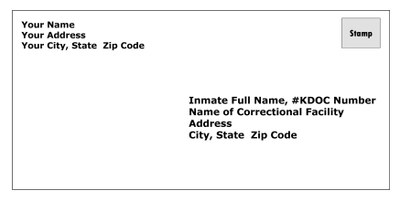
<p class="ARBodyText" style="padding-left: 60px; "><span>Resident’s Full Name,  KDOC# </span><span>XXXXX<br /></span><span>El Dorado Correctional Facility<br /></span><span>P.O. Box 311<br /></span><span>El Dorado, KS 67042</span><span> </span></p>
<p class="ARBodyText" style="padding-left: 30px; "><span></span><span>Female inmates may receive mail at:</span><span> </span></p>
<p class="ARBodyText" style="padding-left: 60px; "><span>Resident’s Full Name,  KDOC# </span><span>XXXXX<br /></span><span>Topeka Correctional Facility<br /></span><span>815 S.E. Rice Road<br /></span><span>Topeka, KS 66607</span></p>
<p class="ARBodyText" style="padding-left: 30px; "><strong>Please remember to include the resident’s full name and KDOC number in the address with all correspondence or the mail will not be delivered. The envelope also must contain the sender’s full name and address as well or the letter will not be delivered. Please note that all mail is subject to search.  </strong></p>
<p style="padding-left: 30px; ">Example:</p>
<p class="ARBodyText" style="padding-left: 30px; "><span><span><span><img class="image-inline" src="../../images/KDOC%20Envelope.jpg/@@images/image/preview" /></span></span></span></p>
<p style="padding-left: 30px; ">For more information about resident mail, please review <a href="http://www.dc.state.ks.us/kdoc-policies/kar/Article12.pdf/">Kansas Administrative Regulation (K.A.R.) 44-12-601, Inmate Writing and Other Inmate Communications or Publications</a>. Also, <a href="http://www.dc.state.ks.us/kdoc-policies/impp/chapter-12/12120.pdf/">Internal Management Policy and Procedure (IMPP) 12-120 Secuirty and Control: Control of Inmate Personal Property</a> provides additional information.</p>
<p class="ARBodyText" style="text-align: center; "><span><span><span></span></span></span>___________________________________________________________________________</p>
<h3 class="ARBodyText"><span><span><span><br />Telephone and Emergencies<a name="Telephone and Emergencies"></a></span></span></span></h3>
<ul>
<li>
<div class="ARBodyText"><strong>Can an inmate make phone calls while in RDU?<br /></strong>Yes. residents are permitted telephone privileges to make collect/pre-paid calls shortly after the reception process begins. Residents cannot receive calls. Upon admission, the resident fills out a phone list of those numbers that the resident would like to call. The resident will update the phone list every 120 days thereafter. Every number that a resident requests be added to the call list will be contacted by staff, verified and asked if the person wants to be on the resident's call list. The numbers are then activated through the facility’s phone system in approximately one week. Residents may establish a telephone list of up to 20 individual phone numbers.</div>
</li>
</ul>
<p>If you need additional information on theresident telephone process including how to establish an account, please visit the <a class="internal-link" href="../inmate-communications/inmate-telephone">Resident Communications section </a>and/or review <a href="../../kdoc-policies/impp/chapter-10/10111.pdf/">Internal Management Policy and Procedure (IMPP) 10-111 Programs and Services: Inmate Access to Facility and Coinless Telephones</a>.  </p>
<ul>
<ul>
<li><strong>How can I reach a resident in an emergency?</strong><br />In the event of a verifiable emergency such as a serious illness or death in the family, you may call the facility. Callers must provide a call back number and their relation to the inmate. Staff will also need the nature of the emergency, the name of the person who is sick or has passed away, the person’s relation to the resident and the name and contact information for the hospital or funeral home.</li>
Before the message will be given to the resident, facility staff will contact the hospital or funeral home to verify the information that you have provided concerning the emergency. Once the message is verified, the resident will be notified. Staff may discuss options with you for notifying the resident including if you would like to tell the resident or if you prefer a chaplain or counselor relay the information. </ul>
</ul>
<p></p>
<p class="ARBodyText" style="text-align: center; "><span><span><span></span></span></span>___________________________________________________________________________</p>
<ul></ul>
<ul></ul>
<ul></ul>
<ul></ul>
<ul></ul>
<ul></ul>
<ul></ul>
<ul></ul>
<h3><br />Other General RDU Questions<a name="Other Questions"></a></h3>
<ul>
<li> <strong>How does the KDOC determine where a resident will be housed?</strong></li>
</ul>
<p class="ARBodyText" style="padding-left: 30px; ">When bed space and programming slots become available in coordination with medical consultation, a resident’s facility placement is determined. If an offender is a recent parolee or post-release violator and not a new commitment to the KDOC, theresident could be placed wherever space is available in the KDOC system based on an resident’s classification status.</p>
<ul>
<li><strong>How can an resident address his/her questions while in RDU?<br /></strong>A form, called a Form-9,  is available to the resident as a formal procedure to address any questions or concerns. After the form is completed, theresident must turn it in to the security staff. After receiving the Form-9, the staff will have 10 days to respond to the resident’s request. </li>
<li><strong>What medical/dental/mental health services are available at RDU?<br /></strong>Within the first three days at RDU, the resident will be assessed for medical needs. Within seven days of being newly admitted and within 30 days for parole violators, each resident receives a dental exam. If major dental work is required, this will be done once the resident is transferred out of RDU to a permanent facility. Mental health services also are available. </li>
</ul>
<p class="ARBodyText" style="text-align: center; "><span><span><span></span></span></span>___________________________________________________________________________</p>]]></content:encoded>
    <dc:publisher>No publisher</dc:publisher>
    <dc:creator>Nancy Burghart</dc:creator>
    <dc:rights></dc:rights>
    <dc:date>2014-01-08T22:10:00Z</dc:date>
    <dc:type>Page</dc:type>
  </item>


  <item rdf:about="https://www.doc.ks.gov/facilities/faq/locating">
    <title>Locating a resident</title>
    <link>https://www.doc.ks.gov/facilities/faq/locating</link>
    <description>How do I know where a resident is housed?</description>
    <content:encoded xmlns:content="http://purl.org/rss/1.0/modules/content/"><![CDATA[<p class="indent" style="text-align: justify; "></p>
<p class="ARBodyText">You may check a resident’s location and status on the <a class="external-link" href="https://kdocrepository.doc.ks.gov/">Kansas Adult Supervised Population Electronic Repository (KASPER)</a> located on the KDOC’s website. Information is updated daily, excluding weekends.</p>
<p class="ARBodyText">KASPER is a database which contains information about offenders sentenced to the custody of the Secretary of Corrections since 1980. KASPER contains information regarding those who are: currently incarcerated; under post-incarceration supervision; and, who have been discharged from a sentence. KASPER does not have information available about inmates sent to Kansas under the provisions of the interstate compact agreement.</p>
<p class="ARBodyText">The information contained in KASPER is public information under provisions of Kansas statute and is made available to the public and law enforcement in the interest of public safety. No names are removed from the database unless a conviction is removed from the public record by one of three ways: one, if the conviction is overturned by means of an appeal; two, if the conviction is expunged; or three, if an offender is granted executive clemency.</p>
<p class="ARBodyText">Through KASPER you can find:</p>
<ul>
<li>Name and KDOC Registration Number;</li>
<li>Physical description (date of birth, height, weight, hair and eye color, body markings, including photograph);</li>
<li>Conviction description (crime(s) of conviction, county, case number);</li>
<li>Anticipated release date;</li>
<li>Inmate housing location (current location and facility movements, including movement dates, location of parole office maintaining supervision);</li>
<li>Custody or supervision level (Whether an offender has been released to post-incarceration supervision (parole, conditional release, post-release supervision, compact probation or parole); and,</li>
<li>Institutional disciplinary record (violations for which offender was found guilty).</li>
</ul>
<p class="ARBodyText">Please note that release dates may change and are contingent upon good time and program credit earnings and forfeitures.</p>
<p class="ARBodyText">Specific questions regarding an inmate’s release date should be directed to the KDOC’s sentence computation unit at (785) 296-3317 or by <a class="mail-link" href="mailto:Michelle.Sullivan@ks.gov">e-mail</a>.</p>
<p style="text-align: center; ">_________________________________________________________________</p>]]></content:encoded>
    <dc:publisher>No publisher</dc:publisher>
    <dc:creator>Nancy Burghart</dc:creator>
    <dc:rights></dc:rights>
    <dc:date>2014-01-08T22:10:00Z</dc:date>
    <dc:type>Page</dc:type>
  </item>


  <item rdf:about="https://www.doc.ks.gov/facilities/lcf/visit/faq">
    <title>FAQ</title>
    <link>https://www.doc.ks.gov/facilities/lcf/visit/faq</link>
    <description>Frequently Asked Questions about Visiting an Inmate</description>
    <content:encoded xmlns:content="http://purl.org/rss/1.0/modules/content/"><![CDATA[<blockquote><ol>
<li><b>I have a previous conviction, can I still visit?<br /></b>Each application is considered individually. If you have a previous conviction it does not necessarily disqualify you from visiting. Emphasis is placed on your honest and complete response to the visiting questionnaire.</li>
<li><b>I am currently on probation/parole, can I still visit?</b><br />Yes. You will need a letter from your probation/parole officer granting permission. Otherwise this fact alone will not disqualify you from visiting.</li>
<li><b>Can I be on more than one inmate's visiting list?</b><br />No. The only exception would be situations where all concerned are immediate family.</li>
<li><b>I am an ex-employee of the KDOC, can I visit?<br /></b>You will not be considered until two (2) years after your employment, and then final approval will rest with the warden.</li>
<li><b>How many of us can visit with the inmate at one time?</b><br />Due to space constraints, each inmate is limited to a maximum of four (4) visitors at a time.</li>
<li><b>Are cameras allowed in the visiting area?</b><br />No. In fact cameras are not allowed on the grounds of this facility at any time.</li>
<li><b>I am under 18 years of age, can I visit?</b><br />Only if you are immediate family as previously defined, and only if you are accompanied by a parent or legal guardian.</li>
<li><b>I have a relative in from out of town, can they come visit with me even though they are not on the visiting list?</b><br />An inmate can request a special visit for friends or relatives who are not on his list and have traveled a great distance. Several things are considered before granting the special visit request, to include: distance traveled, frequency of visits, and benefit to inmate adjustment, etc. You cannot call to set up a special visit. The inmate must initiate the request through his unit counselor.</li>
<li><b>Is there someone who will watch my children while I visit?</b><br />No, parents are responsible for their children’s behavior. Your visit may be terminated if your child is being disruptive in any manner. Children may not be left unattended in automobiles.</li>
<li><b>What kind of identification do I need?</b><br />If you are 18 or older, you will need a photo ID, A marriage license or birth certificate is acceptable for those under 18 years of age.</li>
</ol>
<p align="justify" style="text-align: left; "> </p>
<p style="text-align: center; "><span class="internal"><a class="internal" href="overview-1">Overview</a> </span>| <a class="internal" href="visit">Visitor Information<span class="internal"> </span></a>|<span class="internal"> <a class="internal" href="programs">Programs</a> </span>| <a class="internal" href="history-1">History</a><span class="internal"> </span>| <a class="internal" href="warden"><span class="internal">Warden</span><br /></a>____________________________________________________________________________</p>
</blockquote>]]></content:encoded>
    <dc:publisher>No publisher</dc:publisher>
    <dc:creator>cherylca</dc:creator>
    <dc:rights></dc:rights>
    <dc:date>2014-01-08T16:52:54Z</dc:date>
    <dc:type>Page</dc:type>
  </item>


  <item rdf:about="https://www.doc.ks.gov/facilities/hcf/programs/reentry">
    <title>Reentry</title>
    <link>https://www.doc.ks.gov/facilities/hcf/programs/reentry</link>
    <description></description>
    <content:encoded xmlns:content="http://purl.org/rss/1.0/modules/content/"><![CDATA[<p style="text-align: center; "><strong><br />HCF provides reentry planning and training in the following areas:</strong></p>
<ul>
<ul>
<ul>
<ul>
<ul>
<ul>
<ul>
<ul>
<ul>
<ul>
<li>Money Smart</li>
<li>Parole Interactions</li>
<li>Pre-Employment</li>
<li>Relapse Prevention</li>
<li>Resource Rooms</li>
<li>Tenant Responsibilities</li>
<li>Thinking for a Change</li>
<li>Veterans Benefits</li>
</ul>
</ul>
</ul>
</ul>
</ul>
</ul>
</ul>
</ul>
</ul>
</ul>
<p style="text-align: center; "><span class="internal"><br /><a class="internal" href="../visit-1/overview">Overview</a> </span>| <a class="internal" href="../visit-1/visit-1">Visitor Information</a><span class="internal"> </span>|<span class="internal"> <a class="internal" href="../visit-1/programs">Programs</a> </span>| <a class="internal" href="../visit-1/history">History</a><span class="internal"> </span>| <a class="internal" href="../visit-1/warden"><span class="internal">Warden</span></a><br />____________________________________________________________________________</p>]]></content:encoded>
    <dc:publisher>No publisher</dc:publisher>
    <dc:creator>cherylca</dc:creator>
    <dc:rights></dc:rights>
    <dc:date>2013-12-30T17:45:00Z</dc:date>
    <dc:type>Page</dc:type>
  </item>


  <item rdf:about="https://www.doc.ks.gov/facilities/ecf/programs-1">
    <title>Programs</title>
    <link>https://www.doc.ks.gov/facilities/ecf/programs-1</link>
    <description>The following are programs and services available at Ellsworth Correctional Facility: 
</description>
    <content:encoded xmlns:content="http://purl.org/rss/1.0/modules/content/"><![CDATA[<p><strong>CONTRACTED PROGRAMS </strong></p>
<blockquote>
<p style="text-align: left; "><strong>Education <br /></strong>The<strong> </strong>KDOC contracts with Southeast Kansas Education Service Center (Greenbush) to provide educational and vocational services. </p>
</blockquote>
<ul>
<li><strong>Barton Community College</strong> <br />Provides on-site educational opportunities through a U.S. Department of Labor Community-Based Job Training (CBJT) Grant Program.</li>
<ul>
<li><b>Manufacturing Skills Certification (MSC):</b>  The MSC course provides the student with the skills necessary to obtain entry level work on the shop floor of almost any manufacturing or construction company. The eight-hour credit course consists of five classes:  OSHA 10 Safety Course, basic shop math, blueprint reading/geometric dimensions, precision measurement and employability skills.</li>
<li style="text-align: left; "><b>Welding Certification:</b>  The welding instruction provides the student with the skills necessary to obtain an entry-level welding job. The course covers welding for various types of metals, including oil field pipe and aluminum. The 16-hour credit course consists of six classes: OSHA 10 Safety Course, shielded metal arc welding, gas metal arc welding, gas tungsten arc welding, blueprint ready for welders and cutting processes.</li>
<li style="text-align: left; "><b>Plumbing Certification:</b>  The plumbing instruction provides the student with the skills necessary to obtain an entry level plumbing job in either the residential or commercial areas. Training is provided utilizing numerous types of tools that will be encountered in the plumbing industry. The course allows the student hands-on experience in using PVC, copper, steel, and Pex pipe and fittings. The nine-hour credit course consists of the following classes: OSHA Safety Training, Plumbing I, Plumbing II and Shop Practicum. </li>
<li style="text-align: left; "><b>Internet and Computing Core Certification:</b> This two-course program provides the student with the knowledge and skills necessary to take the Certiport IC-3 certification examination. The three credit hour course includes instruction in introduction to computers and computer concepts and cpplications.  </li>
<li style="text-align: left; "><b>GED Instruction/Testing:</b> This course provides GED instruction and preparation throughout a 40-hour workweek. </li>
<li style="text-align: left; "><b>Work Ready Instruction/Testing: </b>This course provides the student with the knowledge and skills necessary to take the Work Ready certification examination. The program includes classes in reading, locating information and mathematics.</li>
</ul>
</ul>
<p></p>
<p style="text-align: left; "><strong>Medical<br /></strong></p>
<p style="text-align: left; ">ECF's medical services encompass many areas of resident medical needs. In addition to the 24-hour nursing care that is available, a physician is on site 20 hours per week and a dentist is on site 30 hours each week. Services include medical screenings and physical exams; dental exams and prophylaxis with treatment that include oral surgery and limited prosthetics; optometry needs for prescribing and fitting of eye wear; ancillary services for laboratory values and x-rays; referral entities for specialty needs of brace/limb prosthetics; orthopedic consultations and surgeries; neurosurgical and neurological consultations; ophthalmological consultations for general surgical conditions; general medical diagnosis and treatments; internal medicine diagnosis and treatments; and other specialty referrals subject to approval of the state medical director. The chronic care clinic currently provides services in the following areas:  pulmonary, hypertension, diabetic, cardiac, epileptic, positive HIV, TB prophylaxis, past positive TB prophylaxis and hyperthyroidism.</p>
<p style="text-align: left; "><strong>Mental Health<br /></strong>The mental health department’s overall goal is to provide services that encourage and assist the resident in making positive changes and meeting his individual needs. The mental health therapy program provides a variety of services which include mental health group counseling, intensive groups, individual counseling, psychiatric intervention, crisis intervention, psychological evaluations, activity therapy, discharge planning, tele-psychiatry to assist in the management of inmates on psychotropic drugs and on-call services. In addition, mental health professionals provide staff instruction on the assessment and management of the resident population. </p>
<p style="text-align: left; "><strong>Inmate Responsibility and Accountability Model (RAM) Training<br /></strong>The desired result of this training is that the participants will utilize the tools in their daily life. They can also apply the tools when they are released and strengthen their ability to remain on post-release supervision. The focus is on the behavior cycle, errors in thinking, thinking reports and problem resolution techniques. The course has been re-configured as a therapeutic group and targets those who successfully completed a previous group. The group meets once a week for 24 weeks.</p>
<p style="text-align: left; "><strong>NON-CONTRACTED PROGRAMS </strong></p>
<p style="text-align: left; "><strong>Religion<br /></strong>The goal and objective of chaplaincy services is to assist inmates in achieving individual spiritual growth. Services are held weekly for Catholic, protestant, Muslim, Moorish Science Temple of America, Jehovah Witness, United Tribes, Wicca, Buddhist, Assembly of Yahweh, Latter Day Saints, Judaism, Rastafarian and Asatru studies for inmates wishing to attend. A Native American Sweat Lodge ceremony is held on the third Sunday of each month and a pow wow is held quarterly. A variety of counseling services are available, including marriage, crisis, family, individual sessions and Alcoholics Anonymous/Narcotics Anonymous.</p>
<p>Numerous <a class="internal-link" href="volunteers">volunteers conduct religious services, bible studies and assist with other inmate activities</a>.</p>
<p style="text-align: left; ">To further support this mission, a free-standing <a class="internal-link" href="spiritual-life-center-1/slc">Spiritual Life Center (SLC)</a> has been constructed at ECF. The total cumulative cost of this capital improvement funding project was approximately $361,000. This project was accomplished primarily through the efforts of volunteers and facility staff using inmate labor. Project funding came exclusively from donations received from churches, individuals, corporations and grants from private foundations.   </p>
<p><strong>Reentry</strong></p>
<ul>
<li><strong>Central Kansas Reentry Program (CKRP)</strong></li>
</ul>
<p style="text-align: left; padding-left: 30px; ">CKRP primary objective is to ensure inmates have the opportunity to improve their probability of a successful return to society. The program utilizes partnerships with corrections agencies, law enforcement, victim services, mental health services, medical health providers, political and community representatives, employers and employment agencies, landlords, housing authorities and faith-based organizations. </p>
<p style="text-align: left; padding-left: 30px; ">CKRP’s target population consists of inmates who are assessed with high risks and needs in specific areas of their lives, are releasing to the Central Kansas area within a 90-minute radius of the Ellsworth Correctional Facility and who are within 12-14 months from their scheduled release. Once assessed for needs in their high risk-to-reoffend areas, these individuals are referred to groups, classes and workshops designed around their case management plan to target their specific needs. The primary areas of focus include but are not limited to:</p>
<ul>
<ul>
<ul>
<li>
<div style="text-align: justify; ">Thinking for a Change – focuses on the process of acceptance of social controls, the constructs of our environment, understanding thought patterns and ramifications of actions.</div>
</li>
<li>
<div style="text-align: justify; ">Job Readiness Training - designed to increase the likelihood of employment stability through education, career assessments, resume building, interview proficiency and networking.</div>
</li>
<li>
<div style="text-align: justify; ">Family Transitions –  emphasizes creating positive rewards and value systems in relationships including how to avoid and handle conflicts.</div>
</li>
<li>
<div style="text-align: justify; ">Transitional Planning – focuses on housing and reentry in the community and seeking out pro-social rewards and support systems.</div>
</li>
<li>
<div style="text-align: justify; ">Money Matters – provides instruction on financial matters such budgeting, managing bank accounts and incorporating savings and retirement plans into a financial plan.</div>
</li>
<li>
<div style="text-align: justify; ">Interventions – focuses on daily functioning and emotional interventions that address primary life stressors.</div>
</li>
</ul>
</ul>
</ul>
<p style="text-align: left; ">Pro-social supports are also a highlight of CKRP. Families attend quarterly family workshops in the community to speak with reentry and parole staff regarding release planning and community transitions.Providing community supports to individuals assures the best chance for their success. Reentry staff will continue working with the individual and their parole supervisor post-release offering services and mediation as needed until societal stability is achieved and the individual advances through the commencement process.   </p>
<p style="text-align: left; "><strong>Bicycle Refurbishing Program<br /></strong>Established in 1999, the program employs 12 inmates who repair and refurbish bicycles that are then donated to less fortunate individuals in Kansas communities and throughout the United States. The bicycle parts and materials are obtained through donations by individuals, law enforcement agencies and civic organizations.</p>
<p style="text-align: left; "><strong>Recreation<br /></strong>Inmates participate in recreational or leisure time activities depending upon their physical ability, fitness and acceptable behavior. The program targets physical and mental fitness, promotes productive leisure time, and includes intramural, social and cultural programming in addition to special events. The gym and yard are open seven days a week for inmate use. </p>
<p style="text-align: left; "><strong>Community Access Network (CAN), Inc.<br /></strong>Implemented in 2003, this project is a not-for-profit collaborative initiative comprised of representatives from various Kansas government organizations and community partners. The purpose of CAN is to develop an online resource to promote social issues, identify available services, and provide community statistics surrounding social issues and services.</p>
<p style="text-align: left; "><strong>Wheels for the World <br /></strong>Established in 1993, this outreach program for Joni and Friends Ministries refurbishes used wheelchairs that are distributed throughout the world. ECF’s program also manugactures universal footrests that are shipped to other distribution centers. Additionally, the program produced a new all-terrain attachment which allows individuals in various areas of the world to maneuver a wheelchair in rough terrain. The program's ECF supervisors are often called upon to lend their support in training and technical advice to setup similar programs in other states and countries. The program contracts with Personal Energy Transportation Kansas from Moundridge, Kan., to build parts for hand-cranked carts that are needed by those who lost the use of their legs due to polio, landmine injuries or amputation.  </p>
<p style="text-align: left; "><strong>Library<br /></strong>The library provides recreational, educational, legal and other information resources contributing to the development of the inmates in their physical, intellectual, moral and spiritual well-being. The library has approximately 12,000 books, receives about 30 newspapers and magazines and provides reference collection of encyclopedias, dictionaries, directories and other ready reference books. The collection is supplemented by an efficient, state-wide inter-library loan service. Inmates are provided access to all the legal documents, cases, statutes, administrative rules and case notes through the computerized LexisNexis system. The library also provides photocopying services and typewriters for inmates doing legal work. </p>
<p style="text-align: left; "><strong>Canine Assistance Rehabilitation Education and Services (CARES), Inc.<br /></strong>Since 1999, the CARES group has worked with ECF inmates who teach puppies basic obedience and socialization skills during a three- to six-month period.Once these skills are mastered, the dogs are placed with individuals who have a variety of challenges (physical, mental or emotional). </p>
<p style="text-align: left; "><strong>Work Programs<br /></strong>ECF’s policy is to provide inmates with a variety of meaningful work/program assignments patterned after a typical workday in the community. Assignments are designed to encourage inmates to develop desirable work habits and skills while engaging in work projects for ECF and the State of Kansas. </p>
<p style="text-align: left; ">An inmate employment assessment and job assignment program has been established at ECF which is utilized to ensure inmates are assigned jobs commensurate with their technical skills and to encourage inmates to possess positive behavioral characteristics. In addition, inmates are assigned to work crews to obtain on-the-job training which allows them to develop their work skills and assist them with reintegration into society.</p>
<p style="text-align: center; "><span class="internal"><a class="internal" href="overview">Overview</a> </span>| <a class="internal" href="visit">Visitor Information</a><span class="internal"> </span>|<span class="internal"> <a class="internal" href="programs-1">Programs</a> </span>| <a class="internal" href="copy_of_history">History</a><span class="internal"> </span>| <a class="internal" href="warden"><span class="internal">Warden</span><br /></a></p>
<p style="text-align: center; ">____________________________________________________________________________</p>]]></content:encoded>
    <dc:publisher>No publisher</dc:publisher>
    <dc:creator>cherylca</dc:creator>
    <dc:rights></dc:rights>
    <dc:date>2013-12-24T20:05:00Z</dc:date>
    <dc:type>Page</dc:type>
  </item>


  <item rdf:about="https://www.doc.ks.gov/facilities/ecf/history">
    <title>History</title>
    <link>https://www.doc.ks.gov/facilities/ecf/history</link>
    <description>ECF History</description>
    <content:encoded xmlns:content="http://purl.org/rss/1.0/modules/content/"><![CDATA[<p> </p>
<blockquote>
<div class="columns"><strong><br /></strong></div>
<table class="invisible" style="width: 311px;">
<tbody>
<tr><th colspan="3" style="text-align: center; ">Wardens</th></tr>
<tr>
<td style="text-align: center; ">
<p style="text-align: left; "><span>Don Langford<br />Martin J. Sauers<br /></span><span>Dan Schnurr<br /></span><span>Johnnie Goddard<br /></span><span>Sam Cline<br /></span><span>Raymond N. Roberts<br /></span><span>L.E. Bruce<br /></span><span>Robert Harrison<br /></span><span>Michael A. Nelson</span></p>
</td>
<td style="text-align: left; "></td>
<td style="text-align: left; ">
<p>2019-present<br />2016-2019<br />2011-2016<br />2007-2011<br />2003-2007<br />1999-2003<br />1992-1999<br />1990-1992<br />1987-1990</p>
</td>
</tr>
</tbody>
</table>
<p></p>
<div class="columns"><strong><br /></strong></div>
<table class="plain" style="width: 515px;">
<thead>
<tr>
<td colspan="2" style="text-align: center; "><strong> ECF Timeline</strong></td>
</tr>
</thead>
<tbody></tbody>
<tbody>
<tr>
<td>1986</td>
<td>The Kansas Legislature approved construction of a correctional facility to house 96 minimum-custody youthful inmates convicted of non-violent crimes.</td>
</tr>
<tr>
<td>1987</td>
<td>Ellsworth is selected as the location to receive the new facility that will house 252 medium-custody inmates. The facility will be called the Ellsworth Correctional Work Facility (ECWF).</td>
</tr>
<tr>
<td></td>
<td>Michael A. Nelson is named ECWF’s first Warden. (Additional administrative staff was added in 1988.)</td>
</tr>
<tr>
<td>1988</td>
<td>The word “Work” is removed from the title of the facility.</td>
</tr>
<tr>
<td></td>
<td>The first inmates were transferred to ECF to help with construction of the facility.</td>
</tr>
<tr>
<td></td>
<td>The Kansas Legislature approved an expansion of the original project to provide housing for 516 multi-custody inmates.</td>
</tr>
<tr>
<td>1990</td>
<td>Governor Mike Hayden and KDOC Secretary Steve Davies dedicated the facility at a ribbon-cutting ceremony on June 5.</td>
</tr>
<tr>
<td>1994</td>
<td>For two years, the facility housed parole condition violators, conditional release violators and post-release supervision violators KDOC wanted to house separately from the general prison population.</td>
</tr>
<tr>
<td>1995</td>
<td>The Department of Corrections began assessing offender fees for the following:  administrative fees for management of inmate trust fund accounts ($1.00 per inmate, per month); sick call ($2.00 per inmate-initiated visit); and urinalysis testing ($5.35 per confirmed positive test).</td>
</tr>
<tr>
<td>2000</td>
<td>Kansas Legislature approved construction of a 100-cell maximum security unit at ECF. Due to increasing numbers of medium custody inmates in the system, the unit is currently being utilized to house medium custody inmates and facility's segregation population.</td>
</tr>
<tr>
<td>2004</td>
<td>ECF’s Spiritual Life Center was constructed entirely with private donations to provide religious programs to inmates.</td>
</tr>
<tr>
<td colspan="1">2006</td>
<td colspan="1">Then-Senator Sam Brownback, contemplating a presidential run in 2008, spent the night at ECF and met with inmates on May 31.</td>
</tr>
<tr>
<td colspan="1">2012</td>
<td colspan="1">In the fall, a minimum-security unit (ECF East Unit) opened in the southeast corner of Ellsworth, housing 95 inmates, increasing the total operating capacity at the ECF Central and East Units to 915.</td>
</tr>
</tbody>
</table>
<p style="text-align: center; "> </p>
<p style="text-align: center; "><span class="internal"><a class="internal" href="overview">Overview</a> </span>| <a class="internal" href="visit">Visitor Information</a><span class="internal"> </span>|<span class="internal"> <a class="internal" href="programs-1">Programs</a> </span>| <a class="internal" href="copy_of_history">History</a><span class="internal"> </span>| <a class="internal" href="warden"><span class="internal">Warden</span><br /></a></p>
<p style="text-align: center; ">____________________________________________________________________________</p>
</blockquote>]]></content:encoded>
    <dc:publisher>No publisher</dc:publisher>
    <dc:creator>cherylca</dc:creator>
    <dc:rights></dc:rights>
    <dc:date>2013-12-24T20:05:00Z</dc:date>
    <dc:type>Page</dc:type>
  </item>


  <item rdf:about="https://www.doc.ks.gov/facilities/edcf/programs">
    <title>Programs</title>
    <link>https://www.doc.ks.gov/facilities/edcf/programs</link>
    <description>The following are programs and services available at El Dorado Correctional Facility: 
</description>
    <content:encoded xmlns:content="http://purl.org/rss/1.0/modules/content/"><![CDATA[<p>The programs division provides oversight for risk reduction, reentry and case management initiatives at EDCF. The division ensures effective programming is offered to provide rehabilitative treatment to assist inmates for return to society. These programs include academic and vocational education, cognitive skills, self-help groups and mental health services. Programs to enhance work ethics, relapse prevention and goal setting are also available. </p>
<p style="text-align: justify; ">Within the program division, unit teams manage the inmate population assigned to each housing unit. A unit team manager is responsible for the day-to-day operation of the housing unit. Uniformed staff and corrections counselors are also part of each unit team. The unit team's purpose is to decentralize programs and operations to provide more individual attention to the inmate population and to respond to the needs of individual inmates. </p>
<p style="text-align: justify; ">An individualized treatment program is developed, implemented and maintained for each inmate by unit team staff. The unit teams provide services to inmates in the form of work assignments, progress reviews, attitudinal and adjustment counseling, release counseling and other matters. For unit teams, release planning for all inmates is vital to an inmate’s successful transition into society. An inmate employment assessment and job assignment program is utilized to ensure inmates are assigned jobs commensurate with their technical skills. Inmates are also assigned to work crews to obtain on-the-job training which allows them to develop work skills and assist them with reintegration into society. The records office is responsible for providing clerical support for the unit teams and for updating records of inmates received, processed and transferred into and from EDCF.</p>
<p style="text-align: justify; ">Contract services, including medical, mental health and education programs are also overseen by the deputy warden of programs.</p>
<p style="text-align: justify; "><strong>NON-CONTRACTED PROGRAMS </strong></p>
<p style="text-align: justify; "><strong>Facility/Parole Interaction</strong><b><br /></b>Facility/parole interaction meetings convene on a monthly basis for parole and facility staff to make presentations to inmates who will be releasing in 30 to 60 days. Discussions occur surrounding the 12 standard conditions of parole to dispel common myths and beliefs about post release supervision. In Phase 2, conference calls occur between inmates, facility staff (IPO, Unit Manager, Counselor, Release Planner, etc.) inmate family members or home plan sponsor and other appropriate participants.</p>
<p style="text-align: justify; "><strong>SKIP </strong><b><br /></b>The Kansas Strengthening Kids of Incarcerated Parents (KS-SKIP) program is a model program designed to connect incarcerated parents to their children prior to release from prison. The initial phase of the KS-SKIP program is a 13-week parenting class that focuses on increasing the father's understanding of their role as a parent, in spite of incarceration. The goal is to strengthen the father-child relationship prior to release and to prepare fathers to reconnect with their child/children. The second phase is Play and Learn groups. The groups are mobile preschool environments where parents and children gather to play and learn together under the supervision of trained facilitators. Each week for 8-12 weeks, fathers turn an adult space into a playgroup environment for their children. When children arrive at the facility, fathers become the primary caregiver for that hour and a half session. The program's third phase includes support to the caregivers. Concurrent to the Play and Learn group, a support group is offered for the caregivers of the children.</p>
<p style="text-align: justify; "><strong>FLIP </strong><b><br /></b>Directed at segregation inmates, FLIP (Fundamental Lessons in Psychology) consists of various psychological topics including: anger management, anxiety, assertiveness, cognitive self-change, depression, general mental health, grief, loss and forgiveness, men’s issues/adjustment and self-esteem. </p>
<p style="text-align: justify; "><strong>Chaplaincy</strong><b><br /></b>EDCF has two full time chaplains who facilitate, coordinate, and oversee religious programs for the Central Unit. There are over 24 different groups facilitated by the Chaplain's office including Alcoholics and Narcotics Anonymous, Asatru, Assembly of Yahweh, Buddhist, Church of Christ Study, House of Yahweh, Innerchange, Islamic Study, Jehovah's Witnessess, Jewish Study, Latter Day Saints, Mennonite Study, Moorish Science Temple, Native Americans, Pentecostal Worship, Non-Catholic Christian Study, Sunday Services, Rastafarian, Roman Catholic Study/Mass, Seventh Day Adventists, Spanish Speaking Bible Study and Wicca.  The Chaplain's office provides greeting cards and reading materials to inmates as they are provided by donations.  This office also provides premarital counseling, grief counseling, memorial services and emergency notification for families of inmates.  Additionally, counseling is provided for inmates with families, and counseling and assistance is provided to staff as needed and requested.  The chaplains coordinate volunteer services for approximately 250 volunteers, provide training to both volunteers and facility staff, work with local community leaders and clergy and lead worship services for inmates.</p>
<p style="text-align: justify; "><strong>Spritual Life Center<br /></strong>Opened in June 2010, the Spiritual Life Center is an 11,500 sq. foot structure designed to support the spiritual needs of inmates. Constructed primarily through the efforts of inmate labor, volunteers, and facility staff, project funding, furnishings, and equipment have come exclusively from donations received from individuals, corporations and foundation grants. The Spiritual Life Center provides space to an increased number of inmates to attend religious services along with housing support groups such as AA and Life Skills training.  The building contains a large chapel area, a multi-purpose room, five classrooms, a library, two chaplain's offices and a conference room.  </p>
<p style="text-align: justify; "><strong>Transitional Segregation Program (Segregation to Society (STS)) <br /></strong>Aimed at long-term segregation inmates who have 12 to 16 months until release, the program provides a number of tools necessary for the transition to the community. Inmates in this setting have been more restricted in their movement and access to others and have not been able to attend release and re-entry classes. In-cell assignments are conducted through handouts, workbooks, manuals, etc. Instruction is provided directly to inmates by trained staff.<strong> </strong></p>
<p style="text-align: justify; "><strong>Behavior Modification Program (BMP)</strong><b><br /></b>The BMP is a program designed to deal with transitioning segregation inmates in a stratified behavior modification program based on increased steps of privileges for demonstrated appropriate behavior and program compliance. The nine-month, cognitive-based program integrates inmates in a 3-step process that includes portions of Thinking for a Change, Motivation for Change, PAD (Positive Attitude Development), and Anger Management programs.</p>
<ul>
<li>
<div style="text-align: justify; "><span>Step 1: C</span>onsists of the Positive Attitude Development program (9 weeks) and the Positive Communication Development (3 weeks).</div>
</li>
<li>
<div style="text-align: justify; "><span>Step 2: Consists of the </span>Positive Communication Development (12 weeks) and the Self Actualization program (12 weeks).</div>
</li>
<li>
<div style="text-align: justify; "><span>Step 3:</span> Consists of inmates participating in at least two general population groups per week. The programs are Road to Recovery, Life Skills, FLIP: Fundamental Lessons in Psychology, Meditation, Crochet and Communication.</div>
</li>
</ul>
<p style="text-align: justify; ">Added to the program is an additional three months of monitoring under intensive supervision. </p>
<p style="text-align: justify; "><strong>Offender Workforce Development (OWDS)</strong><b><br /></b>OWDS works with inmates to address internal and external barriers and assesses individual interests and skills in preparation for job readiness. OWDS assists with developing such job search skills as developing a resume, completing an application, conducting a job search, honing interview skills and discussing how to address the inmate's felony conviction.</p>
<p style="text-align: center; "><span class="internal"><a class="internal" href="overview">Overview</a> </span>| <a class="internal" href="visit">Visitor Information</a><span class="internal"> </span>|<span class="internal"> <a class="internal-link" href="programs">Programs</a> </span>| <a class="internal" href="history">History</a><span class="internal"> </span>|  <a class="internal" href="warden"><span class="internal">Warden</span><span class="internal"></span></a><a class="internal" href="visit/holiday"><br /></a>____________________________________________________________________________</p>]]></content:encoded>
    <dc:publisher>No publisher</dc:publisher>
    <dc:creator>cherylca</dc:creator>
    <dc:rights></dc:rights>
    <dc:date>2013-12-03T16:25:00Z</dc:date>
    <dc:type>Page</dc:type>
  </item>


</rdf:RDF>