<?xml version="1.0" encoding="utf-8" ?>
<rdf:RDF xmlns:rdf="http://www.w3.org/1999/02/22-rdf-syntax-ns#" xmlns:dc="http://purl.org/dc/elements/1.1/" xmlns:syn="http://purl.org/rss/1.0/modules/syndication/" xmlns="http://purl.org/rss/1.0/">


<channel rdf:about="https://www.doc.ks.gov/search_rss">
  <title>public</title>
  <link>https://www.doc.ks.gov</link>

  <description>
    
            These are the search results for the query, showing results 71 to 85.
        
  </description>


  <image rdf:resource="https://www.doc.ks.gov/logo.png"/>

  <items>
    <rdf:Seq>
      
        <rdf:li rdf:resource="https://www.doc.ks.gov/facilities/faq/dr"/>
      
      
        <rdf:li rdf:resource="https://www.doc.ks.gov/facilities/faq/banking"/>
      
      
        <rdf:li rdf:resource="https://www.doc.ks.gov/facilities/faq/safe"/>
      
      
        <rdf:li rdf:resource="https://www.doc.ks.gov/facilities/faq/communication/phone"/>
      
      
        <rdf:li rdf:resource="https://www.doc.ks.gov/facilities/faq/communication/messages"/>
      
      
        <rdf:li rdf:resource="https://www.doc.ks.gov/facilities/faq/communication/mail"/>
      
      
        <rdf:li rdf:resource="https://www.doc.ks.gov/facilities/faq/rdu"/>
      
      
        <rdf:li rdf:resource="https://www.doc.ks.gov/facilities/faq/incentive"/>
      
      
        <rdf:li rdf:resource="https://www.doc.ks.gov/facilities/faq/custody"/>
      
      
        <rdf:li rdf:resource="https://www.doc.ks.gov/facilities/faq/locating"/>
      
      
        <rdf:li rdf:resource="https://www.doc.ks.gov/facilities/faq/communication/communication"/>
      
      
        <rdf:li rdf:resource="https://www.doc.ks.gov/facilities/canteen/canteen"/>
      
      
        <rdf:li rdf:resource="https://www.doc.ks.gov/facilities/lcf/programs/programs"/>
      
      
        <rdf:li rdf:resource="https://www.doc.ks.gov/facilities/lcf/visit/schedule"/>
      
      
        <rdf:li rdf:resource="https://www.doc.ks.gov/facilities/lcf/visit/visit"/>
      
    </rdf:Seq>
  </items>

</channel>


  <item rdf:about="https://www.doc.ks.gov/facilities/faq/dr">
    <title>Disciplinary Reports &amp; Grievances</title>
    <link>https://www.doc.ks.gov/facilities/faq/dr</link>
    <description>What is a DR?</description>
    <content:encoded xmlns:content="http://purl.org/rss/1.0/modules/content/"><![CDATA[<p class="ARBodyText">DR stands for disciplinary report, a written notice that an inmate receives after committing a disciplinary infraction. Receiving DRs may result in loss of good time and/or loss of other incentives. </p>
<p>If an inmate violates a rule, a staff member writes a DR or issues a summary judgment citation.</p>
<p class="ARBodyText">The inmate may enter a plea of not guilty, guilty or no contest when the report is served to him/her. Each inmate also is entitled to:</p>
<ul>
<li>receive advance written notice of the charge and a fair hearing by an impartial hearing officer;</li>
<li>be present at the hearing;</li>
<li>present documentary evidence;</li>
<li>testify on the inmate's own behalf;</li>
<li>have witnesses, subject to considerations of facility safety and security.</li>
<li>confront and cross-examine witnesses against the inmate; and</li>
<li>be furnished with staff assistance according to K.A.R. 44-13-408.</li>
</ul>
<p class="ARBodyText"><br />Disciplinary proceedings are conducted in a similar manner to how municipal court cases in your own community are conducted. If found guilty, the inmate’s sentence depends upon the severity of the offense. Disciplinary sentencing is mandated by Kansas regulations and consists of a wide range of consequences from being placed in disciplinary segregation to receiving a verbal reprimand. </p>
<p class="ARBodyText">The inmate also is permitted to appeal Class I and Class II convictions to the Secretary of Corrections’ designee whose decision is final. </p>
<p class="ARBodyText">The disciplinary process is explained in the Inmate Rule Book which is given to every inmate during the intake process. Inmates are strongly urged to read the book because rule infractions may adversely affect their incarceration and good time, if eligible. More information is available in <a class="external-link" href="../../kdoc-policies/AdultKAR/Article13.pdf">KAR 44-13-101 </a>and  <a class="external-link" href="../../kdoc-policies/AdultIMPP/chapter-11/11119.pdf">IMPP 11-119 Decision Making: Documentation of the Disciplinary Process</a>.</p>
<p class="ARBodyText"><strong>How does an inmate address grievances?<br /></strong>Before utilizing the grievance procedure, the inmate should try to reach an informal resolution with staff who work with the inmate on a direct or daily basis. Inmate request forms should be used to document this process. If this informal resolution attempt fails, the first level of the grievance system may then be used. If an emergency exists and a resolution could not be obtained by going to the unit team, the inmate may go directly to the grievance process. The grievance procedure incorporates several levels of problem solving to ensure solution at the lowest administrative level possible before moving to the next step:</p>
<ul>
<li>
<div class="ARBodyText">Level 1: The inmate submits a grievance report form to an unit team member.</div>
</li>
<li>
<div class="ARBodyText">Level 2: If not resolved, the inmate submits the grievance report form to the Warden</div>
</li>
<li>
<div class="ARBodyText">Level 3: If not resolved, the inmate submits the grievance report form to the Secretary of Corrections.</div>
</li>
</ul>
<p style="text-align: center; ">____________________________________________________________________________</p>]]></content:encoded>
    <dc:publisher>No publisher</dc:publisher>
    <dc:creator>Nancy Burghart</dc:creator>
    <dc:rights></dc:rights>
    <dc:date>2014-01-08T22:10:00Z</dc:date>
    <dc:type>Page</dc:type>
  </item>


  <item rdf:about="https://www.doc.ks.gov/facilities/faq/banking">
    <title>Resident Trust Accounts</title>
    <link>https://www.doc.ks.gov/facilities/faq/banking</link>
    <description></description>
    <content:encoded xmlns:content="http://purl.org/rss/1.0/modules/content/"><![CDATA[<p class="indent" style="text-align: justify; "></p>
<p class="ARBodyText" style="text-align: justify; ">Inmates deposit 10 percent of their incoming money less any outstanding obligations into a forced savings account. Use of saved funds is restricted to payment of garnishment, identifications (birth certificate, driver's license, and social security card), civil filing fees, transcript fees, subpoena fees or other Warden-approved uses that facilitate an inmate’s re-entry back in to the community.</p>
<p class="ARBodyText" style="text-align: justify; ">All forced savings account funds, plus interest, are returned to the inmate upon release.</p>
<p class="ARBodyText" style="text-align: justify; ">For information about sending funds to an inmate, please visit the <a class="internal-link" href="../inmate-banking">inmate banking section</a>.</p>
<p style="text-align: justify; "><strong>Can I find out how much money an inmate has in his/her account?<br /></strong>No. The KDOC does not share any information (e.g. account balance or how the inmate spent the funds) on an inmate’s trust account. To confirm whether an inmate has received money, you may contact Centralized Inmate Banking at 785-746-7630. You will be asked to supply the date the funds were sent, the method used to send the funds, the amount of funds sent and the sender’s name. </p>
<p style="text-align: justify; "><strong>What happens if an inmate has no money or very little in his account?<br /></strong>Indigent status is defined as an inmate whose inmate bank account, during the previous month, has a cumulative spendable amount of less than $12. Inmates who are indigent will be supplied with essential items including writing supplies, postage and personal hygiene items such as a toothbrush, toothpaste, disposable razor (general population inmates only), comb or pick and soap. </p>
<p style="text-align: justify; "><strong>What can inmates do with their money?<br /></strong>Each facility has a canteen, a store through which inmates purchase allowable items. Inmates can purchase postage, snacks, personal products, radios, TVs, other electronic equipment, handicraft materials, shoes and other approved items depending upon an inmate’s incentive level. Inmates also may request disbursements for expenses such as medical co-pays, copies, magazine/newspaper subscriptions and legal fees. Court-ordered or statutorily mandated disbursements such as restitution, child support and room/board costs also can be collected. </p>
<p style="text-align: justify; "><strong>May family or friends provide glasses, shoes or other items?<br /></strong>No. The KDOC’s medical contractor will provide for items that are deemed necessary, such as glasses. </p>
<p style="text-align: justify; "><strong>Can inmates work?<br /></strong>Inmates must work unless they have a medical condition or other approved reason that will not allow for work assignments.</p>
<p class="ARBodyText" style="text-align: justify; ">Examples of facility work assignment areas are food service, laundry and custodial work. Other employment possibilities include work release programs, traditional correctional industries, which are operated directly by KDOC staff, and private correctional industries programs where the KDOC enters into agreements with private firms.</p>
<p class="ARBodyText" style="text-align: justify; ">Inmates in traditional industries receive incentive pay ranging from $0.25-$0.60 per hour. This compares to a maximum of $1.05 per day that inmates may receive for facility work assignments. Through KDOC partnerships with private industries, inmates earn at least federal minimum wage. Traditional/private industries program inmates pay 25 percent of their gross wages in partial reimbursement for room and board.</p>
<p class="ARBodyText" style="text-align: justify; ">In addition to other KDOC administrative fees, inmates pay court-ordered restitution, child support and federal and state taxes. More employment information is available in the FAQ's employment section.</p>
<p class="ARBodyText" style="text-align: center; ">____________________________________________________________________________</p>]]></content:encoded>
    <dc:publisher>No publisher</dc:publisher>
    <dc:creator>Nancy Burghart</dc:creator>
    <dc:rights></dc:rights>
    <dc:date>2014-01-08T22:10:00Z</dc:date>
    <dc:type>Page</dc:type>
  </item>


  <item rdf:about="https://www.doc.ks.gov/facilities/faq/safe">
    <title>Resident Safety</title>
    <link>https://www.doc.ks.gov/facilities/faq/safe</link>
    <description></description>
    <content:encoded xmlns:content="http://purl.org/rss/1.0/modules/content/"><![CDATA[<p class="indent" style="text-align: justify; "></p>
<p class="ARBodyText">The primary responsibility of the Kansas Department of Corrections is the safety of the public, staff and residents. Residents are encouraged to report any safety concerns to corrections staff who are available 24 hours a day. If at any time a resident does not feel safe, the resident should speak with a staff person or fill out a confidential Form-9.</p>
<p class="ARBodyText">Friends and family who have concerns or who are told of an resident's safety concerns also are encouraged to contact the KDOC. A resident has several options to report sexual misconduct whether by another resident or staff. Residents can report sexual misconduct to any staff member, through a Form-9 or by calling the KDOC’s sexual abuse helpline by dialing #50 from any inmate phone.</p>
<p class="ARBodyText">All helpline calls are free, confidential and may be anonymous. Family members or friends should report in-custody sexual misconduct by calling the KDOC’s toll-free confidential line at 1-888-317-8204.</p>
<p class="ARBodyText">Callers to this number also may remain anonymous. </p>
<p><strong>Is protective custody available?<br /></strong>Protective custody is the removal of a resident from the general population to a secure cell for their personal safety. If a resident is determined to have a valid safety concern and no reasonable alternative is available, a resident can be moved into protective custody.  </p>
<p><strong>How do family and friends file a complaint or voice their concerns to staff?<br /></strong></p>
<div style="text-align: center; "><span>All issues should first be attempted to be resolved at the facility. You may ask to speak with the unit team manager or staff in the Warden’s office. If the issue remains unresolved, you may contact the KDOC’s central office and speak with the Secretary’s designee for issues relating to constituent and inmate grievances. Please call (785) 746-7542 or e-mail,</span><a class="mail-link" href="mailto:kdoc_pub@ks.gov"> </a><span><a class="mail-link" href="mailto:KDOC_Facility_Management@ks.gov?subject=Family Complaint or Concern">KDOC_Facility_Management@ks.gov</a> </span></div>
<p><strong>What about staff sexual misconduct?<br /></strong>The KDOC has a zero tolerance policy with regard to staff sexual misconduct and inappropriate staff/resident relationships. Staff sexual misconduct includes sexual abuse or attempted sexual abuse, sexual contact, sexual assault, unlawful sexual relations and sexual harassment. It also includes conversations or correspondence that suggest or demonstrate a romantic or intimate relationship between a resident and an employee. Employees and contract personnel who violate this policy are subject to disciplinary action, including dismissal. In addition to a zero tolerance policy with regard to staff sexual misconduct and inappropriate staff/resident relationships, K.S.A. 21-3520 prohibits “unlawful sexual relations” between staff and residents. Unlawful sexual relations includes “engaging in consensual sexual intercourse, lewd fondling or touching, or sodomy.” Unlawful sexual relations is a level 5 felony offense. </p>
<p><strong>What is segregation?<br /></strong>An resident can either be placed in the Segregation Unit or the Intensive Management Unit (IMU) for several reasons including: protective custody, isolation to prevent the spread of communicable disease, to prevent self-harm or mutilation, critical monitoring of potentially suicidal residents, to protect the resident population from identified predators, as part of a disciplinary sanction, or for separation of residents who have conflicts with each other. In these units, residents have tighter restrictions of movement but are still allowed such things as religious guidance and exercise periods. </p>
<p><strong>Is the KDOC compliant with standards established under the Prison Rape Elimination Act of 2003 (PREA)?</strong><br />Please review the KDOC's <a class="internal-link" href="../prea">PREA Data section</a> for up-to-date information.</p>
<p style="text-align: center; ">____________________________________________________________________________</p>]]></content:encoded>
    <dc:publisher>No publisher</dc:publisher>
    <dc:creator>Nancy Burghart</dc:creator>
    <dc:rights></dc:rights>
    <dc:date>2014-01-08T22:10:00Z</dc:date>
    <dc:type>Page</dc:type>
  </item>


  <item rdf:about="https://www.doc.ks.gov/facilities/faq/communication/phone">
    <title>Telephone</title>
    <link>https://www.doc.ks.gov/facilities/faq/communication/phone</link>
    <description>Do inmates have access to a telephone?
</description>
    <content:encoded xmlns:content="http://purl.org/rss/1.0/modules/content/"><![CDATA[<p><br />Yes. Inmates are permitted telephone privileges to place collect or prepaid telephone calls. Inmates cannot receive calls.</p>
<p class="ARBodyText">Inmates have access to coinless telephones at various times throughout the day during yard periods. Each living unit also has specified periods when inmates are allowed to make phone calls during the evening hours. Inmates may establish a telephone list of up to twenty individual phone numbers that they wish to call. They may add or delete numbers on this list only during their 120-day review. Inmate phones, with the exception of conversations with attorneys, are subject to monitoring.</p>
<p><strong>How do I establish an account to telephone an inmate?<br /></strong>The process begins with the inmate who must submit a form at the correctional facility with the numbers the inmate would like to call. The inmate must submit the following information:</p>
<ol><ol>
<li>
<div class="ARBodyText">The area code and telephone number;</div>
</li>
<li>
<div class="ARBodyText">The complete name of the person to be called;</div>
</li>
<li>
<div class="ARBodyText">The complete address of the person to be called; and,</div>
</li>
<li>
<div class="ARBodyText">The relationship of the person to be called to the inmate.</div>
</li>
</ol></ol>
<p class="ARBodyText"><br />Every new number must be verified and activated before the inmate is allowed to call. Numbers with missing information will not be entered into the telephone calling service computer system.</p>
<p class="ARBodyText">Friends and family may establish accounts by contacting the inmate telephone service provider, ICS Corrections, Inc., to establish a pre-paid account at 1-<span>888-506-8407 </span><span>or accounts may be set up online at no cost at </span><a href="http://www.icscorrections.com/">ICS Corrections, Inc.</a></p>
<p class="ARBodyText"><span>Inmates cannot call cell phones unless a pre-paid account is established. This may be done by the family by calling ICS at </span><span>1-</span><span>888-506-8407 </span><span>to set up a pre-paid collect account for their cell phone. Please call </span><span>1-</span><span>888-506-8407 </span><span>for other phone questions (i.e., accidental blocks, etc.,).</span></p>
<p class="ARBodyText">Chain dialing, 3-way calling, call forwarding, and/or dialing extra digits is not permitted.</p>
<p><strong>Can I provide a calling card?<br /></strong>No. Calling cards are not part of the contract with the inmate telephone service provider.</p>
<p><strong>How can I reach an inmate in an emergency?<br /></strong>In the event of a verifiable emergency, such as a serious illness or death in the family, you may call the facility. During regular business hours, you will be forwarded to the inmate counselor’s office where you can relay the emergency message, and the counselor will speak with the inmate. After hours or on weekends and holidays, verified emergencies will be passed on to the inmate at the earliest possible time.</p>
<p><strong>How do I get my telephone number removed from an inmate’s call list?<br /></strong>Please contact the correctional facility where the inmate is currently housed and report that you would like your number removed. If you are receiving threatening calls from an inmate, please contact the correctional facility and report the calls.</p>
<p><strong>Can I be on an inmate’s call or visiting list if I once worked for the KDOC?<br /></strong>Former employees, former volunteers and former contract workers cannot be added to an inmate’s phone or visiting list within two years of the severance of the individual’s relationship with a correctional facility. Approval of visits after two years is at the discretion of the Warden.</p>
<p>If you need additional information on the inmate telephone process including how to establish an account, please visit the <a class="internal" href="../inmate-communications/inmate-telephone">Inmate Communications section </a>and/or review <a href="../../kdoc-policies/impp/chapter-10/10111.pdf/">Internal Management Policy and Procedure (IMPP) 10-111 Programs and Services: Inmate Access to Facility and Coinless Telephones</a>.</p>
<p style="text-align: center; ">____________________________________________________________________________</p>]]></content:encoded>
    <dc:publisher>No publisher</dc:publisher>
    <dc:creator>cherylca</dc:creator>
    <dc:rights></dc:rights>
    <dc:date>2014-01-08T22:10:00Z</dc:date>
    <dc:type>Page</dc:type>
  </item>


  <item rdf:about="https://www.doc.ks.gov/facilities/faq/communication/messages">
    <title>Electronic Messages</title>
    <link>https://www.doc.ks.gov/facilities/faq/communication/messages</link>
    <description>Can I send electronic messages?
</description>
    <content:encoded xmlns:content="http://purl.org/rss/1.0/modules/content/"><![CDATA[<p><br />Yes, you can correspond with an inmate through electronic messaging by going to <a class="external-link" href="https://www.gettingout.com/">www.gettingout.com</a> and <span>establishing an account and identifying the inmate(s) with whom you wish to correspond. </span></p>
<p><span>An inmate can correspond with you in either one of two ways: by replying to an electronic message you have sent to him/her; or by having the system send you a form letter requesting permission for him/her to be able to correspond.</span></p>
<p class="ARBodyText">If you approve the request he/she can then write messages to you. If you deny the request or simply do not respond, he/she cannot write to you. If you have questions about how to use the electronic mail, please call 1-800-574-5729.</p>
<p><strong>Does this mean that inmates have access to the Internet?<br /></strong>No. The kiosk and tables used by the inmates to read their messages do not give access to the Internet. The entire process is electronic unless the inmate elects to pay to have the message printed for an extra cost.</p>
<p><strong>Do all inmates have access to electronic messaging?<br /></strong>Electronic messaging may not be available to all inmates depending upon their security status and other factors related to their incarceration. Inmates in administrative segregation or disciplinary segregation status do not have access.</p>
<p class="ARBodyText">The restrictions and limitations which may apply to traditional paper mail apply to electronic messaging based on an individual inmate’s incentive level, custody classification or other security issues.</p>
<p class="ARBodyText">All electronic messages will be screened by the computer software for words and phrases that may represent a risk to the facility security or the public safety. All attached photos will be viewed by staff before they can be accessed by the inmate. All Kansas Administrative Regulations regarding inmate correspondence will apply. For more information, please see <a class="external-link" href="../../../kdoc-policies/AdultKAR/Article12.pdf">K.A.R. 44-12-601 (Mail)</a>.</p>
<p class="ARBodyText"><strong>What if I no longer want an inmate to e-mail me?<br /></strong>You may request to be removed from the inmate’s approved correspondence list at any time by contacting the facility or e-mailing your request to <a class="mail-link" href="mailto:kdoc_pub@ks.gov">kdoc_pub@ks.gov</a>.</p>
<p><strong>Does it cost the inmate money to receive or print out the message?<br /></strong>The cost is paid by the person who is sending the e-mail, whether it is the inmate or the writer on the outside. Each electronic message costs one stamp. Each attachment costs one stamp. It does not cost the inmate to view an electronic message. If the inmate wants a copy of the message printed, the inmate would incur cost of paper and printing supplies.</p>
<p><strong>Can I send photographs as attachments?<br /></strong>Yes. Inbound messages can contain up to five attachments of one megabyte each. Photographs sent as attachments do not count toward an inmate’s limit of 50 allowable photographs unless the inmate has them printed. There is no limit on the number of emails that can be sent.</p>
<p style="text-align: center; ">____________________________________________________________________________</p>]]></content:encoded>
    <dc:publisher>No publisher</dc:publisher>
    <dc:creator>cherylca</dc:creator>
    <dc:rights></dc:rights>
    <dc:date>2014-01-08T22:10:00Z</dc:date>
    <dc:type>Page</dc:type>
  </item>


  <item rdf:about="https://www.doc.ks.gov/facilities/faq/communication/mail">
    <title>Mail</title>
    <link>https://www.doc.ks.gov/facilities/faq/communication/mail</link>
    <description>What is the process to mail a letter to a resident? </description>
    <content:encoded xmlns:content="http://purl.org/rss/1.0/modules/content/"><![CDATA[<p></p>
<p class="ARBodyText">All residents may send and receive mail. Residents may receive letters, post cards, photographs and non-musical greeting cards. Please note that all letters are subject to being read and to inspection for illegal or unauthorized items.</p>
<p class="ARBodyText"><strong>How do I know where to address a letter?</strong><br />A resident’s location can be found through the Kansas Adult Supervised Population Electronic Repository (KASPER) through the KDOC’s website at <a href="../../../kasper">www.doc.ks.gov/kasper</a>. Once you have identified the facility where the resident is housed, look up the correctional facility mailing addresse <a class="internal" href="../../index">here</a>.</p>
<p class="ARBodyText"><strong>How do I address a letter?<br /></strong>Click here to see an example of <a class="internal-link" href="../../inmate-communications/inmate-mail">how to address a letter</a>.</p>
<p class="ARBodyText"><strong>Can I send stamps to a resident?</strong><br />No. Residents may not receive stamps through the mail. Stamps, envelopes and paper can be purchased through the facility’s canteen, a store through which residents are provided an opportunity to purchase allowable items.</p>
<p class="ARBodyText"><strong>Can I send a magazine or book?</strong><br />Yes, but the items must be mailed directly from the publisher or vendor. Once the item leaves the store, you will not be able to mail it to the correctional facility. Many people find that websites, like Amazon.com, are a good way to purchase the books and have them mailed directly to the resident. If you purchase a book at a bookstore, ask the bookstore to mail it to the resident. Books may be either paperback or hard cover. Magazines and newspaper subscriptions are also an option.</p>
<p class="ARBodyText">However, a resident may receive printed material, including newspaper and magazine clippings, if the material is included as part of a first-class letter that does not exceed one ounce in total weight.</p>
<p class="ARBodyText">Each resident is allowed to have 12 books and 10 magazines in their cell. When a resident reaches the limit, the resident must remove items to allow more to be sent in. A resident can mail them home, donate the materials to charity or throw them away.</p>
<p class="ARBodyText">The correctional facility will review the reading materials and will censor materials that are determined to be a security threat, are of a sexually explicit nature or contain nudity. The facility will not allow role playing games or books related to those games.</p>
<p class="ARBodyText">The decision made by the staff of the designated facility may be appealed by a resident to the Secretary of Corrections or, at the direction of the Secretary, to the Secretary’s designee.</p>
<p><strong>Can I send photographs?</strong><br />Yes. Residents are allowed to keep up to 10 personal letters and 50 photographs (8X10 or smaller). Polaroid photographs are not allowed.</p>
<p><strong>Why was my letter returned as containing sexually explicit content?<br /></strong>No resident may possess any sexually explicit materials, including drawings, paintings, writing, pictures, items and devices. The material is considered sexually explicit if the purpose of the material is sexual arousal or gratification and the material meets either of the following conditions:</p>
<ol>
<li>Contains nudity or</li>
<li>Contains any display, actual or simulated, or description of sexual intercourse.</li>
</ol>
<p class="ARBodyText"><br /><strong>Why was my mail returned to me as censored?<br /></strong>When mail is censored or rejected, the sender, if known, is notified of the reason for the action and provided with an opportunity to appeal the decision.</p>
<p class="ARBodyText">Some common reasons why mail is withheld are:</p>
<ul>
<li>Does not include full name and address of sender.</li>
<li>Homemade cards with stickers or other items glued to the paper.</li>
<li>Laminated cards.</li>
<li>Bookmarks.</li>
<li>Inappropriate photographs such as:</li>
<ul>
<li>
<div class="ARBodyText">Photographs with nudity, guns, alcohol or gang signs.</div>
</li>
</ul>
<li>Correspondence between offenders.</li>
<li>Correspondence through a third party.</li>
<li>Sexually explicit language or other inappropriate content.</li>
<li>Promotes illegal activity.</li>
</ul>
<p><br /><strong>What if I don't want to have contact with an inmate?</strong><br />If a resident contacts you and you do not want contact with him/her, the facility can issue an “Order to Cease Correspondence” to the resident. If you have safety concerns or are a victim of the resident, please contact the Office of Victim Services at 1-866-404-6732.</p>
<p>For more information about resident mail, please review <a href="http://www.dc.state.ks.us/kdoc-policies/kar/Article12.pdf/">Kansas Administrative Regulation (K.A.R.) 44-12-601, Inmate Writing and Other Inmate Communications or Publications</a>. Also, <a href="http://www.dc.state.ks.us/kdoc-policies/impp/chapter-12/12120.pdf/">Internal Management Policy and Procedure (IMPP) 12-120 Secuirty and Control: Control of Inmate Personal Property</a> provides additional information.</p>
<p style="text-align: center; ">____________________________________________________________________________</p>]]></content:encoded>
    <dc:publisher>No publisher</dc:publisher>
    <dc:creator>cherylca</dc:creator>
    <dc:rights></dc:rights>
    <dc:date>2014-01-08T22:10:00Z</dc:date>
    <dc:type>Page</dc:type>
  </item>


  <item rdf:about="https://www.doc.ks.gov/facilities/faq/rdu">
    <title>Admission RDU</title>
    <link>https://www.doc.ks.gov/facilities/faq/rdu</link>
    <description>What is RDU?</description>
    <content:encoded xmlns:content="http://purl.org/rss/1.0/modules/content/"><![CDATA[<h2></h2>
<h2>Overview<a name="Overview"></a></h2>
<p class="ARBodyText">Upon admission, all residents are photographed, fingerprinted and placed in the Reception &amp; Diagnostic Unit (RDU). All residents are assigned to the intake level upon admission.</p>
<p class="ARBodyText">Male residents are initially housed at El Dorado Correctional Facility’s (EDCF) RDU. All female residents are housed at Topeka Correctional Facility (TCF) where the intake process occurs for females.</p>
<p class="ARBodyText">Residents are searched, showered and provided with a health evaluation. The resident's property will be inventoried and either issued to the resident or returned with officers transporting the resident to KDOC custody. Residents complete the RDU process in approximately two weeks though this time may vary. A permanent facility placement  for male residents may take up to two months. The initial classification process includes several tests, an interview and an evaluation of court documents and other information including physical, family and criminal history.</p>
<p class="ARBodyText">The process will determine the resident’s:</p>
<ul>
<li>Custody level</li>
<li>Service needs</li>
<li>Program needs including education</li>
<li>Facility placement.</li>
</ul>
<p><br />Residents also will undergo orientation. The resident will be provided with information about KDOC rules and regulations, behavioral expectations and the disciplinary process. Residents also are advised as to how to access medical, mental health, religious and educational services and programs. A staff member also will work with the resident on establishing a visiting and telephone list to communicate with family and friends.</p>
<p class="ARBodyText" style="text-align: center; "><span><span><span></span></span></span>___________________________________________________________________________ </p>
<ul>
<ul>
<ul>
<ul>
<ul>
<ul>
<ul>
<ul>
<ul>
<ul>
<li style="text-align: left; "><strong><a class="anchor-link" href="#Admission Property">Admission Property</a></strong></li>
<li style="text-align: left; "><strong><a class="anchor-link" href="#Visiting and Mail">Visiting &amp; Mail</a></strong></li>
<li style="text-align: left; "><strong><a class="anchor-link" href="#Telephone and Emergencies">Telephone &amp; Emergencies</a></strong></li>
<li style="text-align: left; "><a class="anchor-link" href="#Other Questions"><strong>Other General RDU Questions</strong><br /></a></li>
</ul>
</ul>
</ul>
</ul>
</ul>
</ul>
</ul>
</ul>
</ul>
</ul>
<p class="ARBodyText" style="text-align: center; "><span><span><span></span></span></span>_________________________________________________________________________</p>
<h3><strong><br />Admission Property:</strong> <a class="external-link" href="../../kdoc-policies/AdultIMPP/chapter-12/12120.pdf">Attachment H, IMPP 12-120</a><a name="Admission Property"></a></h3>
<p class="ARBodyText">Upon admission to the KDOC, residents are assigned to Intake Level. <a class="external" href="../../kdoc-policies/AdultIMPP/chapter-12/12120.pdf">Attachment H, IMPP 12-120</a> lists what items may be retained by resident when they are taken in to the custody of the KDOC. All other items are considered contraband.</p>
<p class="ARBodyText">Items not allowed by the KDOC will be subject to the policies and procedures of the facility from where the resident was held prior to KDOC custody, per IMPP 12-120, Security and Control: Control of Inmate Personal Property.</p>
<ul>
<li>
<div class="ARBodyText"><strong>What items are issued to an resident in RDU?</strong><br />Each inmate is provided with clean, durable and presentable clothing of the proper size that is suitable to climatic conditions, and basic hygiene items and shower shoes. Each resident also receives four pre-paid envelopes in their intake package. </div>
</li>
<li>
<div class="ARBodyText"><strong>What happens to the money that an inmate brings with him/her to RDU?</strong><br />If an inmate is in possession of any money, the funds will be placed in the inmate’s trust fund account. More information about sending money to an inmate can be found in the <a class="internal-link" href="../inmate-banking">Inmate Banking Section</a>. </div>
</li>
</ul>
<p class="ARBodyText" style="text-align: center; "><span><span><span></span></span></span>___________________________________________________________________________</p>
<h3 class="ARBodyText"><br />Visiting and Mail<a name="Visiting and Mail"></a> </h3>
<ul>
<ul>
<li>
<div class="ARBodyText"><strong>Can family members visit a resident in RDU?<br /></strong>No. All residents in the RDU process are at the Intake Level and have not yet earned visiting privileges. Visits are limited to attorneys, clergy and law enforcement until the resident earns a promotion to Incentive Level 1. While in RDU, a resident fills out a visitation form with the names he/she would like to be granted permission for visits when the resident has moved to the next incentive level. The resident is responsible for ensuring potential visitors receive visiting applications that must be approved before visitors will be allowed in to a correctional facility. The list will be valid for 45 days after leaving RDU. More information about the application process is available in the <a class="internal-link" href="visits">FAQs visiting section</a>.</div>
</li>
</ul>
</ul>
<div></div>
<div class="ARBodyText">
<ul>
<ul>
<li><strong>Can a resident send/receive mail while in RDU?<br /></strong><span>Yes. </span><span>You may send letters to a resident in the RDU; however, packages are not allowed</span><span>. Residents receive four pre-paid envelopes in their intake package. </span><span>Residents may not receive stamps through the mail.</span><span> </span><span>Stamps, envelopes and paper can be purchased through the facility’s canteen, a </span><span>store through which residents are provided an opportunity to purchase allowable items.</span></li>
</ul>
</ul>
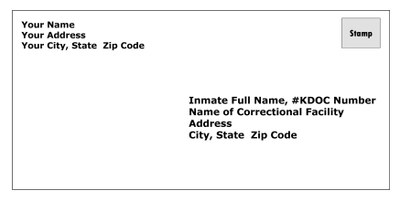
<span><br />To contact a male resident in the RDU, you may write to him at the following address until his approved phone list is activated:<br /></span><span> </span></div>
<p class="ARBodyText" style="padding-left: 60px; "><span>Resident’s Full Name,  KDOC# </span><span>XXXXX<br /></span><span>El Dorado Correctional Facility<br /></span><span>P.O. Box 311<br /></span><span>El Dorado, KS 67042</span><span> </span></p>
<p class="ARBodyText" style="padding-left: 30px; "><span></span><span>Female inmates may receive mail at:</span><span> </span></p>
<p class="ARBodyText" style="padding-left: 60px; "><span>Resident’s Full Name,  KDOC# </span><span>XXXXX<br /></span><span>Topeka Correctional Facility<br /></span><span>815 S.E. Rice Road<br /></span><span>Topeka, KS 66607</span></p>
<p class="ARBodyText" style="padding-left: 30px; "><strong>Please remember to include the resident’s full name and KDOC number in the address with all correspondence or the mail will not be delivered. The envelope also must contain the sender’s full name and address as well or the letter will not be delivered. Please note that all mail is subject to search.  </strong></p>
<p style="padding-left: 30px; ">Example:</p>
<p class="ARBodyText" style="padding-left: 30px; "><span><span><span><img class="image-inline" src="../../images/KDOC%20Envelope.jpg/@@images/image/preview" /></span></span></span></p>
<p style="padding-left: 30px; ">For more information about resident mail, please review <a href="http://www.dc.state.ks.us/kdoc-policies/kar/Article12.pdf/">Kansas Administrative Regulation (K.A.R.) 44-12-601, Inmate Writing and Other Inmate Communications or Publications</a>. Also, <a href="http://www.dc.state.ks.us/kdoc-policies/impp/chapter-12/12120.pdf/">Internal Management Policy and Procedure (IMPP) 12-120 Secuirty and Control: Control of Inmate Personal Property</a> provides additional information.</p>
<p class="ARBodyText" style="text-align: center; "><span><span><span></span></span></span>___________________________________________________________________________</p>
<h3 class="ARBodyText"><span><span><span><br />Telephone and Emergencies<a name="Telephone and Emergencies"></a></span></span></span></h3>
<ul>
<li>
<div class="ARBodyText"><strong>Can an inmate make phone calls while in RDU?<br /></strong>Yes. residents are permitted telephone privileges to make collect/pre-paid calls shortly after the reception process begins. Residents cannot receive calls. Upon admission, the resident fills out a phone list of those numbers that the resident would like to call. The resident will update the phone list every 120 days thereafter. Every number that a resident requests be added to the call list will be contacted by staff, verified and asked if the person wants to be on the resident's call list. The numbers are then activated through the facility’s phone system in approximately one week. Residents may establish a telephone list of up to 20 individual phone numbers.</div>
</li>
</ul>
<p>If you need additional information on theresident telephone process including how to establish an account, please visit the <a class="internal-link" href="../inmate-communications/inmate-telephone">Resident Communications section </a>and/or review <a href="../../kdoc-policies/impp/chapter-10/10111.pdf/">Internal Management Policy and Procedure (IMPP) 10-111 Programs and Services: Inmate Access to Facility and Coinless Telephones</a>.  </p>
<ul>
<ul>
<li><strong>How can I reach a resident in an emergency?</strong><br />In the event of a verifiable emergency such as a serious illness or death in the family, you may call the facility. Callers must provide a call back number and their relation to the inmate. Staff will also need the nature of the emergency, the name of the person who is sick or has passed away, the person’s relation to the resident and the name and contact information for the hospital or funeral home.</li>
Before the message will be given to the resident, facility staff will contact the hospital or funeral home to verify the information that you have provided concerning the emergency. Once the message is verified, the resident will be notified. Staff may discuss options with you for notifying the resident including if you would like to tell the resident or if you prefer a chaplain or counselor relay the information. </ul>
</ul>
<p></p>
<p class="ARBodyText" style="text-align: center; "><span><span><span></span></span></span>___________________________________________________________________________</p>
<ul></ul>
<ul></ul>
<ul></ul>
<ul></ul>
<ul></ul>
<ul></ul>
<ul></ul>
<ul></ul>
<h3><br />Other General RDU Questions<a name="Other Questions"></a></h3>
<ul>
<li> <strong>How does the KDOC determine where a resident will be housed?</strong></li>
</ul>
<p class="ARBodyText" style="padding-left: 30px; ">When bed space and programming slots become available in coordination with medical consultation, a resident’s facility placement is determined. If an offender is a recent parolee or post-release violator and not a new commitment to the KDOC, theresident could be placed wherever space is available in the KDOC system based on an resident’s classification status.</p>
<ul>
<li><strong>How can an resident address his/her questions while in RDU?<br /></strong>A form, called a Form-9,  is available to the resident as a formal procedure to address any questions or concerns. After the form is completed, theresident must turn it in to the security staff. After receiving the Form-9, the staff will have 10 days to respond to the resident’s request. </li>
<li><strong>What medical/dental/mental health services are available at RDU?<br /></strong>Within the first three days at RDU, the resident will be assessed for medical needs. Within seven days of being newly admitted and within 30 days for parole violators, each resident receives a dental exam. If major dental work is required, this will be done once the resident is transferred out of RDU to a permanent facility. Mental health services also are available. </li>
</ul>
<p class="ARBodyText" style="text-align: center; "><span><span><span></span></span></span>___________________________________________________________________________</p>]]></content:encoded>
    <dc:publisher>No publisher</dc:publisher>
    <dc:creator>Nancy Burghart</dc:creator>
    <dc:rights></dc:rights>
    <dc:date>2014-01-08T22:10:00Z</dc:date>
    <dc:type>Page</dc:type>
  </item>


  <item rdf:about="https://www.doc.ks.gov/facilities/faq/incentive">
    <title>Incentive Levels</title>
    <link>https://www.doc.ks.gov/facilities/faq/incentive</link>
    <description>What are incentive levels and why are they important?</description>
    <content:encoded xmlns:content="http://purl.org/rss/1.0/modules/content/"><![CDATA[<p class="indent" style="text-align: justify; "></p>
<p class="ARBodyText">The KDOC’s graduated incentive level system requires that inmates earn privileges in areas which include personal property, visitation, canteen expenditures and eligibility for incentive pay.</p>
<p class="ARBodyText">Inmates progress through the four-level system by complying with KDOC rules and regulations, participating in programs and practicing pro-social behavior. Once earned, privileges may be lost for non-compliance as an inmate’s behavior determines which incentive levels he/she can earn while incarcerated. Level three is the highest incentive level possible. All inmates enter the Reception and Diagnostic Unit at Intake Level.</p>
<p class="ARBodyText" style="text-align: left; "><strong>Inmate Privileges and Incentive Level System: </strong><span class="internal-link"><a class="internal-link" href="impp-11-101a">Attachment A, IMPP 11-101</a></span></p>
<p class="ARBodyText" style="text-align: center; "> ____________________________________________________________________________</p>]]></content:encoded>
    <dc:publisher>No publisher</dc:publisher>
    <dc:creator>cherylca</dc:creator>
    <dc:rights></dc:rights>
    <dc:date>2014-01-08T22:10:00Z</dc:date>
    <dc:type>Page</dc:type>
  </item>


  <item rdf:about="https://www.doc.ks.gov/facilities/faq/custody">
    <title>Custody Classification</title>
    <link>https://www.doc.ks.gov/facilities/faq/custody</link>
    <description>What is the custody classification system?</description>
    <content:encoded xmlns:content="http://purl.org/rss/1.0/modules/content/"><![CDATA[<p></p>
<p class="indent" style="text-align: justify; "></p>
<p class="ARBodyText">Custody classification is how inmates are assessed with regard to the risk they present to themselves, other inmates, staff and the community. The standard set of objective criteria includes:</p>
<ul>
<li>Length of minimum sentence</li>
<li>Length of time remaining to serve</li>
<li>Criminal behavior involved in the current offense</li>
<li>Past criminal behavior</li>
<li>Escape history/characteristics</li>
<li>Institutional adjustment</li>
<li>Behavioral characteristics (suicidal, predatory, etc.)</li>
<li>Special needs (protective custody, etc.)</li>
</ul>
<p class="ARBodyText">Also considered are such issues as inmate performance in sex offender treatment, detainers, absconding supervised release, gang involvement, pending disciplinary issues and civil commitment issues. This system was developed to promote public safety and institutional order while providing guidelines to place inmates in the least restrictive level of supervision required based upon their assessed level of risk. The KDOC has five custody levels in KDOC facilities: special management, maximum custody, high-medium custody, low-medium custody and minimum custody.</p>
<p class="ARBodyText"><strong>Custody Classification Level System</strong></p>
<ul>
<li>
<div class="ARBodyText"><strong>Special Management</strong></div>
</li>
</ul>
<p style="padding-left: 30px; ">Describes an inmate who, because of either a short-term or long-term condition surrounding his/her incarceration, requires segregation from the general population. Housing within a segregation unit and highly structured movement within that unit is required. The inmate is out of his/her cell one hour out of every 24 hours, five days a week.</p>
<ul>
<li>
<div class="ARBodyText"><strong>Maximum Custody<br /></strong>Describes an inmate who is most suitable for housing at a maximum-security facility and whose movement and activities within that facility are highly structured and closely monitored. </div>
</li>
</ul>
<ul>
<li>
<div class="ARBioBoxInfoText"><strong>High-medium Custody<br /></strong>Describes an inmate who is most suitable for housing at a medium- or maximum-security facility, except HCF-East Unit and NCF-Central Unit. The inmate is not approved for an open-dormitory environment. Within the facility assigned, activities and movements are moderately controlled and structured.</div>
</li>
<li>
<div class="ARBioBoxInfoText"><strong>Low-medium Custody<br /></strong>Describes an inmate who is most suitable for housing at a medium- or maximum-security facility or unit. The inmate can be assigned to dormitory-style living units. Low-medium custody inmates may be allowed greater movement within the perimeter. Low-medium custody inmates may be housed at HCF-East Unit or NCF-Central Unit.</div>
</li>
<li>
<div class="ARBioBoxInfoText"><strong>Minimum Custody<br /></strong>Describes an inmate who is appropriate for housing at any level of security, with minimum security preferred.</div>
</li>
 </ul>
<p><strong>When will an inmate know his/her custody classification?<br /></strong>Each inmate receives a classification review:</p>
<ul>
<li>upon reception;</li>
<li>upon admission as a condition violator;</li>
<li>at regularly scheduled intervals (120 day or annuall)y following admission; and,</li>
<li>as unscheduled events occur that trigger a re-classification.</li>
</ul>
<p style="text-align: center; ">____________________________________________________________________________</p>]]></content:encoded>
    <dc:publisher>No publisher</dc:publisher>
    <dc:creator>Nancy Burghart</dc:creator>
    <dc:rights></dc:rights>
    <dc:date>2014-01-08T22:10:00Z</dc:date>
    <dc:type>Page</dc:type>
  </item>


  <item rdf:about="https://www.doc.ks.gov/facilities/faq/locating">
    <title>Locating a resident</title>
    <link>https://www.doc.ks.gov/facilities/faq/locating</link>
    <description>How do I know where a resident is housed?</description>
    <content:encoded xmlns:content="http://purl.org/rss/1.0/modules/content/"><![CDATA[<p class="indent" style="text-align: justify; "></p>
<p class="ARBodyText">You may check a resident’s location and status on the <a class="external-link" href="https://kdocrepository.doc.ks.gov/">Kansas Adult Supervised Population Electronic Repository (KASPER)</a> located on the KDOC’s website. Information is updated daily, excluding weekends.</p>
<p class="ARBodyText">KASPER is a database which contains information about offenders sentenced to the custody of the Secretary of Corrections since 1980. KASPER contains information regarding those who are: currently incarcerated; under post-incarceration supervision; and, who have been discharged from a sentence. KASPER does not have information available about inmates sent to Kansas under the provisions of the interstate compact agreement.</p>
<p class="ARBodyText">The information contained in KASPER is public information under provisions of Kansas statute and is made available to the public and law enforcement in the interest of public safety. No names are removed from the database unless a conviction is removed from the public record by one of three ways: one, if the conviction is overturned by means of an appeal; two, if the conviction is expunged; or three, if an offender is granted executive clemency.</p>
<p class="ARBodyText">Through KASPER you can find:</p>
<ul>
<li>Name and KDOC Registration Number;</li>
<li>Physical description (date of birth, height, weight, hair and eye color, body markings, including photograph);</li>
<li>Conviction description (crime(s) of conviction, county, case number);</li>
<li>Anticipated release date;</li>
<li>Inmate housing location (current location and facility movements, including movement dates, location of parole office maintaining supervision);</li>
<li>Custody or supervision level (Whether an offender has been released to post-incarceration supervision (parole, conditional release, post-release supervision, compact probation or parole); and,</li>
<li>Institutional disciplinary record (violations for which offender was found guilty).</li>
</ul>
<p class="ARBodyText">Please note that release dates may change and are contingent upon good time and program credit earnings and forfeitures.</p>
<p class="ARBodyText">Specific questions regarding an inmate’s release date should be directed to the KDOC’s sentence computation unit at (785) 296-3317 or by <a class="mail-link" href="mailto:Michelle.Sullivan@ks.gov">e-mail</a>.</p>
<p style="text-align: center; ">_________________________________________________________________</p>]]></content:encoded>
    <dc:publisher>No publisher</dc:publisher>
    <dc:creator>Nancy Burghart</dc:creator>
    <dc:rights></dc:rights>
    <dc:date>2014-01-08T22:10:00Z</dc:date>
    <dc:type>Page</dc:type>
  </item>


  <item rdf:about="https://www.doc.ks.gov/facilities/faq/communication/communication">
    <title>Communication</title>
    <link>https://www.doc.ks.gov/facilities/faq/communication/communication</link>
    <description>How do I call or otherwise contact an inmate?</description>
    <content:encoded xmlns:content="http://purl.org/rss/1.0/modules/content/"><![CDATA[<p></p>
<p class="indent" style="text-align: justify; "></p>
<p class="ARBodyText">Please see "inmate communications" under the facilities' section for details on establishing accounts for <a class="internal-link" href="../../inmate-communications/inmate-electronic-messaging-and-video-visitation">electronic messages</a> and <a class="internal-link" href="../../inmate-communications/inmate-telephone">telephone</a>. For frequently asked questions about mail, electronic messages and telephone service, click the links below.</p>
<h2 class="ARBodyText" style="text-align: center; "><a class="internal-link" href="mail">Mail</a></h2>
<h2 class="ARBodyText" style="text-align: center; "><a class="internal-link" href="messages">Electronic Messages</a></h2>
<h2 class="ARBodyText" style="text-align: center; "><a class="internal-link" href="phone">Telephone</a></h2>
<p style="text-align: center; ">____________________________________________________________________________</p>]]></content:encoded>
    <dc:publisher>No publisher</dc:publisher>
    <dc:creator>cherylca</dc:creator>
    <dc:rights></dc:rights>
    <dc:date>2014-01-08T22:08:23Z</dc:date>
    <dc:type>Page</dc:type>
  </item>


  <item rdf:about="https://www.doc.ks.gov/facilities/canteen/canteen">
    <title>Adult Correctional Facilities: Canteen</title>
    <link>https://www.doc.ks.gov/facilities/canteen/canteen</link>
    <description>Kansas Correctional Industries Commissary Menus</description>
    <content:encoded xmlns:content="http://purl.org/rss/1.0/modules/content/"><![CDATA[<p>  </p>
<p></p>
<ul class="buttonList" style="text-align: center; ">
<li><b></b></li>
<li><b></b></li>
<li><b></b></li>
<li><b><a class="internal-link internal" href="index">Facilities</a></b></li>
<li><b><a class="internal-link internal" href="inmate-communications">Inmate Communications</a></b></li>
<li><b><a class="internal-link internal" href="inmate-banking">Inmate Banking</a></b></li>
<li><b><a class="internal-link internal" href="prea">PREA Data</a></b></li>
<li><b><a class="internal-link internal" href="../publications/kdoc-facilities-management">Publications</a></b></li>
<li><b><a class="internal internal-link" href="canteen">Canteen Lists</a></b></li>
<li><b><a class="internal internal-link" href="faq">FAQs</a><br /><br /></b></li>
</ul>
<p></p>
<p></p>
<h2 style="text-align: center; "><strong><span class="st"></span></strong> <strong><span class="st">Commissary menus are provided for informational purposes only </span></strong></h2>
<p style="text-align: center; "><strong><span class="st">The items and prices listed here are <em>subject to change</em> without notice.<br /></span></strong></p>
<table class="plain" style="width: 515px;">
<thead></thead>
<tbody></tbody>
<tbody>
<tr>
<td colspan="2">
<h3 style="text-align: center; "><strong>Males</strong></h3>
<p style="text-align: center; "><em>(NOTE: Larned State Correctional Facility is listed separately. Click <strong><a class="anchor-link" href="#LCMHF List">here</a></strong>.)</em></p>
</td>
</tr>
<tr>
<td>
<ul>
<li><b><a class="internal-link" href="kdoc-male-canteen-october-2023">KDOC Male Cantee</a>n</b></li>
</ul>
</td>
</tr>
<tr>
<td>
<ul>
<li><strong><a class="internal-link" href="male-exempt-10.2023">Exempt Items</a> </strong>(Male)</li>
</ul>
</td>
</tr>
<tr>
<td>
<h3 style="text-align: center; "><strong>Females</strong></h3>
</td>
</tr>
<tr>
<td>
<ul>
<li><strong><a class="internal-link" href="tcf-menu-10.2023">Topeka Correctional Facility</a><a class="internal-link" href="commissary-menus/tcf"> </a></strong>(Female)</li>
</ul>
</td>
</tr>
<tr>
<td>
<h3 style="text-align: center; "><a name="LCMHF List"></a>Larned State Correctional Facility (LSCF)</h3>
</td>
</tr>
<tr>
<td>
<ul>
<li><strong><a class="internal-link" href="commissary-menus/lcmhf-general">LSCF General Population </a></strong>(Central Unit)</li>
<ul>
<li><em><span id="result_box"><a class="internal-link" href="commissary-menus/lcmhf-cgp-spanish">E<span class="hps">n español: Población General</span></a></span></em></li>
</ul>
</ul>
</td>
</tr>
<tr>
<td>
<ul>
<li><strong><a class="internal-link" href="commissary-menus/lcmhf-ad-seg">LSCF Administrative Segregation</a></strong></li>
<ul>
<li><em><span id="result_box"><span class="hps"><a class="internal-link" href="commissary-menus/lcmhf-adseg-spanish">En español: Segregación Administrativa</a></span></span></em></li>
</ul>
</ul>
</td>
</tr>
<tr>
<td>
<ul>
<li><strong><a class="internal-link" href="commissary-menus/lcmhf-disc-seg">LSCF Disciplinary Segregation</a></strong></li>
<ul>
<li><em><span id="result_box"><a class="internal-link" href="commissary-menus/lcmhf-dseg-spanish"><span class="hps">En español: </span><span class="hps">Segregación Disciplinaria</span></a></span></em></li>
</ul>
</ul>
</td>
</tr>
</tbody>
</table>
<p style="text-align: center; "> </p>]]></content:encoded>
    <dc:publisher>No publisher</dc:publisher>
    <dc:creator>Nancy Burghart</dc:creator>
    <dc:rights></dc:rights>
    <dc:date>2014-01-08T22:05:00Z</dc:date>
    <dc:type>Page</dc:type>
  </item>


  <item rdf:about="https://www.doc.ks.gov/facilities/lcf/programs/programs">
    <title>Programs</title>
    <link>https://www.doc.ks.gov/facilities/lcf/programs/programs</link>
    <description>The following are programs and services available at Lansing Correctional Facility: 

</description>
    <content:encoded xmlns:content="http://purl.org/rss/1.0/modules/content/"><![CDATA[<p><b><a class="external-link" href="http://www.kancorind.com/shop/">Kansas Correctional Industries</a></b></p>
<p><strong><a class="internal-link" href="private">Private Industries</a></strong></p>
<p><b>Life Skills Enhancement Program</b></p>
<ul>
<li>has two components: academic education and vocational training;</li>
<li>literacy and the General Equivalency Diploma (GED) programs are provided as well as vocational training programs such as commercial food service and welding; and,</li>
<li>includes the employability program, which provides guidance on seeking employment, and is provided to all residents enrolled in a program.</li>
 </ul>
<p><b>Therapeutic Community Program</b></p>
<ul>
<li>began in 1996 in the maximum-security unit under direction of the Douglas County Citizens Committee on Alcoholism (DCCCA) of Lawrence;</li>
<li>the program’s goal is to create a positive peer culture and facilitate overall lifestyle changes;</li>
<li>each resident in the program is expected to leave the primary treatment program having acquired basic recovery skills;</li>
<li>residents assigned to this program are in the therapeutic community 24 hours a day; and,</li>
<li>the resident will remain in the program for 9 - 12 months depending on the needs of each individual resident.</li>
 </ul>
<p><b>Sex Offenders Treatment Program (SOTP) Program</b></p>
<ul>
<li>treatment for the male sex offenders;</li>
<li>the program is 20 hours per week for 18 months and is contracted through DCCCA of Lawrence;</li>
<li>the program’s goal is to habilitate offenders toward emotional health and successful transition back into the community; and,</li>
<li>the program provides psycho-educational classes with group therapy and individual sessions.</li>
</ul>
<p><b><br />Vehicle Maintenance</b></p>
<ul>
<li>a staff of ten resident employees and two staff equipment mechanics oversee the care of more than 100 vehicles, and</li>
<li>maintenance includes everything from washing the vehicles to major overhauls and body work. Department employees are responsible for a large inventory of parts, supplies, and equipment.</li>
 </ul>
<p><b>Chaplaincy Department</b></p>
<ul>
<li>oversees coordinating resident religious support and coordinating volunteer services;</li>
<li>religious support is provided to a variety of faith groups which include many Christian denominations, Jewish, Islamic, Moorish Science, Native American, Bhuddist, Asatru, Thelemic and Wiccan faith groups;</li>
<li>coordinates special holiday events that support LCF residents and their families; and,</li>
<li>relies on a dedicated group of <a class="internal-link" href="../volunteers">volunteers to assist in addressing inmate religious and activities </a>needs.</li>
</ul>
<p> </p>
<p><b>Activities Support</b></p>
<ul>
<li>includes variety of resident activities including individual health and fitness activities, arts and crafts, music groups and resident self-improvement groups, and</li>
<li>normally led by volunteers from the greater Kansas City area, resident groups meet a diverse array of resident interests and needs, such as Alcoholics and Narcotics Anonymous, African Awareness, El Chicano (Hispanic awareness), Jaycees, Lifer's Club and several other organizations.</li>
</ul>
<p style="text-align: center; "><span class="internal"></span> </p>
<p style="text-align: center; "><span class="internal"><a class="internal-link" href="../volunteers/overview-1">Overview</a> </span>| <a class="internal-link" href="../volunteers/visit">Visitor Information<span class="internal"> </span></a>|<span class="internal"> <a class="internal-link" href="../volunteers/programs">Programs</a> </span>| <a class="internal-link" href="../volunteers/volunteers">Volunteers</a> | <a class="internal-link" href="../volunteers/history-1">History</a><span class="internal"> </span>| <a class="internal" href="warden"><span class="internal">Warden</span><br /></a>____________________________________________________________________________</p>]]></content:encoded>
    <dc:publisher>No publisher</dc:publisher>
    <dc:creator>Nancy Burghart</dc:creator>
    <dc:rights></dc:rights>
    <dc:date>2014-01-08T16:55:00Z</dc:date>
    <dc:type>Page</dc:type>
  </item>


  <item rdf:about="https://www.doc.ks.gov/facilities/lcf/visit/schedule">
    <title>Schedule</title>
    <link>https://www.doc.ks.gov/facilities/lcf/visit/schedule</link>
    <description>On May 6, 2017 we will be changing the hours of visitation.  Visiting will be 7:00 a.m.-3:30 p.m. on Saturday and Sunday.  No visits will be processed after 2:00 p.m.  

Effective May 22nd, Castle Cuisine will no longer offer food in the visiting rooms except for the minimum compound

We have established a visitation hotline whereby visitors who see illegal activity occurring in the visiting room may call 913-250-2741.  The caller can remain anonymous.
</description>
    <content:encoded xmlns:content="http://purl.org/rss/1.0/modules/content/"><![CDATA[<p></p>
<p><b>MAXIMUM GENERAL POPULATION:<br /></b>Rotate days (Saturday and Sunday) based on living unit. A1,B1,D,TRU,PC Units will visit on Saturday. A2,B2,C2,PC will visit on Sunday. These units will alternate each weekend and rotate on holidays. Non-Contact status will visit on day unit is assigned.</p>
<p></p>
<p><b><i>NOTE:</i> </b><i>No visits will be processed after 11 a.m. for morning visits or 2:00 p.m. for afternoon visits. Any visitor who visits any hour in the morning will have it count as the inmate's half-day visit. For example, a visitor who arrives at 11 a.m. may not extend to the afternoon on the day that the inmate has half-day visiting privileges.</i></p>
<h2 style="text-align: center; "><b>Minimum Visiting has visiting either Saturday and/or Sunday <br />from 7:00 a.m. – 1:30 p.m</b></h2>
<p></p>
<h2 class="internal" style="text-align: center; ">Minimum Visiting will go back to normal</h2>
<h2 style="text-align: center; ">2/8/2020</h2>
<p style="text-align: center; ">Thank you for your understanding</p>
<p></p>
<h2></h2>
<p></p>
<p>                                         </p>
<p></p>
<p></p>
<p></p>
<p></p>
<p></p>
<p></p>
<p></p>
<p></p>
<p></p>
<p></p>
<p></p>
<p></p>
<h3></h3>
<h3></h3>
<h3 class="mceContentBody documentContent"><span class="internal"><span class="internal"><br /></span></span></h3>
<h3><span class="internal"><br /></span></h3>
<h3><span class="internal"><br /><a class="internal" href="overview-1">Overview</a> </span>| <a class="internal" href="visit">Visitor Information<span class="internal"> </span></a>|<span class="internal"> <a class="internal" href="programs">Programs</a> </span>| <a class="internal" href="history-1">History</a><span class="internal"> </span>| <a class="internal" href="warden"><span class="internal">Warden</span></a></h3>]]></content:encoded>
    <dc:publisher>No publisher</dc:publisher>
    <dc:creator>cherylca</dc:creator>
    <dc:rights></dc:rights>
    <dc:date>2014-01-08T16:55:00Z</dc:date>
    <dc:type>Page</dc:type>
  </item>


  <item rdf:about="https://www.doc.ks.gov/facilities/lcf/visit/visit">
    <title>Visiting Information</title>
    <link>https://www.doc.ks.gov/facilities/lcf/visit/visit</link>
    <description></description>
    <content:encoded xmlns:content="http://purl.org/rss/1.0/modules/content/"><![CDATA[<p>Once an inmate is eligible for visiting privileges, the inmate is responsible for ensuring that his visitors receive the necessary paperwork to register as visitors. For more information, please review <span class="external"><a class="external-link" href="../../../kdoc-policies/AdultIMPP/chapter-10/10-113d-eff-8-24-21.pdf">IMPP 10-113D: Offender Visitation</a></span>.</p>
<blockquote>
<blockquote>
<blockquote>
<blockquote>
<blockquote>
<blockquote>
<blockquote>
<ul>
<li><strong><a class="internal-link" href="LCF_GO16101_042821.pdf">Inmate Visiting Program: LCF General Orders</a> (04.28.21 update)<br /></strong></li>
<li><strong><a class="internal-link" href="in-person-visitation-schedule">In-Person Visitation Schedule</a> (7.21.23 update)</strong></li>
<li><strong><a class="internal-link" href="LCFVisitingPamphlet04.15.2021.pdf">In-Person Visitation Pamphlet</a> (04.15.21 update)</strong></li>
<li><strong><a class="internal-link" href="LCFInfoInPersonsitespec04.15.2021.pdf">In-Person Visitation LCF Details</a> (04.15.21 update)</strong></li>
<li><strong>See also <a href="../../../visitation-in-person">Visitation In-Person — (ks.gov)</a></strong></li>
</ul>
<ul>
<li><strong><a class="internal" href="holiday-visitation">Holiday Visitation</a></strong></li>
<li><strong><a class="internal" href="special-visits">Special Visits</a></strong></li>
<li><strong><a class="internal-link" href="directions-transportation-information">Directions/Transportation Information</a></strong></li>
<li><strong><a class="internal-link" href="faq">Visitor Frequently Asked Questions</a></strong></li>
<li><strong><a class="internal-link" href="visitingapp.pdf">Visiting Application</a></strong></li>
</ul>
</blockquote>
</blockquote>
</blockquote>
</blockquote>
</blockquote>
</blockquote>
</blockquote>
<p style="text-align: center; "></p>
<p style="text-align: center; "><span class="internal"><a class="internal-link" href="../volunteers/overview-1">Overview</a> </span>| <a class="internal-link" href="../volunteers/visit">Visitor Information<span class="internal"> </span></a>|<span class="internal"> <a class="internal-link" href="../volunteers/programs">Programs</a> </span>| <a class="internal-link" href="../volunteers/volunteers">Volunteers</a> | <a class="internal-link" href="../volunteers/history-1">History</a><span class="internal"> </span>| <a class="internal" href="warden"><span class="internal">Warden</span><br /></a>____________________________________________________________________________</p>]]></content:encoded>
    <dc:publisher>No publisher</dc:publisher>
    <dc:creator>Nancy Burghart</dc:creator>
    <dc:rights></dc:rights>
    <dc:date>2014-01-08T16:55:00Z</dc:date>
    <dc:type>Page</dc:type>
  </item>


</rdf:RDF>